Showing posts with label fanfiction. Show all posts

Saturday, July 27, 2013

Important Middle Earth Questions: Is There Chocolate In Middle Earth?


So, one of the folks I follow on tumblr asked this question this morning, and like the inquisitive person I am, I decided to do some research on this interesting and important question. Let’s explore this a little, shall we?


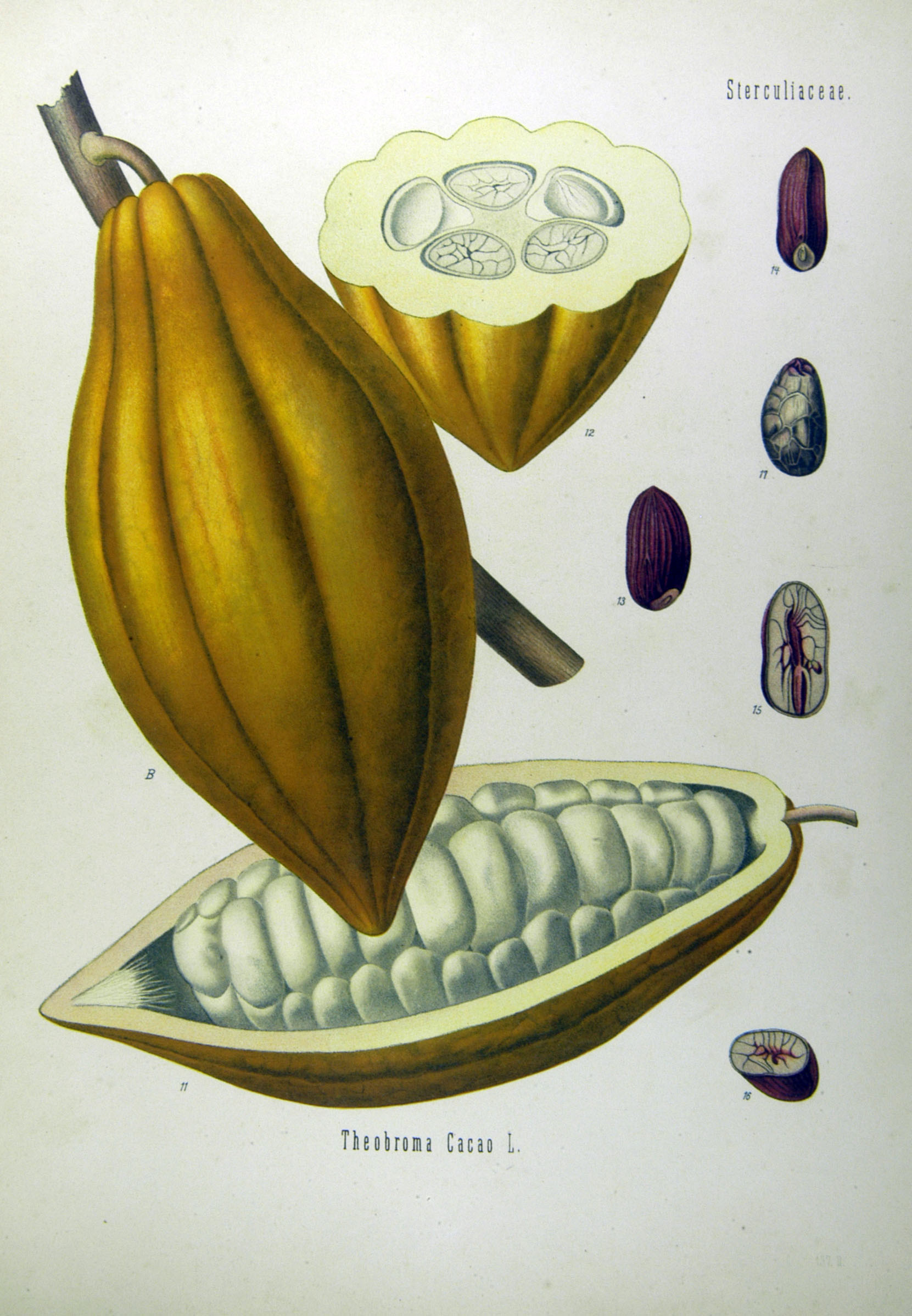
Chocolate as we know it comes from the seedpods of Theobroma cacao, an evergreen tree whose generic name comes from the Greek for ‘food of the gods.’ (Nice job, Carl Linneaus.) The tree is pollinated, flowers, and produces a fruit whose large seedpods form the basis for chocolate. The fruit is gathered, and the seedpods are extracted. They are then fermented, and quickly dried, before being roasted, hulled, and ground up, and turned into the first step on the road to chocolate.

All of this doesn’t matter to us at all if Theobroma cacao can’t grow.


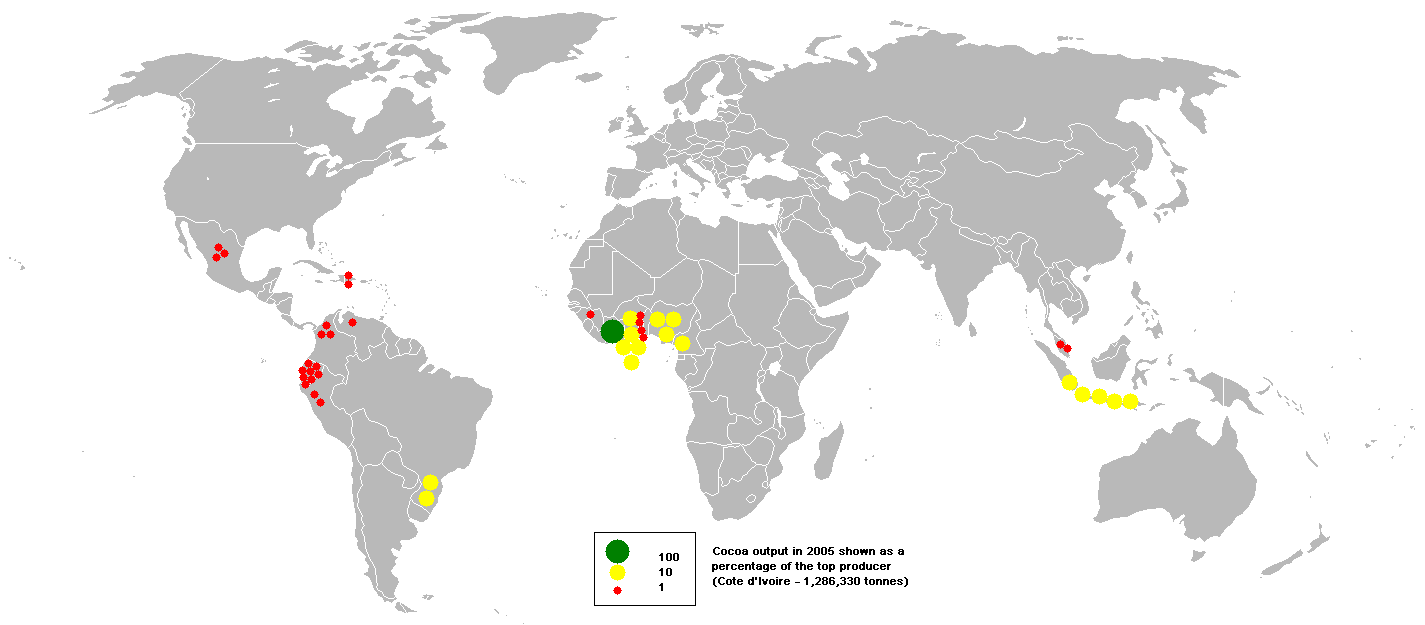
 Above is a map detailing cacao output around the world. Notice the concentration in equatorial climates. My good friends over at Wikipedia confirm this -- “Cacao trees will grow in a limited geographical zone, of approximately 20 degrees to the north and south of the Equator. Nearly 70% of the world crop is grown in West Africa.[source]

The Royal Botanic Gardens at Kew inform us “In its natural habitat, cocoa grows in the understory of evergreen tropical rainforest. It often grows in clumps along river banks, where the roots may be flooded for long periods of the year. Cocoa grows at low elevations, usually below 300 metres above sea level, in areas with 1,000 to 3,000 mm rainfall per year.” [source]

So. Equatorial climates, evergreen tropical rainforest, river banks, low elevations with lots of rain. That's what we need here.
Karen Wynn Fonstad’s Atlas of Middle Earth has several maps pertaining to vegetation, climate and season conditions in Middle Earth. Based on the pieces of information she gathered from what one hopes to be a close reading of Tolkien’s work, she suggests that Gondor, the southernmost region Tolkien’s work touches on in any detail, has mild winters and hot, dry summers, similar to the climate of the Mediterranean and Southern California. She also suggests that further south of Gondor, in Harad, is arid grassland, similar to what one might find in the Great Plains region or in Central Asia.
Nowhere in her maps is any mention made of rainforest, or of a climate with a rainfall level significant enough to support a rainforest. (Those would make really cool Ents, though, don’t you think?) >So, in answer to the question, “Does Middle Earth have chocolate” my answer is… No, probably not in the known world. Now, Tolkien doesn’t ever explore whether there’s something farther south after Harad.  Maybe there are equatorial climates and rainforests as one goes deeper into the interior. (Maybe that can be a subject for a fanfic – explorer/diplomat goes to Harad after the king returns, comes back with cacao beans. Cue new fad for drinking chocolate in Gondor.) One has also to consider whether Tolkien considered his world to exist on a globe or on a flat plain. If the flat plain, is it meteorologically possible to have an equatorial climate, given that all the other climates represented in Middle Earth don’t have such conditions? I’m not a meteorologist or a physicist, so I don’t know and can’t speculate. Let me offer you some honeycakes in consolation. I do know Middle Earth has bees.

Thursday, April 25, 2013

This is a post about Fan Identity. And Friendship. And the Upcoming Thor Movie. (But mostly about Friendship.)


I’m now on week four of my new job, and things are going splendidly  (For those of you who don’t know, four weeks ago I transitioned to a full time job in visitor services at a local arboretum.) I took a walk at lunch time yesterday and, walking through a stand of really magnificent conifers, realized “They actually PAY ME to show up here every day!” It was a really good realization that I need to make more often, because I've been a little down lately.

Don’t get me wrong – my new co-workers are lovely, lovely people. But I’m easily the youngest person on staff by twenty years and as such, I have a different sensibility about the way the world works and a totally different view on pop culture.
 
As I put it to my friend the other day, there is a large nerd-shaped hole in my work life.

 At both of my other jobs, I had people I could talk to about movies and books and sci-fi things, and make Star Trek jokes, and that was awesome. Now I’m still trying to figure out if anyone will understand my Star Trek jokes, let alone laugh at them.

Put it this way: I didn't know I liked being able to publicly identify as a nerd and with other nerds/geeks/fans until that identification didn't make a connection with people.

I think my more recent involvement in Tumblr has something to do with this as well – on tumblr, everyone is all fandom all the time. They’re excited to share things they make and find, and I love that enthusiasm.
 I also like to share and ‘real life reblog’ with WILD abandon. We have a board at work where we can write what wildlife we've seen, and  you have no idea how excited I get when I see a new bird and I have something to write on the board. I do this with birds, with books I've read, movies I've seen, and especially movies I want to see.

Except now I have no one to reblog to.

Well, the temporary solution to this problem is going to be dinner after work with my good friend, former co-worker and all-around lovely person on Friday. For the purposes of this blog post and the internet, we’ll call her Artemis. Last night, in planning for said dinner, we talked about a number of museum things (I consider her someone I can talk about professional development stuff with)  and then I said we should make time to see the new Thor movie (we initially bonded over the Avengers films.)

She said this was a GREAT idea, and then she asked a rather interesting question. “Is it bad that I’m more excited to see Loki rather than any other character in that movie?”

I assured her I did not think this was bad in the slightest, and observed that there's a whole HUGE group of people on the internet who fangirl Loki like it's not cool to fangirl Thor.

Please don’t mistake me, I think Loki is a fascinating character, both in the mythological sense and in the Marvel sense.  I just can’t get my head around supporting the embodiment of mischief. My personal mythological fangirlyness has always been directed at Tyr, the son of Odin who loses his hand fighting Fenrir and who is supposed to be the embodiment of the valor befitting warriors. The mythological Thor seemed a little mainstream. And so, it seems, is the Marvel Thor considered a little mainstream.

“It’s the bad boy thing,” Artemis explained. “Girls have this inner need to take care of or help the "lost, dark soul" kind of guy. Thor, on the other hand, is a jock type.”

I agree with this statement. In real life, we often have very little patience for jock types whose confidence and braggadocio can be overwhelming, especially for people who have never had confidence like that. Loki as a character is much more accessible. Particularly in the first movie, where so much of his story line is about trying to find himself. Thor in the first film is also trying to find himself in the wake of loosing Mjolnir and being kicked out of Asgard, but not to the same extent that Loki is.  For fans, and I think particularly for the young women to whom a tortured, dark soul appeals,  his story is one they see reflected in their own lives, where they too are searching for meaning and identity.  One of the places they find their identity is in their fandoms, which leads me back to the issue of identity that I was having, and that Artemis was fulfilling for me with this conversation, and that I am now fulfilling with this blog post.

Anyway.

“Also,” Artemis went on, “A TON of fangirls ship Loki/Thor, which is interesting.”

What do you know, another part of fan identity! I commented that, at least in my fan practice, fangirls as a general rule tend to ship M/M ships. There's actually a considerable body of research on why that I couldn’t get into during the course of our conversation, but some psychologists and media studies folks think this is because many young female fans are at a point in their lives where they may feel threatened or intimidated by the thought of romantic involvement, and therefore writing a relationship that they don’t need to see themselves inside can be grounding. Other media studies folks explain that M/M shipping is a way to rebel or talk back against heteronorming inside mainstream media, which also appeals to teenagers who are trying to explore their sexuality.

Whatever the case may be, I have never considered myself one of those fans. From day one inside the fandom, if I was going to be a fan of a male character, I was also going to write myself (or a better, prettier, much more interesting version of myself) into the story, there was going to be lots of really fabulous, M/F sexual encounters, and that was  going to be that. (I have a pretty stable, boring, mainstream gender identity – probably more information than you wanted to know.)

 “Another part of my issue,” she explained, “is that there are so few well written OCs (male or female) so even when a character is clearly straight [inside the text] it can be easier to see an emotional connection between them and another male rather than a poorly written female OC.”

Now, that I whole-heartedly agree with. OCs are a sticky wicket. But the reason for me writing those characters is also one of the reason I think M/M shipping occurs at the level it does-- because there is a general dearth of female characters inside many mainstream fandoms.  It's simply easier to make an M/M friendship into something more than pairing them with an existing female character, or trying to write a believable original female character, or OC.  As a reader, I want a place to see myself inside the text, which is why I strongly champion, or flat out make up, more female characters. (In general, I think I've been pretty good at writing OCs in the past, and I haven’t gotten too many complaints about them so far.)

“I can support any ship there is evidence for,” Artemis went on. “That people who just throw two characters together who never interact or have any chemistry is a little annoying.” This much I think we can all agree on. “But with the Thor/Loki, I'm the fence, because if you looked at it from the right angle, there could be underlying emotion going on. Even more so when you add in the deleted scenes from the movie.”
I get that. That makes sense to me. The Sherlock/John ship makes sense to me. The Frodo/Sam ship makes sense to me. Heck, even the Kirk/Spock ship makes sense to me. I’m not hating on valid and wonderfully close readings and interpretations of our fan texts. I think that’s great, and as I've gotten older, I've given these ships more credit than I had in the past because I see the close reading that goes into legitimizing those relationships, and I am in awe of some of it. (I just don’t want your Fili/Kili slash on my dashboard. Sorry. Brothers are different.)

But, as I explained to Artemis, another part of me gets kind of angry because I feel like shipping for some of those reasons almost de-values deep friendships between males, like they can't happen without having a romantic root. And I don't think that's fair to men. Not just fictional men, not just John and Sherlock, not just Frodo and Sam – all men. When two female characters have a close friendship, I don’t see the same kind of F/F shipping sprouting up that I see when two men do, just as in real life two women can get away with being much, much closer than two men seem to be able to without people reading the relationship as something that it isn't. 

And I really don’t think that’s fair.

I wish I had someplace interesting and concrete to go with all of this, but I don’t. I suppose the point I could be  making is that identity, especially fan identity, is important to all of us, we should find it where we can, hold up and defend the personally chosen identities of others, and strive, always, to incorporate them and the values they stand for into our real lives as well.

Whatever it is, Artemis is coming over for dinner tomorrow night, and we shall make a good night of it and be fans together.


Saturday, January 26, 2013

Gems of Erebor: The Case for Dwarf Women In Tolkien-Based Fanfiction


Since seeing The Hobbit a few days ago with my sister, I’ve had dwarves on the brain.

Yeah, I know, you’re all rolling your eyes and sighing, Oh, dear, Mercury joined the Thorin Oakenshield bandwagon, and it’s true. I admit it freely and gladly. Before seeing the Hobbit, I wouldn’t have given the occupants of the Iron Hills a second chance. Now, I’m reconsidering that position. I re-read The Hobbit, twice, and I’m working my way through Lord of The Rings again, and I’m reading a lot of fanfiction.

Oh, dear. Fanfiction.

Now, as the fanfiction around the Hobbit has picked up steam, we’ve started to see the same trends that long-time readers of LOTR fanfiction have seen– the movement towards writing Original Characters in a (mostly) highly unbelievable style, the trope known in fanfiction as the Mary Sue. What’s interesting to me is that many of these Sues, like those in the LOTR canon before them, are all elves, Men, and Hobbits. There are very few dwarf women written about in fanfiction.

This doesn’t make a lot of sense for a lot of reasons, chief among which is that elves and dwarves don’t get along. At all. Ever. The Battle of the Five Armies was pushing it. No matter how well written your character, the fact that she’s an elf, or a half-elf half human, or an elf who was raised with dwarves, it will not make sense inside Tolkien’s canon, movie or otherwise. (Not until the late Third Age and the friendship of Gimli and Legolas. But that is noted as being extremely out of character for the both of their races.)

Ladies, hear me out here. I know that your OCs are wish-fulfillment. We’ve all been conditioned to think that the way the elves look and the way the women of the Dunedain look is ‘normal’ and ‘beautiful’. I get that. Most of my favorite LOTR characters are females of Numenorean descent. I’ve got a whole story filled with females of Numenorean descent, and I love them all dearly. We’ve also been conditioned to think that Dwarf females are different. Like, waaay different. Like, the punchline of jokes different. And that scares us, because it makes us and our OCs vulnerable.


Yeah, like that. Laugh it up, Gimli.


And the more I thought about it, and read about it, and researched about it, the more I started asking  myself, what’s wrong with being a female dwarf? In fact, who wouldn’t want their character to be a female dwarf? Because female dwarves have some really awesome stuff going for them.


1) Dwarf beauty, male and female, runs on a totally different level.  

Writing about the beauty of dwarves can be a new challenge for a writer, and an exciting one at that --  they’re not a race that Tolkien spends a lot of time on, and so their standards of dress and beauty can be something totally outside of what we consider ‘normal’. This can be very liberating – you can make up whatever you want to! Several fan artists have explored this concept with dwarf beards (or lack thereof) and female facial/body hair.  Now, some people will argue with me that most of the other races of middle earth would consider dwarves ugly, and the idea of being mistaken for a dwarf man is not an appealing one. Fair point – not all dwarf men can look like Thorin Sexyshield. But – and this is a big but – what if the reason that dwarf women are seldom seen in the rest of the world, and when they are they’re mistaken for dwarf men, is because they are so terrifyingly beautiful they have to disguise themselves out among the other peoples?  Also, if dwarf beauty is different, then dwarves will find different things beautiful. Not a problem at all.

2) The dwarves have a love of craft, and practice is open to both genders.

Since the beginning of time, when they were fashioned by Aule, the heavenly smith, they have loved to build and make beautiful things out of the precious stones in the earth, and they admire those who can do this well. In fact, they believe that at the End of Days it will be the task of the Dwarves to help re-build Arda. If women among them are few, and those few women can easily pass as men in the world outside the dwarf cities, it seems to me that both men and women can gain great skill in their chosen craft, be it smithing or carving, and be appreciated and well-noted for it. Not only do they carve stone and shape metal with great skill, but they are also tremendous singers and writers of songs, as well as makers of instruments – when Thorin and Company show up on Bilbo’s doorstep, they also bring with three flutes, two fiddles, a drum, two clarinets, two bass viols, and Thorin’s great golden harp ( Hobbit 26). (Recall also when they finally do come to the Mountain, they find that harps left silent for centuries are still in tune. (Hobbit 228))

3) There is very little emphasis in dwarf culture on family life. 

Now, I am not saying here that there are no happy families among the Dwarves – I think that is very untrue. If what we see of the familial groups in the Company of Thorin is any indication, dwarves form very strong ties with their families – another attribute in their favor. My point here is that it is not the be-all and the end-all for dwarf women to marry. As previously discussed, it is perfectly acceptable among the dwarves to devote your life single-mindedly to the pursuit of your craft – one of the reasons the dwarf population doesn’t grow very quickly. Several authors, as well as Appendix A of the Lord of the Rings, allude to the fact that only a third of the dwarf population were women, and that part of the population didn’t feel the need to marry all the time. (Thorin, for instance, is noted not to have a wife.) Many of them found fulfillment in the perfection  and recognition of their chosen art.

4)    Dwarf love runs deep.  

Tolkien always writes of them as a single minded kind of people; for instance, in the Silmarillion, when speaking of the creation of the dwarves, he writes “…Aule made the Dwarves strong to endure. Therefore they are stone-hard, stubborn, fast in friendship and in enmity, and they suffer hunger and hurt of body more hardily that all other speaking peoples…” (Silmarillion 44) It is because of this stubbornness that love and admiration among the dwarves can be a difficult thing – “Dwarves only take one husband or wife in their lifetime, and are jealous, as in all matters of their rights. The number of Dwarf-men that marry is actually less than a third, and not all the Dwarf-women take husbands either; some desire none, some want one they cannot have, and will have no other one. There are also many Dwarf-men that don't want a wife, because they are obsessed with their crafts.” (Tolkien Gateway). While this sounds a bit dire, it sounds a bit dire for both genders. If you fall in love with someone you can’t have – tough luck on both sides. Unlike the women of the races of Men, who tend to be stuck if they marry someone they don’t like or are barred from marrying someone they do, Dwarf women have the possibility of  spurning romantic entanglements in favor of craft, or of finding solace in their work. On the reverse, if you do end up finding someone who loves you back, heaven help the rest of the world if they want to keep you apart.

5) They already don’t get written about often.

 By my count, there are seven women of some importance in the Lord of the Rings. Three of them (Arwen, Eowyn, and Galadriel) have appearances in the book and made it to the movies, two of them (Goldberry and Ioreth) make appearances in the books but not the movies and two more (Gilraen, Aragorn’s mother, and Finduilas, Boromir’s mother) only get name-dropped but are still pretty crucial to the story. The Women of Middle Earth, in my opinion, need all the help they can get. But the dwarves have it even worse:  only one dwarf woman is mentioned in all four books – Thorin’s sister, Dis. We don’t know anything about her except that she had two sons, and her status as the daughter of a king is enough to get her named in a genealogy table. But in my mind, that’s wonderful. We have no idea what dwarf women do or do not do! They can be warriors or smiths, songstresses or great miners. The sky (or perhaps the roof of the cavern) is the limit!

So, if you’re considering investing some time and effort in creating one of the beauties of Erebor, take a moment to read about the dwarves of Norse mythology, who are pretty closely tied to Tolkien’s dwarves. Find a really awesome Norse name for your leading lady and outfit her however you want to, with hospitable table and harp, or battle-horn and axe, and get out there and represent!


(And hey, if you're going to link to this somewhere else, or you've got a story to share, post it in the comments below.)

Sunday, August 15, 2010

Drawing From the Model

When Edith Wharton speaks of Ellen Olenska's unorthodox education in her novel "The Age of Innocence" she speaks of 'drawing from the model' as a thing 'never dreamed of before,' an element of Ellen's education that most of New York society can never condone. If we may take "drawing from the model' to mean that Ellen, like many aspiring artists, learned anatomy and muscleture from sketching both men and women in the nude, it's no small wonder the rest of 19th century New York found it so appalling.

Writers of fanfiction also draw from the model -- we take our source text and strip it bare to see how muscles move and bones work underneath the skin. We then take those basic anatomical ideas back to our own canvases and do something new with them.

For the next chapter of A Rose in the Briars, however, I'm finding that drawing from the model has become rather difficult. The scene is a simple one -- two characters are getting married. I need a marriage formula. Tolkien gives me little to go on here -- of the two marriages mentioned in his text, the first (Aragorn and Arwen's) is unspecific and the second (Sam and Rosie's) is unapplicable.

Having nothing in my original model, I turned to my friends at the Gwethil for some suggestions as to who I might get to officiate this important scene. Simon suggested no officiant, in the Pre- Council of Trent Christian tradition, and Robyn suggested having a justice or magistrate. Having no sourcebooks on early Catholic pontifical councils lying around my house, I took the opportunity to ask my grandparents, who know a great deal more about Catholic theology than I do. They, too, were stumped, but suggested instead the Jewish tradition instead.

It is much easier to find documents about the customs surrounding a Jewish wedding than it is to find those pertaining to marriage customs in 14th century Christian Europe. One of those elements common to both types of marriage is a marriage contract, in the Jewish tradition called a ketubah. It lists the date, who is marrying whom, what each party is bringing to the marriage in terms of material goods and what each party should expect of the other. I used a form similiar to the one found here.

Simple, right? A large part of my ceremony will now be the two parties reading and signing the contract to make it valid and sharing a cup of wine, found in both the Jewish and Anglo-Saxon traditions. Except, of course, that marriage contracts involve giving dowries and those usually involve currency, something ELSE Tolkien didn't include much of in Lord of the Rings. After searching "middle earth currency' and coming up with ONE quote on Gondorian currency from Tolkien's History of Middle Earth Volume 7 --

"Similarly farthing has been used for the four divisions of the Shire, because the Hobbit word tharni was an old word for 'quarter' seldom used in ordinary language, where the word for 'quarter' was tharantin 'fourth part'. In Gondor tharni was used for a silver coin, the fourth part of the castar (in Noldorin the canath or fourth part of the mirian). "
Ah, helpful. Currency conversions to more currencies I still don't know about, because Tolkien never discussed the buying power of the castar, only silver pennies. So I arbitrarily decided a Gondoran castar is equal to the late medieval ducat, and using some average dowry figures from the same period converted the whole mess to some numbers I could use.

If Eleanor of Montfort's dowry was 200 pounds a year in 1230, and she's about the same rank as Serawen, what would the same dowry be in Gondorian castari?

Well, Alex, one ducat is equal to 9 shillings 4 pence (according to Sir Robert Palgrave's The History of Politcal Economy, found on GoogleBooks) or 85 pence, and there are 240 pence in one pound (there being ten pence in a shilling and 12 shillings in a pound). If we multiply the number of pence in a pound by the number of pounds and then divide that by the number of pence in a ducat, we should come out with the number of ducats and therefore the number of castari needed to give Serawen a nice nest egg: roughly 565 castari.

Fhew!

And the moral of the story is this -- Not every canon is perfect. Not every model will give you a perfect idea of how the human body moves. Even Tolkien, who has more than nine volumes of supplemental material to his name, doesn't cover all his bases. Covering those bases is what writing fanfiction is all about.

I just wish sometimes I didn't have the compulsion to be so thorough.

Wednesday, May 12, 2010

New Books, Author Talks, and Fanfic

Let me begin this post by saying that I never buy new books, and when I do, I buy paperbacks. I'm a poor college student and both space and hardcovers are expensive. So when I shell out twenty-six dollars to get a hardcover copy of Rick Riordan's book signed by him (in person!!), it's kind of a big deal for a lot of reasons. I was just as excited as all the ten year olds I was sharing the theatre with, and they were really excited. I got there a half-hour early (the doors opened an hour early) and sat reading my new book against the background of the musical gymnastics of the Tivoli Theater organist and the excited murmurings of the nearly 800 people who'd come to listen to what Mr. Riordan had to say. ( I also observed that I was probably the only college student in the audience, so I don't know what that says about me... or about my fellow college students, for that matter.)

I'm fortunate enough to live in a heavily suburban area with at least one indie bookstore, Anderson's Bookshop, within reach. They're wonderful people there, and they really love what they do. They also bring A LOT of authors to come and sign books, and I got lucky -- Rick Riordan was one of them. So I paid my money and bought my book and went to go hear him speak.  I guessed from his blog that he's a really laid-back, cool kind of guy, and seeing him in person confirmed that for me. (Truth be told, I wouldn't have minded having this guy for a middle school language arts teacher; the teaching profession has lost a special one there.) He basically book-talked his new book, The Red Pyramid, which I thought was funny, since these kids have already both bought it and dragged their parents out on a school night to let them hear the author speak. They're not the ones that need the book 'sold' to them on why it's a good read. But it was good to hear a well-done book talk.

After his prepared remarks, he took a few questions from the audience, most of which I took notes on if I didn't know the answer already. (Ten-year olds ask some really obvious questions sometimes.)

He says he was inspired to write about Ancient Egypt because that was always popular with his students while he was teaching. "Maybe it's the mummies, maybe it's the pyramids -- I don't know exactly why." It takes him about a year to write a whole story, but he's trying to shorten that to six months now that he's writing both the next two books in the Kane Chronicles and the new Camp Half-Blood Series Heroes of Olympus. The title is always the last thing he writes  and the he really made my day by reaffirming something I'm going to share with my writing campers at the end of June.

He said that if there was one thing that he'd recommend to new writers it would be to outline everything that's going to happen in the book before you start writing. That way, he explains, you'll never be stuck on where the story will go next. He talked about how he started writing when he was twelve and there are a lot of stories he never finished, but that's because you're just practicing and you're learning how to write.

A real life example of prewriting! Fantastic! I was really excited for that.

Anyway, I've had a post-it note with a question for Riordan all ready and waiting on my desk since I found out he was speaking at Anderson's -- it was a good question, too, I think. Unfortunately, I didn't get a chance to ask it to the big group because I think there was a little ageism going on with the microphone lady, but I guess that's what I get for being a college student going to a young adult book signing. The question was this:

Mr. Riordan, on your blog you've made several posts about YouTube videos of tapes of Carter and Sadie Kane that fans have made themselves from the audio clip posted on your website and you say that 'it all must mean something.' I was wondering if you could expand on what you meant by that and what you think of other fan-produced works like fanart and fanfiction based on your work?


Needless to say, I didn't have time to ask all of this in the signing line, so I clipped it down to a very simplistic version of my original question.

Scene.

Me: Mr. Riordan, I have a question. What do you think of fanfiction? [had to add the 'question' marker since I obviously looked old enough not to be the one getting the book signed for myself]

RR: *slightly stressed face, appropriate for a man who's had to sign several hundred books in the space of two hours* Well, you know I can't read any of it, for reasons of copyright and all that, but I don't...I mean...I... I don't like it. It's like someone else trying on your clothes. *gestures with hands as if indicating he is trying to get something slimy and disgusting off them.*

Me: Trying on your clothes. That's a good one. Thanks! *moves along in line and writes this down in notebook*

End Scene.

And it was a good one. In fact, it was a great metaphor. Writing fanfiction and using someone else's characters is exactly like trying on someone else's clothes. I don't think he'd ever gotten that question before (His lack of an immediate answer would seem to suggest this) and I'm glad I asked it for that reason. There are a dozen better ways I might have asked it, whether he was impressed or flattered that children love his characters so much that they want to write adventures of their own for him, but I didn't, and I think that means I got an honest answer.

Does this mean I'm going to take down my PJO fic because I have it from the author himself that he disapproves? Nope. The way I figure, my one lonely PJO fic uses a character Riordan himself used for about a paragraph, and my story uses characters exclusive to PJO for a small fraction of the story. I think it's a fair exchange, more like borrowing a pair of socks from a friend after yours were soaked through than stealing a favorite t-shirt. You return the socks when you're done and thank him for the gesture.

I had a lot of time on the drive home to extend my metaphor, and this is what I came up with.

If writing fanfiction is like trying on someone else's clothes, then isn't writing fanfiction about a dead author's works something like second-hand clothes shopping?

Think about it. Jane Austen's dresses are having the ride of their life right now if that's the case.

Friday, May 7, 2010

Check Your Flamethrowers at the Door -- a few thoughts on Flaming.

I know I've been talking a lot about the Percy Jackson people on this blog lately, but it's really interesting watching this community work and evolve. It's like I'm turning into the Jane Goodall of fanfiction. It's kind of scary and kind of cool at the same time.

And lately, I've been thinking a lot about flames.

I've been seeing this kind of notice in story summaries for years, but I haven't started thinking about it until now -- it's the kind of hopeless, feeble attempt at saving face you could only find on the internet. "Plz don't flame! first fic!!!!!" the newbie writers cry plaintively from their summary boxes.

First of all, if you think your story is worth flaming, chances are you might be right, which means that you ought to go back and change it, get a second opinion from someone you trust and whose writing you admire...something else besides putting a note in your summary that might only attract more flamers.

I understand why people put the notes there. They're scared. They're venturing out onto the ice for the first time and they don't want to end up at the bottom of the lake with ten-thousand pounds of icy pressure drowning them in the sentiment that their writing sucks. And after a lot of further thought about this, I realized that not only does flaming hurt the recipient, but in the long run hurts the writer of the flame and the community as well.

A lot of you may be sitting in your desks going "Really now? Flaming doesn't hurt the flamers." But it does. Allow me to explain.

The reasons behind how flaming hurts the recipients is easy enough to understand. It's almost a form of cyberbullying, a senseless barrage into why the story is terrible and, in tandem, why the authors as people are terrible as well. Without face-to-face interaction, critiques against the material become critiques of the author themselves. (And often, flames bite into an author's personal character, asking why they'd be such a terrible person to put this up in the first place.) Flames also hurt recipients because they do nothing to solve the problems that started the flame. If flamers are truly anti-bad writing, they should begin by telling people (personally, not just in a blanket statement on their profile page) what it is they need to fix.

Now, on to the tough sell -- how flaming hurts the flamers.

The best writers (as Nancy Atwell, writer-workshop teacher extraordinaire, tells us in "Writing from the Inside Out") are the self-reflective ones, the ones who in addition to reading extensively THINK about what they're reading, why they like it, and what they can incorporate from that writing style to better their own work. I experienced this firsthand last semester when my Writing Essays professor asked us to read several essays by Annie Dillard (AMAZING!) and incorporate something from her writing that we admired (her sentence structure, her format, etc) into our next essay.  Flaming as a practice does nothing to encourage this reflection -- because flamers don't stop to identify problems as well as possible solutions, their own writing doesn't benefit from the give-and-take process of attempting to mentor another writer.

When you attempt to explain what you would do differently, you're mentally problem-solving for something that you yourself might have to do in the future.  When writers begin to work collaboratively and mentor each other's work, they gain an increased understanding of what they themselves need to change in order to become better at what they do. I know I've become very mindful of the critiques I give others and make sure that I'm following my own advice when I post my own stories.

Flaming is also hurtful to the flamers for another reason -- by starting blogs like Flamespots, (a collection of the worst PJO fanfics on the web) writers are drawing attention to the terrible examples of writing, which beginning writers see ALL THE TIME.  Instead, attention should be given to the exemplary pieces  in the collection, which serve as models for newer writers to emulate (like Annie Dillard in the example above.)

Now, I know what the hard-core flamers are thinking -- We haven't got time for all this hold-your-hand-and-talk-you-through-it nonsense! The world's a tough place. Deal with it. And I realize that in some cases, this very well might be true and there may not be much time for mentoring. If that's the case, then go with my mom's Golden Rule --

IF YOU CAN'T FIND ANYTHING NICE TO SAY, DON'T SAY ANYTHING AT ALL. 

This works in fanfiction almost as well as it works in life. A lack of reviews says volumes to a new writer. It says "No one likes this enough to take the time to tell me; I need to change something." Just like attention-seeking children, sometimes giving them the cold shoulder is the best thing to change behavior.

In addition to all of this, flaming is hurtful because it doesn't foster a sense of community or networking, only fear.  (And as we all know, fear leads to anger, anger leads to hate, hate leads to suffering and suffering  leads to the Dark Side.) Who's going to want to begin writing if they know their first efforts are going to be knocked over like so many passers-by in a police chase? Heck, even I was scared to post my first PJO fic, and I'm a senior in college! People respond much better to the sentiments of a helping hand up --  "Well, I didn't loooove  it, but if you changed this it could be really good -- keep working at it!" than a stomp in the face suggested by "You have got to be kidding. Seriously? Is your conscience clean after you posted this piece of sh*t? It can't be. It just can't." How can you expect the quality of writing to improve if you don't offer any suggestions on where to start?

Flamers only network with other flamers. Constructive Critics network with new writers and become mentors, sounding boards, and beta readers.  Mentoring means that you hold yourself to a higher standard because you know someone's looking up to you for advice and direction. (This is also great practice if you want to teach English and/or writing some day like I'm doing this summer, but that's a small side-note.)

Constructive Critics also get emails like this in thier inboxes (received after five lengthy and at points kind of harsh reviews were sent to the same author) "Thanks for your in-depth reviews. Nobody apart from my beta has given me such CC before. I really feel as though I can improve this story with your help!"


That's much better than a flamewar, methinks.

Friday, April 9, 2010

Before The Pen Hits The Page -- Pre-Writing Your Way to Good Product

Yesterday in Pedagogy we began our unit on Writing Instruction, a process that my whole class (all eleven of us) has agreed is nuanced and complicated and definitely intertwined with reading. If you want good writers, it's been decided, you have to make them good readers first, and if you want them to be better readers, you have to get them to reflect on their reading activities by writing. Creating this kind of classroom, with the constant stimulus of new reading material and the constant expectation to have to think about it later, allows for the most development of a student's personal voice and taste when it comes to their own books, which will hopefully encourage them to read more later.

I've been reading voraciously for years. That is why I know what I enjoy reading and what I don't enjoy reading. I have a hard time explaining to people that I put the book down because I don't like the way the author structures sentences. Some people get it; some people don't. It's also why after three years, my mom can read this blog at home and hear my voice coming out of the computer. Constant practice is making it easier to put my narrative voice into type.

The first step of the writing process in the classroom should begin with Pre-Writing, a brainstorming process where the student puts down a lot of thoughts on paper first and then goes back to organize and further distill those thoughts. One process is webbing, where a central idea (the big question of the paper) is placed in the middle and offshoot thoughts are added to form a thought web. Another is questioning, a method where a question is asked by the teacher, the paragraph answer is written down and then four or more questions are asked to further shape your answers and finely tune your paragraph. This second method is a freewrite, where your brainstorm takes place in complete sentences and may form part of your finished work.

And while we were learning all of this, I began thinking about prewriting in fanfiction. The PJO people (I love them dearly, but they are really quite young) are showing more and more stories about "How to Write A Better Fanfic" and it saddens me that pre-writing never seems to show up on their lists.

So I've created some interrogative prewriting questions for fanfic. When I defined Fanfiction for my Linguistics paper (boy, was that a while ago...) I decided this brand of writing comes down to this:

Fanfiction. N., fan(atic), one who admires or follows + fiction, a work of writing not based in fact. A story written by a fan of a particular existing work in which the writer re-examines the work and attempts to answer a question the work has raised. Also the entire body of said works. May also be clipped to 'fanfic.'

Questions in fanfic are things like "What event or series of events was Jack Sparrow talking about when he said 'Clearly, you've never been to Singapore'?" or "What happens to Elizabeth and Darcy AFTER the happily ever after?"  The first prewriting question an author should ask themselves is


1. What question in the Narrative am I trying to answer?

I just started a fanfic recently to answer a question I have about the character Godfrey in Kingdom of Heaven -- "What was Godfrey like before he came to the Holy Land?" We'll use that for example purposes here.

The second question is harder for younger writers because we don't teach them to look at both sides of an argument.

2. What possible answers can I find in the Narrative already? Am I creating this story because I don't like those answers?

This question is especially important because we need to see what preconceptions people already bring to our fanfic when they read it. If the book says that Percy and Annabeth end up together, it's going to be harder for you to make the case that Percy should really be with Rachel. You can do it, and you should do it, because fanfiction is meant to be subversive, but know that you're going to be talking to a tough crowd if you do. Come to the fight armed.

If the answer to the second part of that question is "Yes, of course!" you're going to have to work harder to answer some of these other questions. For the Godfrey question, I have to look at what other characters say about him; Tiberias and Baldwin IV both describe him as a friend, Baldwin recounts the episode where Godfrey determines he has leprosy, his brother in the extended edition talks about how his brother took the Cross. In this case, I don't need to answer the second part because I like the answers and I want to reveal more of them. The second part becomes important when creating stories around the premise of an alternate romance than the one the Narrative offers.

3. What answer did I want to find when I was reading?

I'd call this question the 'I could have been chasing ghosts' evaluation. Regardless of what it is we read, we bring to that text a list of assumptions and world views that shape what we read and what we pass over in a text. I'm going to use religion for this question because it's a bigger example (and I can make a pun!) I read the Gospel accounts of the Last Supper and relate it to the Eucharist because I'm Catholic and that's what my theology teaches me. Judaic scholars read the same accounts and recognize that Jesus celebrates the Passover wrong because it's their tradition and they're trained to notice that. Catholics pass over the Passover part, and Jews pass over the 'Jesus is trying to be divine here' part of the story.  (Passover, pass over...see, there's my pun. I didn't say it was going to be good.)

If we read to look for evidence, we often skip the parts that could form a counterargument. This is bad, because in those counterarguments we could find (or create, as in Question 5) more evidence towards our goal.


4. What answer do I want to create?
Hopefully you already answered this question when you created what question it was you were trying to answer, but if not, now's the time to do so. Recognizing here that you're going against the Narrative is important -- if you are, it means you have to work harder than those canonically leaning fanfic folks to sell your case.

5. What, if anything, can I use from the Narrative to create my case?
Return to the evidence you collected or recalled in question 2 and see if there's anything there you can use. With Godfrey, I realized I could include his brother, his friendship with Tiberias and Baldwin, and his 28 year stint in the Holy Land as building blocks in my narrative. His brother's the reason he leaves in the first place, one of the first people he meets is a sixteen year old Raymond of Tiberias, and the story takes place over a good 28 year chunk of time. I'm also using the image of his house at Ibelin and Godfrey's flashbacks from the beginning of the movie.

6. What additions to the world of the narrative will I have to create in order for this story to work? How or where can I find help creating them?

Since very little is said about Godfrey in KoH, I needed to create his parents, where he was from in France, his hobbies, and perhaps most importantly, his history in love. To do this, since I had little Narrative scaffolding to work on, I turned to my Medieval Life sources about life in Frankish towns and cities during the 1150s, SCA name lists and chivalric code books.

In my Rose ReWrite, I needed to create the domestic sphere within Gondor -- what the women do when they're not looking pretty in the narrative. For help on this, I returned to Tolkien and looked at points in the narrative where women are involved in Rohan and in Gondor as well as researching what life was like in medieval cities and castles. Armed with these facts, I'm working on the less war-like side of life in Gondor during the War of the Ring.


When I was discussing the  'cyberbullying incident' of several weeks ago with my Pedagogy teacher, she seemed to think researching the links between home literacy and school literacy and the links that exist (or don't exist) between the would make a great senior thesis. Why do fanfiction writers shy away from teaching influences online? Why aren't they using tools they learned in school and applying them to their productions outside of school? Do we need to give them more tools they can use outside of the classroom? Is there a way to bring products like fanfiction into the classroom for instructional use?

It would be a fascinating study, I think.

Friday, March 19, 2010

Ethics and the Internet

Several studies have come out lately analyzing and examining the effect the Internet is having on our ethics, morality, and willingness to voice opinions. The case is being made that the Internet allows us to say things that we wouldn't normally say in public.

Today I experienced just that -- a random writer, whose work I'd never reviewed , set me a rather snarky PM chastising me (chastising is a soft word -- she reamed me out) for leaving what I thought was a friendly reminder review on someone's fic saying "I'm sorry to be the one to have to tell you this, but this shouldn't be on this site; it's listed in the rules as something you're not supposed to post here and I'm reminding you because I want to be nice instead of just reporting you." (I'm not the only one who noted this, either.)

This writer (who did not review the story in question herself) messaged me saying I was an "uptight asshole" for giving this review, no one gives a shit and I should "shut the hell up about it" because "a third of the fics on ff.net are chat-style stories anyway" and "some of them are really good."

(I have yet to read a chat style story that was any good, but I digress.)

I was going to PM the writer and say that I was sorry she thought that way but I thought I was doing something nice by reminding the author instead of just reporting her (as someone had already done on another story, leaving the review "Terribly OOC and against the rules. Reported for using a text format.") At least I gave the first writer the benefit of explaining which rule she was breaking. And I used a complete sentence to do it, too. Interestingly enough, the second author had disabled private messaging.

So I did the next best thing possible.

I wrote a really nice, really constructive-criticism filled review to her story. Her only story. The one where she nicely asked for constructive criticism and said she'd ignore flames. You tell me if this sounds like an uptight asshole. Because if it does, I have a problem; I've been reviewing like this for YEARS.

I don't know that I've ever read anything where a little voice inside someone's head has a name. I like the concept. I also like the little voice, who has a bit of a down-home personality I feel I could get along very well with. I hope you keep her in the story. I also like that you didn't directly come out and say who the immortal parent of your original character is -- that's a great first step towards not writing a Mary-Sue. Using all your clues (like the hissing hair and actually threatening her hairdo to behave) was a great way to introduce that in a way that shows rather than tells.

I'm not sure how much I like using the underlining as a way to denote when Queen is talking; for me it's a little distracting, but maybe that's just me. Apart from that, there's only a few punctuation errors (omitted commas in some places) and a randomly capitalized word (Jacket, in the last paragraph) keeping this from being a really solid beginning to what I hope will be a great story. My only other comment (and you can take this any way you like) is that I prefer my beginnings to be a little longer to give the reader just a little bit more of an idea where the story might be headed.

For a first try, this is very good, and I really am looking forward to see where you take this. (This is also my attempt at trying to prove that I am not, as you termed it, uptight.) Wherever you do take this, I'm sure it will be a good place. Best of luck, and keep up the high quality!

Friday, March 12, 2010

One Big Fishbowl

When teachers need some kind of observable assessment process to see if their students are learning (or have learned) something, we are told we can facilitate the type of discussion known as The Fishbowl, a technique where a small group sits in the midst of a larger group and are told to hold thier own discussion sans teacher guidance or outside class imput. The first two minutes of such a technique are agony for the students who haven't done their homework, as everyone is now watching them fail, which in my mind makes this a very strong motivator.

I've come to realize that my subscription to the "New Stories" thread in the Percy Jackson fandom on ff.net is exactly like me being on the outside of the fishbowl circle looking in.

This story is the third or fourth that I've come across there and it's fascinating to read. I say it's interesting because it's not a story at all, which means that as a violation of site rules that link will probably be broken soon. Rather, it's an open letter to members of the community who are behaving in an anti-community building way (flamers, writers of less than quality fanfic.)

After I discussed the question posed in my last post with a friend of mine, also an education student interested in young adult literature-- (I'm wondering if this narrow-mindness with the Canon is due to the relative youth of the fandom itself or the relative youth of the fans themselves) -- we decided that the PJO participants' adherance to Canon comes from a lack of confidence in thier own creative abilities due to their relative newness to the process of writing fanfiction and participating in the fanfiction community. Harry Potter, being a fandom that recieved a lot of traffic both from younger readers as well as older ones who had grown up with the series (like myself,) produces a different milieu of fanfiction because of the wide spectrum of ages and the length of time the participents have had to grow into the fandom and the writing process.

When in the case of PJO you have such a concentrated body (over 4000 fics) of young, inexperienced writers, it makes sense that from that group there will emerge several slightly more experienced writers who serve as flamers, reviewers who never have anything nice to say but always refrain from saying nothing. I think this happens when a fandom experiences a large growth spurt -- the 'old growth' writers in fandoms like LOTR (which got new life after the movies came out) become resentful of both the movies and the writers inspired by them who don't love the same fandom for the same reasons and so turn to flaming.

The most common response to flamers by young authors like this is to post passionate pleas asking them to stop or refrain from commenting in the first place. It's an ineffective tactic at best -- flamers pick the worst of the worst fanfics, usually the writers who are just starting out, and bully thier  tenuous hold on their new craft into a complete lack of confidence. Asking them to stop won't do anything. (I got lucky in my beginning years as a writer -- I was adopted by a wonderful group of older writers who gave me confidence when I did get hurtful reviews, and...well, I never got many very hurtful reviews.)

This writer, however, takes a remarkably adept approach. In the first part of her essay (that's what we'll call it; diatribe's too strong a word) she speaks to people who flame, but in the second part, she addresses the authors themselves, saying this is a two way street and if they are getting flamed, they have only themselves to blame. I don't know of any beginning writers who have taken that approach before, and I must commend this young person on being so open to the idea that the problem of flames is two sided -- I created something you didn't like, but you didn't give me the help I wanted to make it better. She (or he) offers little in the way of specific improvement strategies, which in this fandom can usually start with "Find someone to teach you how to punctuate your sentences, and learn what a run-on sentence is and how not to write one." Nevertheless, a good effort.

Her/His style is very elementary, jumping from viewpoint to viewpoint with a lot of hopeless-to-follow mess in between coherant points (a style I believe might come from watching cartoons; it bears some resemblence) but her/his intent is admirable. A little beta polishing and a better place to post this would do wonders.

At the very least, it's teaching this writer-teacher once more that observing what your students produce outside of class may be the very best way to direct your instruction inside of class.

Grammar, here we come.

Sunday, March 7, 2010

Percy Jackson, Time Thief


Friends, I've been to the land of Young Adult Literature, and I've come back bearing wonderful treasures. Behold, a Percy Jackson addiction!


There aren't too many young adult books I hound my librarians for. Percy has become an exception. I read the first book in the five part series two or three years ago and remember not being terribly impressed -- I didn't like the main character, the language was simple...


Just me being an elitist jerk of a reader again, in other words.

After news that the movie was going to be starring two of my favorite leading men:
I gave the books another try. I wasn't disappointed this time. I went with a totally different approach and a drastically different set of expectations, wanting a young adult book that might be appropriate for reluctant readers and might also be great for a unit on the greek gods and perhaps mythology in general, and I found all I wanted. Percy was nicely snarky and pre-teen and perfect for any students I might have who deal with ADHD. In my true fashion, I stalked the library and devoured the first three books in a matter of a week and a half. Now I'm waiting for returns on books four and five and I'm still excited.

To make all this age-unappropriate fangirling even worse, I carved out part of my Monday afternoon two weeks ago to go and see the movie. Sean Bean and Kevin McKidd aside, I was more than a little disappointed. So much of the material that I had really enjoyed in the books wasn't there. I realize that sometimes film has to cut material to keep time manageable. Observe Lord of the Rings. But re-writing the whole plot so you don't have to cast someone as Ares, introducing some teen romance and topping it all off with lamentably poor fight quality? Poor show, Chris Columbus, poor show. My movie-going buddy Mal and I enjoyed ourselves, though, because we hadn't gone to the movies to see a top-quality, oscar winning film; we'd gone to see a tween movie. That's exactly what we got. (We also got the whole theatre to ourselves -- BONUS!) Mal hadn't read the books, so she didn't have anything to be disappointed about. (She has also been woken up to the wonderful realization that Kevin McKidd is VERY good looking, so there were no complaints on the car ride home about that.)

After all this, I've also starting following Rick Riordan's blog, and I have to say, he sounds like a wonderfully approachable fellow. He's in the middle of writing another Percy-Jackson universe book and another series, based in Egyptian Mythology, is coming out this year. I read the first chapter and I'm not going to deny that I'm excited.

Riordan's PJO universe has sparked a few fanfic ideas, one of which I've already started playing with about a semi-major Greek deity he left out of his universe, the sea-goddess (and wife of Posiedon!) Amphitrite, and per my usual, I've begun following the incoming stream of fanfic on FF.net to get a handle on what kind of audience exists out there for this kind of thing.

Friends, that audience is big, it's bad, and it's all under the age of fifteen and incapable of writing anything other than Mary-Sues. It's scary and exciting at the same time -- I want to know what happens when someone introduces something that's not quite Canon (and hopefully better written) into the fandom pool. (All these Mary-Sues also make me want to send in Thursday Next and some Reality Rounds, but that's a fanfic for another time.)

On the subject of Canon, one of the other things I've noticed about Percy Jackson's fans is that unlike some other genres of young adult literature (Harry Potter comes to mind) PJO people are VERY concerned about adhering to Canon. We're talking "almost to the point of insanity" concerned. If you don't ship Percy-Annabeth, they don't want you there, period. I've read the books, and just as in Harry Potter, I know that a case for Percy being romantically involved with any number of other female characters could be made and written very well. I'm wondering if this narrow-mindness with the Canon is due to the relative youth of the fandom itself or the relative youth of the fans themselves. More observations might have to be conducted for me to find out.
Anyway, that's all that's new from the Wordsmithy.

Friday, February 26, 2010

A Different Kind of Book Art

Being the week before spring break, today’s Monday to Friday was pretty hairy-scary, as the saying around here goes. People had too much homework and not enough time to do it, I had to theoretically be in three places at once on Thursday night (although I’m glad I was where I was at the end of the night) and everyone’s freaking out about how we’re going to get through the projects due on the flipside of break.

Not a lot of time for the blogging, in other words.

But now it’s Friday morning, I haven’t got to be anywhere for an hour and then all I have to do is finish my essay for Writing essays on my revelation on the nature of life, the universe, or anything and I’ve got two days before I go on retreat at the Monastery here at Saint Ben’s.

Ah, blog, how I have missed you.

I got to participate in two cultural activities this week I’d love to share with you, but I think I’ll save the first one for tomorrow morning. On Monday night I went to the movie theatre and saw Percy Jackson and Olympians: The Lightning Thief with a good friend of mine, and on Wednesday, I ate lunch with Buzz Spector, a reknowned book artist, art critic, and currently the Dean of the College and Graduate School of Art in the Sam Fox School of Design & Visual Arts at Washington University in St. Louis.

Percy needs a whole other post – Buzz I can talk about here.

If you EVER get a chance to see this man’s work or hear him speak at an event, GO. He is one of the most insightful, depth-filled and honestly funny men I think I’ve ever met. And he’s succinct, too. I honor and respect people who can be succinct without trying. He doesn’t look like much when he walks into a room, kind of a mad scientist type with curly gray hair that’s going everywhere and anywhere, but get him talking and it is a thing awesome to behold.

Buzz (I’m friends with him on facebook, I think I can call him Buzz; Mr. Spector sounds a little strange) is, as I mentioned, a book artist. He does things with books. Yes, that could sound dirty, but he also writes about how the rest of us do things with books as well – in his article “Going Over The Books” re-published from the magazine Dialogue in his collection of essays The Bookmaker’s Desire, he talks about how books, unlike any other artwork, are a medium consumed when we are at our most vulnerable –
“The space of reading is intimate; only the beloved’s body comes closer to that
of the reader than the book, held in the hands, resting on the chest, or nestled
in the lap…we dress up and go out to look at art. Undressed, in bed, we read.”

Buzz also addresses the physical presence of the book as an erotic thing – open a book to the middle pages and set it out on a table. Do the spread pages remind us perhaps of spread legs? Do we not say after we have read a book that we “know” it?

I thought it was a beautiful image. The rest of my book arts class was a little wierded out by that one.

In our tour of the gallery exhibition Spreading The Word (which I had to help set up in exchange for good grace to be somewhere else other than the opening on Thursday) Buzz brought up the idea of surplus meaning when we read a book, and in order to explain this, I think we have to expand on the word 'book.'

BOOK in the book arts sense can, I think, be broken down into three elements. First we have Book as Concept, the ideas we get when we think of the word Book. A repository for knowledge, a way to communicate experience. Historically and conceptually, a scroll is a book, just not one we recognize. Book artists explore these ideas when they create books that at the end of their process don’t look like the second concept at all, Book as Object. This category intersects with element One a little bit -- Covers, pages, spine, words maybe, pictures maybe, story maybe, a particular book, paperback, hardback, no back at all. And third, we have Book as Text. Now that Kindle is removing the physicality of covers and paper pages, reading a book is coming back to reading text in a different vehicle. When we ‘discuss the text’ in English class, we don’t care about whether your copy is hardback or paperback – as long as it’s not abridged and you have THE TEXT, we’re fine.

The surplus meaning that Buzz was talking about comes when the book as text and the book as object work together to convey meaning. A less obscure example than the one Buzz gave us is Harry Potter’s textbook in Prisoner of Azkaban, the Monster Book of Monsters, a book about magical creatures that is itself a creature – attempting to pacify the book enough to read it is also to experience in the anger and power of the creatures portrayed in the book.

One of Buzz’s concepts as an artist is altering books – he tears out pages, removes text, adds elements like spindles to the middle of books. He feels bad about this process sometimes, as he grew up in a family of committed bibliophiles and is technically taking apart someone else’s piece of art. “The book came to me a finished product,” he says, “and I have unfinished it, yet when it leaves my hands as an artwork it is once again finished.” (On a side note, this reminded me of the quote from DUNE – “Arrakis practices the attitude of the knife – chopping off that which is incomplete and saying ‘It is complete because it ended here.”)

As I look at Spector’s work online, I can’t help drawing some connections between the art of physically altering the book and the less physical process of fanfiction and the way it alters the way we experience books. Can’t we say that attempting to make two characters love each other in a non-canonical way is the same thing as putting a knife through the text in an attempt to create “space”?

I’m not saying all fanfiction rips out pages and gouges prose. Certainly some of mine does. The Rose re-write, for instance, is akin to taking a tractor-trailer through Tolkien’s original concept and brutally running it down in the middle of the road, a blatant disrespect in some eyes. But some of it is a different type of book art, the kind that gently pries apart the spine of the book and gently attempts to wedge another page, another character, another scene inside, something that expands the experience of the text at the same time it alters it.

Fanfiction is also different from book art in another way – it’s far more accessible on the internet than most galleried art works. But does it loose something as Text when we don’t have the physically comforting prescence of the Book-Object to find it in? Is there a way to incorporate fanfiction as part of a Book-Object-as-Art-Experience?

An interesting thought.

Friday, February 12, 2010

When Worlds Collide

In string theory, the universe is given as being composed on a gigantic membrane, a large flat surface that ripples, flows, and in some cases, runs into other membranes like it, causing the universes (yes, in string theory there are multiple universes) to collide. If you watch Fringe, you know that funky things happen when universes collide, like what happened in last week's episode, Jacksonville.

Yeah, I know, string theory. Something you probably thought would never be mentioned on this blog. But it's interesting stuff, though, really. If you are looking for a book, I recommend The Elegant Universe by Brian Greene. Good stuff.

Back out in the real world, we don't necessarily have worlds colliding on a quantum level, but I at least have my internet life and my real life colliding quite a bit this week over the matter of reviews.

Normally I'm pretty open about the fact that I lead this 'other life' on the internet. I write a blog that I love to tell everyone about. I use Facebook. I Skype. I write a lot of fanfiction. And, perhaps more importantly about the fanfiction, I review other people's stuff. Not as much anymore as I probably should in order to remain an active and participating member of my community, but enough. And I start running into trouble when people from my real life outside the internet tell me they'd like me to read their stories and review them.

Okay, that's not the troubling part. The troubling part is when I read them and I don't like them.

It's one thing to get a review from someone you don't know saying "I didn't like this for reasons A, B, and C listed below" and another thing entirely when you get a review from someone you DO know saying "I don't like your story for reasons A, B, and C listed below." When someone asks you to read something in person you feel obligated to like it and say nice things.

Especially troubling is when the person you're reviewing for is older than you (so theoretically you should be defering to them in matters of style and expierience) and you have more experience in the online community. I've been writing (and publishing, the publishing-and-exposing-for-critique part is important) online for six years -- the person in question has been writing and publishing online, as far as I can tell, for two.

Let me explain for the fanfiction laypeople in the audience-- In the online community, because many participants lack what in the real world might be called credentials to show that they're experinced in the field and because the age of the participants ranges across such a wide continuum, legitimacy is defered to those members of the community who have been participating the longest. I've been writing for six years. I have well over three hundred reviews on those stories, with several of them having a chapter to review ratio of 1 to 20. Chapter to review ratios mean that not only have a lot of people read it, but a lot of people have liked it enough to review. It's one thing to have a hundred chapters and six hundred reviews -- that's six reviews a chapter. Nothing special. It's another thing to have twelve chapters and 150 reviews. That's twelve reviews a chapter, a much more respectable number. The LOTR rewrite is averaging seven or eight reviews a chapter, not surprising given that the fandom is large and the original population has moved on to writing and reviewing other things.

Ergo, six years of writing fanfic and review ratios like that give me...well, I don't know, something like a bachelor's degree, maybe even a master's degree equivalent in fanfiction. At least that's what I like to think of it as.

And so we're at a bit of an impass. I'm supposed to defer to her in real life, but in online life, she should be defering to me. Meaning it's going to be hard for her to take my critique and it's going to be hard for me to give it. I don't want to write a long and disinterested review because for reasons of online etiquette no one gives those disinterested reviews and for reasons of proximity I don't want to tell her flat out that I didn't like it because then she can come up to me in person and say "Why?"

I'm also having the same problem not with fanfiction but with editing and workshopping we're supposed to be doing for my Writing Essays course. This week we turned in copies of our essays to our workshop groups and this afternoon we'll be getting together to discuss revisions. There are three other people in my group.

I had no problem finishing and editing two of the essays.

The third was a disaster. Okay, maybe I'm overstating a little bit. The first two were funny, relatable. The third was...an essay. We had a topic, and Essayist Number Three wrote about his topic. It was neither funny nor engaging nor even very well written. It was words on a page, and they weren't even cleverly placed. And I don't know how I'm going to tell him that in workshop today after I'm in raptures about the other two essays.

Anyway, we'll report back this afternoon and tell you how it went. Meanwhile, I think I'm going to type up my notes to my online/real-life freind and see how rocky that road gets. Maybe worlds colliding won't have to be a diaster after all.

Monday, February 1, 2010

Warning, This Content May Not Be Suitable for Young Adults

Yeah, I put that as my title in a joking sort of way, but I'm actually serious. Some of this content may not be appropriate for young adults. I'd hide it behind a cut or something like you can do on LiveJournal, but Blogger has its limitations, and that's one of them.

So I'll write it again in LARGE RED LETTERS.


SOME OF THE ISSUES ADDRESSED IN THIS BLOGPOST MAY NOT QUALIFY FOR A PG13 RATING.


Okay, best I can do. Anyway. It's my job both as an academic and as a member of the fanfiction writing community who takes her appropriative art form kind of seriously (as seriously as you can take fanfic, anyway) to question why my community does the things they do and what that says about its component members. You may remember my post on marginality a few days back.

No sooner had I written about why fanfiction is often used to involve or emphasize overlooked populations when this little gem crossed my LJ flist. (A flist, for those of you not familiar with the term, is a portmanteau of freind-list)


chichuri (chichuri) wrote in oliviaandpeter
Entry tags:fic
Fic: A Minor Adjustment (Olivia/Peter)
Fandom: Fringe
Characters/Pairing: Olivia, Peter, Olivia/Peter, male Olivia/Peter
Word Count: 3105 Rating: R
Summary: Olivia runs afoul of a pathogen that changes her from female
to male.
Warnings: Smut, some swearing.
Spoilers: Through Season 2.
Disclaimer: I don't own Fringe or its characters.
Author's Note: Written for Porn Battle IX.
Prompts used: genderswap, secret.


Given the reactions of the characters involved, this story should either be categorized as crackfic or as evidence that the Fringe team has become way too jaded. About a ton of thanks go to crazylittleelf , muselives , alamo_girl80 , and vagajammer for enabling me; without them this story never would have been finished.


Okay, so now you all know that yes, I follow the TV show FRINGE enough that I'm part of a group on LJ that ships Olivia/Peter (because come on, after last episode we all know even Walter ships O/P) and you also know that let's face it: fanfiction writers write some CRAZY shit. This is otherwise known as crackfic or crack!fic, i.e., writing you would do if you were on crack. Additionally, you also may have figured out that I'm crazy and liberal enough to give this fic half a chance. I only got about half-way through because I am not a slash shipper and as much as I support the gay rights movement, I don't want to hear about gay sex. Sorry. I have issues with heterosexual couples kissing in public, too, though, so I don't know what that says about me.


Anyway. The mere existence of things like this brings to my mind a lot of questions about fanfiction and the crazy people who propagate it. Olivia and Peter as a m/f pairing is something that is a completely and totally viable plot option within the premise of the show. As I've already mentioned, we even have a canon character rooting for the Olivia/ Peter ship to sail. So why go through the trouble of making Olivia turn male for the purposes of a story? Fringe is one fandom where, oddly enough, things like that might actually happen.


The obvious answer is that some teen girls (and some not so teen girls, for that matter) really like guy on guy sex. Don't ask me why, I'm not one of them. The more subtle and slightly less obvious answer is that fanfiction has always been a way to question the standards of heteronormative society (big word that i'm sure my Human Relations prof would be proud of me using) and this is one more way to do it, by physically changing the gender boundaries already placed on the characters to allow a heteronormative pairing (Olivia and Peter) to be made into something that can question the norm (Oliver and Peter.) Catherine Tosenberger in her 2008 article for Children's Literature magazine entitled "Homosexuality at the Online Hogwarts: Harry Potter Slash Fanfiction" brings in the work of several other authors on why slash is prevelent, saying


"It is unsurprising that most fandom scholar-ship presents slash as a potential
site for women to resist the dominant ideologies of patriarchal, heteronormative
culture. [Constance] Penley draws upon the work of Joanna Russ, as well as that of Patricia Frazer Lamb and Diana L. Veith, and discusses slash as a subversive act, wherein women can articulate a fantasy of equality between romantic partners that is difficult to achieve in heterosexual relationships (see "Brownian" 155–57, and
NASA/TREK 127–30)."

Never thought about questioning the heterosexual norm for reasons of equality, but hey, I guess it makes sense. (The rest of this article, by the way, is really interesting, and if you can get to an academic library that can get you an online copy through Project Muse or something, read the rest of it.) Tosenberger goes on to talk in the rest of her article about why Harry Potter fanfiction in particular is a great playground for authors intent on exploring thier identity through fanfiction, gender or otherwise, which is something that I've already explored in other writings.


In the course of my wanderings to make something substantial out of this find I discovered two things. One is the existence a term I'd come across before but never known the meaning of -- acafan. Tosenbeger identified herself at the end of her article as someone who participates in online fandom; like all statements of this nature, I wanted to find out more. A search of her name lead me to 'acafan'. The term can be hyphenated (aca-fan) and appears most significantly in the title of Henry Jenkins' Blog "Confessions of an Aca-Fan." Henry Jenkins, whose work was only some of the source material I used for my fanfiction paper, is an academic at USC currently teaching a course on participatory culture, and the term he uses in his blog title comes from the abbreviated term 'academic fan' an academic who both identifies themself as a member of the online participatory culture community (as either a contributor or observer) and a mainstream academic involved with researching appropriatly mainstream things. (Or teaching about non-mainstream things, as Jenkins' case may be.)


Does this make me an acafan? I consider myself academic, and I consider much of the fanfiction writing I do now to be based in an academically sourced ethos (observe the five books I checked out today on medieval poetry and courtly love for research on where to begin an interesting cultural exercise I'm inserting into the middle of my LOTR fanfic reboot.)


The other discovery (more of a pet peeve, actually) is why my fanfiction, as a perpetuation of the heteronormative discourse, isn't worthy of scholarly articles. Can't I explore my sexuality too and have people write about it? I know that's what I used fanfiction for in middle and high school. It's something I'm revisiting as I revisit this LOTR story that occupied most of my time as a fanfic writer then, too. Two massive (and may I say for the fifteen year old version of me, very racy) sex scenes? Probably not going to be in this version. At least the first one isn't. The second one is going to be toned down on account of a lot of things, not the least of which is me paying more attention to the ROTK timeline.

So that's my two cents worth of research that I'm not getting a grade for. Like so much other research in my life at the moment, unfortunately. But hey, as my pedagogy class is teaching me, the self-motivated learning is the kind you get the most from, so maybe this blog thing might be beneficial after all...

Sunday, January 17, 2010

Writing in the Margins

When we speak of marginality or marginalized people, we're referring to those groups who for whatever reason (race, ethnicity, sexual orientation) aren't given space to express themselves in the political or social spectrum as much as they should be or when they are allowed a chance to speak, participate in political process or vocalize their ideas aren't given legitimacy as participants.

I'm doing a lot of reading for my education seminar on Human Relations relating to how we better involve those students who are in the margins in our classrooms and how we can give them positive stereotypes to grow into and aspire to. Many of these activities involve self-expression of some kind because young adolescents (the technical term for what we might also call Tweens, the middle-school age group) need a lot of self- expressive, self-reflective activity because this is the stage where children start really developing their sense of who they are and where they fit in the world.

And this, of course, has gotten me thinking about my own writing. When I was stalled over break trying to work more on "A Rose in the Briars" I tried many of my usual techniques for jumpstarting a stalled brain. I watched the movies over again. I reread pertinant passages in the books. I tried to do some photocollages and changed my background several times. I tried (very unsuccessfully) to do some research. And I realized why all this reading and movie watching wasn't helping me.

When we write fanfiction, we are "Writing in the Margins," bringing out characters that the author could have written in but didn't. These characters exist in possibility but for reasons of brevity or a lack of appeal to a wide audience don't make it into the narrative. (There's a technical term for this, but I can't recall what it is.) Jasper Fforde, one of my favorite authors, brings characters like these into his books by literally putting them in the margins when they have footnoterphone conversations. Thursday overhears two extras from Anna Karenina discussing AK's affair with Alexei Vronskey on her footnoterphone -- marginalized characters being pulled into the narrative.

I can't find the characters I'm writing by reading the original material because they're not there, and if they are, they're in the background, very faintly. Fanfiction has a long history of trying to include the marginalized populations, particularly when it comes to sexual preference -- anyone who's familiar with the origins of widely recognized fanfiction in the 70s is familiar with the concept of slash coming from the notation Kirk/Spock, a widely practiced pairing in the Star Trek fandom.

In the case of A Rose in the Briars, as it is in most of my work, my marginalized population is women. There aren't many female characters in Lord of the Rings, and there isn't a lot written about the ones that are there. Add to this the additional problem that most of the women who are mentioned can't come into my story for reasons of rationality and geography, and therein lies my dilemma. But I think I've finally gotten over it by realizing this is an opportunity for me to break some new ground in LOTR. For instance, last night I wrote several pages about Rhoswen and her friend Faeldes preparing the body of Faeldes' husband for burial. It's a very emotional passage, but a female-centric one. It's women's work, and it allows Rhoswen space to both face what she might one day have to do, deal with the war-heavy context of Gondor and show off some things Tolkien never really talks about; the daily lives of women, how death is received at home, and what princesses do when they're not gracing high tables at feasts and fighting off Witch Kings.

If only bringing marginalized students in my classroom was this easy.