Showing posts with label research. Show all posts

Saturday, July 27, 2013

Important Middle Earth Questions: Is There Chocolate In Middle Earth?


So, one of the folks I follow on tumblr asked this question this morning, and like the inquisitive person I am, I decided to do some research on this interesting and important question. Let’s explore this a little, shall we?


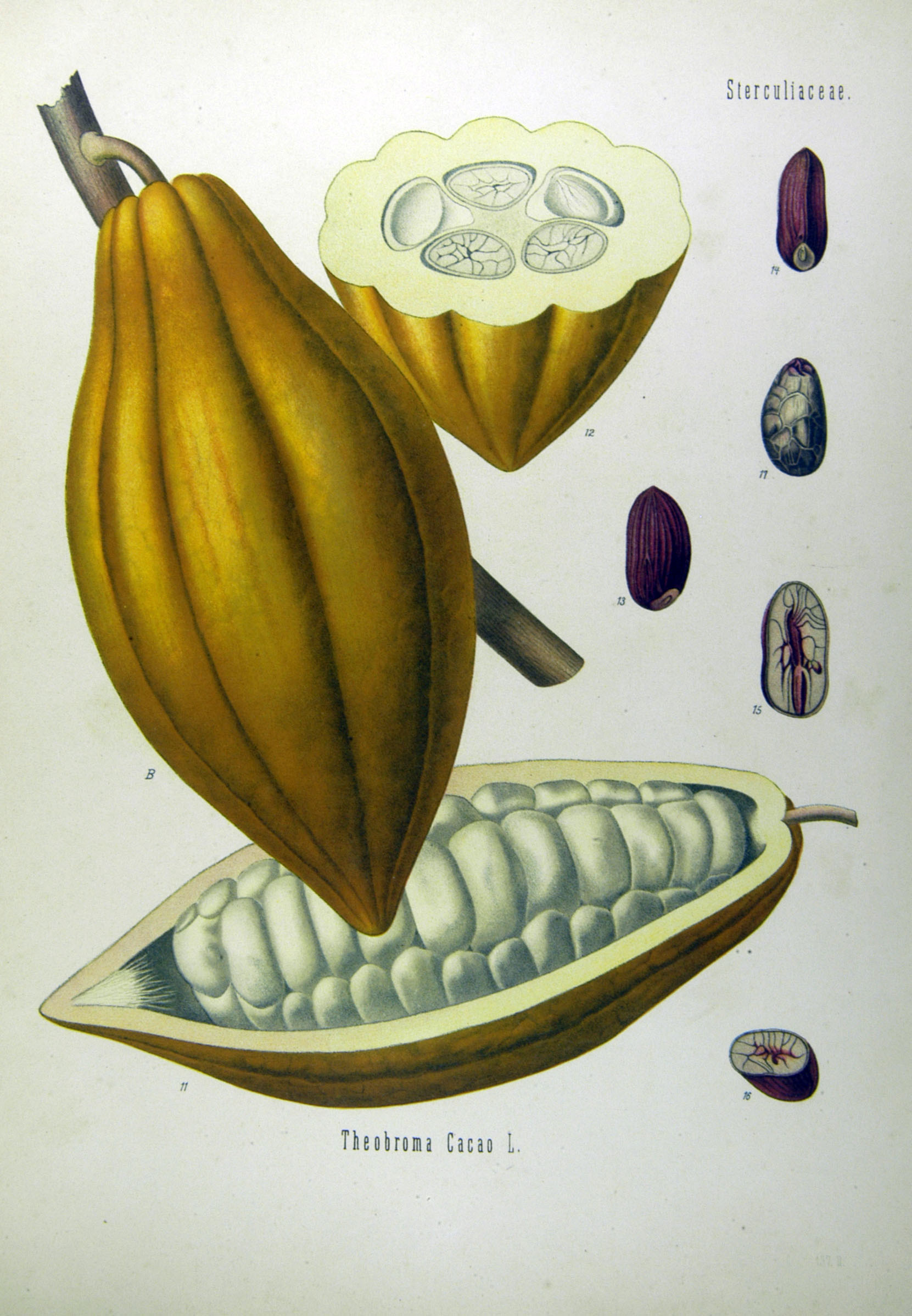
Chocolate as we know it comes from the seedpods of Theobroma cacao, an evergreen tree whose generic name comes from the Greek for ‘food of the gods.’ (Nice job, Carl Linneaus.) The tree is pollinated, flowers, and produces a fruit whose large seedpods form the basis for chocolate. The fruit is gathered, and the seedpods are extracted. They are then fermented, and quickly dried, before being roasted, hulled, and ground up, and turned into the first step on the road to chocolate.

All of this doesn’t matter to us at all if Theobroma cacao can’t grow.


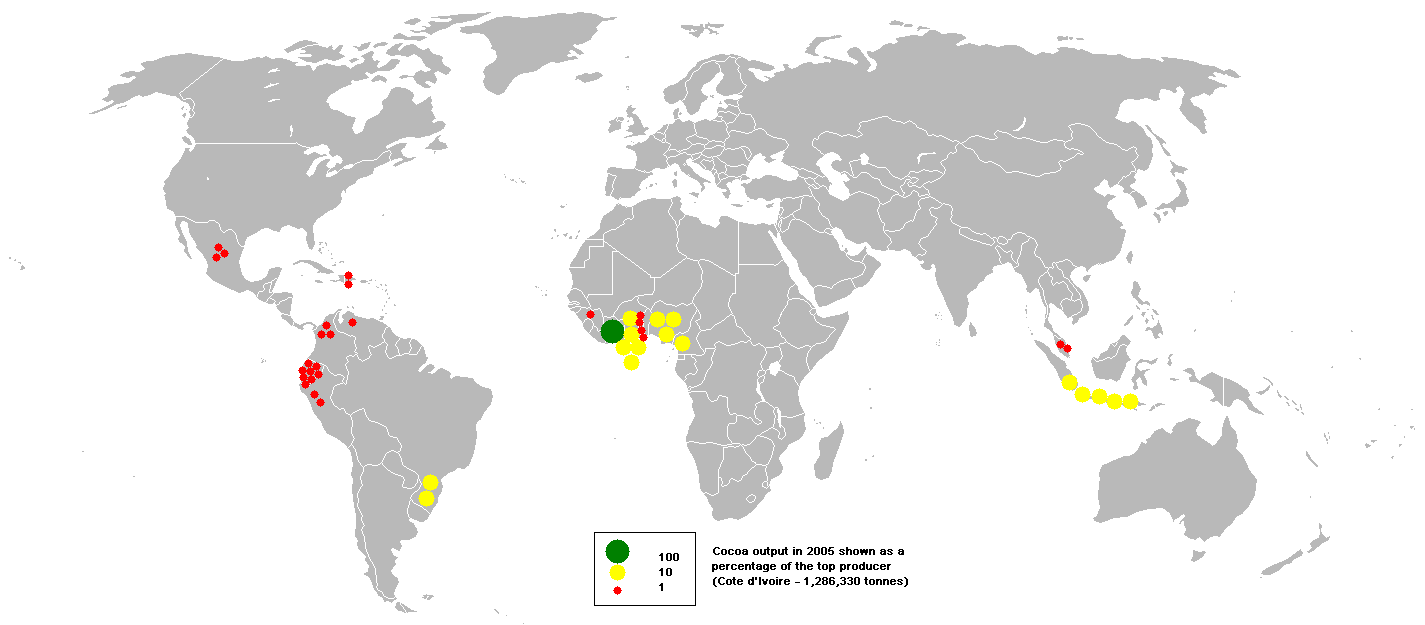
 Above is a map detailing cacao output around the world. Notice the concentration in equatorial climates. My good friends over at Wikipedia confirm this -- “Cacao trees will grow in a limited geographical zone, of approximately 20 degrees to the north and south of the Equator. Nearly 70% of the world crop is grown in West Africa.[source]

The Royal Botanic Gardens at Kew inform us “In its natural habitat, cocoa grows in the understory of evergreen tropical rainforest. It often grows in clumps along river banks, where the roots may be flooded for long periods of the year. Cocoa grows at low elevations, usually below 300 metres above sea level, in areas with 1,000 to 3,000 mm rainfall per year.” [source]

So. Equatorial climates, evergreen tropical rainforest, river banks, low elevations with lots of rain. That's what we need here.
Karen Wynn Fonstad’s Atlas of Middle Earth has several maps pertaining to vegetation, climate and season conditions in Middle Earth. Based on the pieces of information she gathered from what one hopes to be a close reading of Tolkien’s work, she suggests that Gondor, the southernmost region Tolkien’s work touches on in any detail, has mild winters and hot, dry summers, similar to the climate of the Mediterranean and Southern California. She also suggests that further south of Gondor, in Harad, is arid grassland, similar to what one might find in the Great Plains region or in Central Asia.
Nowhere in her maps is any mention made of rainforest, or of a climate with a rainfall level significant enough to support a rainforest. (Those would make really cool Ents, though, don’t you think?) >So, in answer to the question, “Does Middle Earth have chocolate” my answer is… No, probably not in the known world. Now, Tolkien doesn’t ever explore whether there’s something farther south after Harad.  Maybe there are equatorial climates and rainforests as one goes deeper into the interior. (Maybe that can be a subject for a fanfic – explorer/diplomat goes to Harad after the king returns, comes back with cacao beans. Cue new fad for drinking chocolate in Gondor.) One has also to consider whether Tolkien considered his world to exist on a globe or on a flat plain. If the flat plain, is it meteorologically possible to have an equatorial climate, given that all the other climates represented in Middle Earth don’t have such conditions? I’m not a meteorologist or a physicist, so I don’t know and can’t speculate. Let me offer you some honeycakes in consolation. I do know Middle Earth has bees.

Tuesday, December 18, 2012

Centennial Dress Project -- The Fun Has Arrived!

One would think that graduating from college would give a person more time to do things like update their blog, but it has become apparent to me that real life takes it out of a body more than school life does. And two jobs does not time for dress projects leave. However, I think I can safely say that in three months (goodness me, three months!) I have made some pretty significant progress.

Item One:

I have purchased my patterns. (Huge hurdle to jump through).


Item Two: 

I have purchased a large quantity of good muslin, and have made what amounts to one good muslin mock-up of my shirtwaist!

Historically correct garment in historically correct setting -- the Farmhouse.

This also involved setting my first sleeve, which I was VERY proud of, since it turned out lovely.  The second mock-up will be forthcoming in January when I actually have several days off.

Item Three:

My sewing table no longer has a hole in the middle where the original machine used to sit. It now has a lovely little door. Hip-hip-hooray for my father's carpentry skills!

Item Four:

I have met May.

Wait, you're asking yourselves, who on God's green earth is May and why is she so important that she gets bolded, italics, and underlines? Well, as I told you several months ago when I learned of May's existence, she's my new best friend  And I finally got a chance to meet her.

Not in person, unfortunately, although I would have liked that a lot. May died in 1993 at the ripe old age of 96 years old. I got to met her through her letters, now housed at the Saint Benedict's Monastery Archives -- three years of correspondence that she sent to her mother and freinds at home between 1912, when she enrolled in Saint Benedict's Academy for one year of high school, through 1915, when she graduated from Saint Benedict's College as part of its first college graduating class with a degree in Music.

Internet, meet May. May, meet the Internet. They'll love you just as much as I do, I promise.

 I got to read about her fears about being far away from home for the first time, about her despair that she would never be a good student (and then watch her grades climb to straight As by her last semester of college) and listen to her tell her mother about all her hijinks with the other girls in her class.

Saint Ben's in 1913 -- so cool we had our own postcards.

And oh boy, did those original Bennies get into some trouble sometimes. One of May's good friends, a girl named Denver McCloskey (Yes, I know, Denver! In 1912! I couldn't make this up! ) had "a kodak (sic)...and she's been taking pictures of different ones. Somehow the sisters always avoid having their picture taken." May goes into great detail about the various tricks the girls played trying to capture the nuns on film. She relates another hilarious story where, when a visiting dignitary was going to be shown the dormitories and one of her friends had stopped by to visit in her pajamas, the friend was shoved in the closet until the visit was over. She wrote home to tell her mother that she had bought her first piece of 'school swag', "One of the Saint Benedict's pillows. The colors are red and white," and, she adds with pride, "and I'm going to work it." ('Work it' as in, embroider over it even more, not 'work it' as in, show it off and be awesome with it. Although I'm sure she did that sometimes too. It may even be the pillow featured in this picture.)

She wrote about her freshman five (well, four and a half) with pride -- pride! -- when she wrote home to her mother after only a month at school and proudly declaimed that she was now 101 1/2 pounds. (At seventeen years old. Goodness me.)

To be quite brief, her letters were a wellspring of goodness and delight. I wished that I had known May -- I wished that I had gotten a chance to go to school with her. I wrote a poem memorializing my time spent abroad in Ireland to the great delight of the rest of the people on my trip. May did that, too, for all the girls in her graduating class. It was published in her yearbook. That was in her file, too. I might as well have been reading the letters of the 1912 equivalent of...well, of me.

This is part of the memorial poem. She donated this lovely type-written manuscript to the college and it contains a few really wonderful pieces.
But one of the absolute jewels of May's letters (and there are many) is her letter home to her mother in her senior year, in which she details a long list of items her mother will have to supply her money for. New music for the graduation recital, gloves, shoes, new stockings, new corset, photos for the year book, graduation announcements, calling cards -- a list I am sure Bennies graduating today would recognize in some form or another. Today's parents, however, will probably not recognize the price -- May asked her mother for a princely ten dollars to cover her expenses. I include a selection here where May details some of her finances to give you a better picture of the buying power of a dollar in 1915.

Of course, if you could send me a five dollar bill, I'll have enough to defray all my expenses there [in Saint Cloud.] I don't know how much things cost, but I suppose my slippers will come to about three dollars, my gloves to a dollar and a half, and my stockings to about the same as the gloves, and then as to a corset -- I suppose that will be two dollars. My last one cost that much, I think. There, you see, that comes to eight dollars already and I only have four dollars to my name...

And in the midst of all that, she took a solid page to tell her mother how she wanted her graduation dress to look. Riches!
...Yes, I got that dress that you cleaned for me. By the way, don't make my sleeves on my graduation dress too long. Perhaps three-quarter length sleeves would be better. I wanted long sleeves but they won't look good with long gloves. I want the sleeves to lay over the gloves at least three inches -- if you make short sleeves. You see I'll have to wear that dress at my recital and I want the sleeves to come to about 4 inches below my elbow so I won't have to wear sleevelets at my recital. 
So there we have it. Three quarter sleeves to lay over longer gloves and no sleevelets. The historical record has spoken.

I talked everyone's ear off about these letters after I got home from Minnesota. I couldn't quote them enough, reference them enough, rhapsodize about them enough. Now my parents think I should look into seeing what it takes to get letters published along with some sort of supplemental material for use in women's studies classes and the like. I think that would be a tremendously fun project.

But I still have to make a dress first.

Monday, August 20, 2012

Hittin' the Books -- Back to School with the Centennial Dress Project

The little yellow signs are out at all the crosswalks in my neighborhood and traffic slows to a crawl just around 9 o'clock -- which means that school must be back in session. Unfortunately, I am not among the lucky little duckies going back to their classrooms for lots of learning and making new friends and breaking in your new box of crayons and whatever else back to school means. But I am not going to let that get me down, no sir! I am trying to get ready for my back to school as well, next June!

I'll be honest with you -- the dress project stalled out a few months ago. The reason? I decided, after lugging a folding table in and out of my room for about a week so I could finish my walking skirt, that I needed a sewing table, or at the very least a sewing cabinet that once housed a sewing machine. You know, one of these numbers where the machine flips down inside?


I already have a machine, so all I really needed was an empty cabinet that I can set it on top of. I went to all my local secondhand shops (at least twice) and the local ReStore, a shopping outlet run by Habitat for Humanity that, in addition to taking used or left-over building supplies, also sells reused furniture. (If you have one in your area, GO! It supports a good cause and they have all kinds of odds and ends.) They had a lot of sewing cabinets...in a corner of the sales floor where I couldn't go and look at them. So that trip was a  bit of a bust too.

I spent a weekend on vacation in the city with some of my school friends, and when I called to check-in with my family on Saturday night, my mother told me that she and her sister and found (and purchased for me) a sewing table they thought I was really going to like. So, when I arrived home on Sunday night, I found this little beauty waiting for me:

Helloooo, gorgeous!
It's a Sears, Roebuck, and Company cabinet with a matching stool, and after checking all the sites on the internet I could find, I still have no idea when it was manufactured or what kind of machine was originally inside. I also did not find a single picture of a table that looks a thing like this one -- it's in a sort of Japanoiserie/ Frank Lloyd Wright Prairie style, which makes me love it even more. Given the model number inside, I think it was manufactured in the late 1930s.

And they told me it was my birthday present. Thanks, Mom and Sis!

So, with my table problem solved, I went to the library, checked out a number of books on 1910s fashion, and continued with my research. One of the books I really wanted (and eventually found) was Dover Publications "Everyday Fashions, 1909-1920, as Pictured in Sears Catalogs". The other books I've found are nice, but not very helpful. My turn-of-the-century Bennie is not buying a Parisian couture dress by Lucille or Poiret.  She's probably getting a ready made dress from the Sears or Montgomery Ward catalog, a significant investment for school that will set her parents back anywhere between $5.90 and $6.95. A hefty sum, considering the average salary of a US Postal worker was about $1124 dollars a year, and that of a teacher was a meager $547 yearly.  For hourly workers, wages could range from 21 cents an hour in manufacturing to 55 cents an hour in construction trades. (Statistics from The National Bureau of Economic Research)

And, as today's parents can commiserate, new clothes for school come after paying for school, which is also not cheap. In 1916, one semester at Saint Ben's would cost this Bennie's parents a whopping $172, not including boarding at school over Christmas and Easter vacations, which would have been twelve dollars more.

So, what does a six dollar, off-the-rack dress look like in 1913?

All of the dresses in this illustration, with the exception of the second from the left, fit the price range.
 Sears and Roebuck also state very nicely at the bottom of the catalog page that "All dresses will be furnished in skirt length ordered, but with open hem so that length can be adjusted to suit customer." Even if we buy a ready-made dress, we're still going to at least hem it so it fits. How interesting.

Sears also has a page of dresses for 'Misses' (I think this may be the 1910s term for a 'young adult') and 'Junior Dresses for 13 to 17 year old Girls.' Have we really been calling it the Juniors department since the 1910s? I never knew.

This is what the Plastics looked like in 1912. Big perfect hair and tiny ankles.

These dresses are being made up in fabrics like velveteen, mohair, whipcord serge, and broadcloth. Norah Waugh's 1968 book "The Cut of Women's Clothes, 1600-1930" reports that fabrics like voile or muslin were in use, as were materials like linen, cotton, and shantung for something called a tub frock, which I think might be another name for a washdress.

Next step -- Buying a pattern, and a trip to the fabric store!

Sunday, August 15, 2010

Drawing From the Model

When Edith Wharton speaks of Ellen Olenska's unorthodox education in her novel "The Age of Innocence" she speaks of 'drawing from the model' as a thing 'never dreamed of before,' an element of Ellen's education that most of New York society can never condone. If we may take "drawing from the model' to mean that Ellen, like many aspiring artists, learned anatomy and muscleture from sketching both men and women in the nude, it's no small wonder the rest of 19th century New York found it so appalling.

Writers of fanfiction also draw from the model -- we take our source text and strip it bare to see how muscles move and bones work underneath the skin. We then take those basic anatomical ideas back to our own canvases and do something new with them.

For the next chapter of A Rose in the Briars, however, I'm finding that drawing from the model has become rather difficult. The scene is a simple one -- two characters are getting married. I need a marriage formula. Tolkien gives me little to go on here -- of the two marriages mentioned in his text, the first (Aragorn and Arwen's) is unspecific and the second (Sam and Rosie's) is unapplicable.

Having nothing in my original model, I turned to my friends at the Gwethil for some suggestions as to who I might get to officiate this important scene. Simon suggested no officiant, in the Pre- Council of Trent Christian tradition, and Robyn suggested having a justice or magistrate. Having no sourcebooks on early Catholic pontifical councils lying around my house, I took the opportunity to ask my grandparents, who know a great deal more about Catholic theology than I do. They, too, were stumped, but suggested instead the Jewish tradition instead.

It is much easier to find documents about the customs surrounding a Jewish wedding than it is to find those pertaining to marriage customs in 14th century Christian Europe. One of those elements common to both types of marriage is a marriage contract, in the Jewish tradition called a ketubah. It lists the date, who is marrying whom, what each party is bringing to the marriage in terms of material goods and what each party should expect of the other. I used a form similiar to the one found here.

Simple, right? A large part of my ceremony will now be the two parties reading and signing the contract to make it valid and sharing a cup of wine, found in both the Jewish and Anglo-Saxon traditions. Except, of course, that marriage contracts involve giving dowries and those usually involve currency, something ELSE Tolkien didn't include much of in Lord of the Rings. After searching "middle earth currency' and coming up with ONE quote on Gondorian currency from Tolkien's History of Middle Earth Volume 7 --

"Similarly farthing has been used for the four divisions of the Shire, because the Hobbit word tharni was an old word for 'quarter' seldom used in ordinary language, where the word for 'quarter' was tharantin 'fourth part'. In Gondor tharni was used for a silver coin, the fourth part of the castar (in Noldorin the canath or fourth part of the mirian). "
Ah, helpful. Currency conversions to more currencies I still don't know about, because Tolkien never discussed the buying power of the castar, only silver pennies. So I arbitrarily decided a Gondoran castar is equal to the late medieval ducat, and using some average dowry figures from the same period converted the whole mess to some numbers I could use.

If Eleanor of Montfort's dowry was 200 pounds a year in 1230, and she's about the same rank as Serawen, what would the same dowry be in Gondorian castari?

Well, Alex, one ducat is equal to 9 shillings 4 pence (according to Sir Robert Palgrave's The History of Politcal Economy, found on GoogleBooks) or 85 pence, and there are 240 pence in one pound (there being ten pence in a shilling and 12 shillings in a pound). If we multiply the number of pence in a pound by the number of pounds and then divide that by the number of pence in a ducat, we should come out with the number of ducats and therefore the number of castari needed to give Serawen a nice nest egg: roughly 565 castari.

Fhew!

And the moral of the story is this -- Not every canon is perfect. Not every model will give you a perfect idea of how the human body moves. Even Tolkien, who has more than nine volumes of supplemental material to his name, doesn't cover all his bases. Covering those bases is what writing fanfiction is all about.

I just wish sometimes I didn't have the compulsion to be so thorough.

Saturday, February 7, 2009

Foiled by the Hill AGAIN!


Okay, it's bad enough when you constantly check books out of the library like these:


(Yes, that last one really is the size of my head -- it's a little over 1000 pages and weighs about five pounds. I think I have a serious problem when the books I check out for kicks and giggles are bigger than the ones I check out for actual classwork.)


But it's really bad when you're looking for obscure books in the library catalog and not only does your library have them, but they're so obscure they're held at the RARE BOOK LIBRARY on your campus.


Yeah, that's right. I've been foiled by the Hill Manuscript Museum and Library on not one, but TWO books tonight. I wanted a copy of "Berengaria : in search of Richard the Lionheart's queen" and "A History of Deeds Done Beyond the Sea" (the Babcock translation) and both of them are at the Hill.

I know, I need a new hobby. Or a life. But I really don't care.


And I just found out this evening that Hildegarde of Bingen, my favorite 11th century mystic, told someone not to marry Princess Sybilla of Jerusalem. This makes me excited!


...Yes, I have a favorite 12th century mystic. Deal with it.