
Forgive me, readers, for I have sinned – It’s been over two weeks since my last blog post. There’s really no excuse for it other than monumental laziness. In the middle of Midwestern July heat, one finds oneself content to merely sit and wallow and occasionally pick up a book.
Last Wednesday my writing class met for the last time with a grand total of ten participants. It’s been interesting to see who comes back and who doesn’t – throughout the course of the four weeks I had a grand total of twenty-two people show up, with about four kids who showed up to every class (Melisa, Kahil, Hadiya, and Monica, you’re the best!) and seven or eight more who tried their darnest to make it to at least three because they’d forgotten week one or had to be on vacation. As my grandfather commented, it might have been wiser to charge something for the program because then people would have a reason to come – they’d be "invested" in it.
I didn’t feel right charging people to come hear me talk about writing – for starters, I don’t think what I had to say was anything worth charging for. I was sharing experience, not proven and published fact. If I had a New York Times Bestseller under my belt or a Booker Prize, then yes, I would start thinking about selling the secrets to my writing success. As it is, I was happy I wrote six pages of my fanfic yesterday. My writing is supposed to be non-profit to keep the copyright folks happy and I think that’s the way it’s going to stay.
Over four weeks I learned just as much from my kids as I hope they learned from me. They taught me that it’s unsafe for my voice to talk for an uninterrupted 45 minutes, that this is very boring for middle schoolers in particular anyway, and that one has to be very careful with the way one words one’s advertisements. (Some parents signed their kids up thinking it would be an ESSAY writing workshop, which makes sense, given that all the other teen programs at the library are geared towards school somehow.)
In their evaluations on Wednesday night, they reminded me of many other things as well. Kids need time to practice and share their ideas (“More sharing time, please!”). High schoolers have different writing needs than middle schoolers do (“Grammar wasn’t very helpful – more on character development?”) but everyone can use positive criticism (“Thanks for all the great feedback – really helped my confidence!”). I also learned, once again, that you cannot please everyone – I had high achieving students so elitist in their reading habits I’d never heard of anything they’d read and kids who hated to read whose parents had signed them up in the hopes that I would work some magic on their kids and open books for them. (Newsflash to parents – if your child is in middle school and hates to read, it may be that they have a problem a qualified reading instructor needs to sort out. Also, if they hate to read they will probably also hate to write)
If I do this writing workshop again, I’ll be more selective on age – middle schoolers in one section, high schoolers in another. I’ll make the class longer (an hour and a half) and make sure I have enough handouts for everyone. I’ll request a better meeting space so everyone has a place to write and I'll come to class better prepared than I was this time. I’ll listen better. I’ll remember your names. I"ll always bring pens and paper. I’ll find more resources for different writing development topics like character development so that students with specific needs or wants will be able to get the help they want and deserve. I’ll make them read a little more and have discussions. I'll make your assignments easier and cleaner cut.
My students also told me something I wouldn’t have gotten anywhere else – “You’d make a great middle school teacher!” Three or four of my students told me that, and that made me feel really good. Tomorrow I have to go in and take the Praxis, a big liscensure test that will measure whether I can, indeed, begin my student teaching in the spring. Let’s hope for the sake of future middle schoolers in Minnesota and elsewhere that I pass.
Friday, July 23, 2010


Friday, July 9, 2010
Why I am not enjoying “The Life and Times of Lucrezia Borgia”
As part of the summer reading program at my local library, I have to read books from a number of different categories – a novel, a non-fiction book, a biography. I decided I’d choose for my biography the life of someone whose time period or lifestyle I’m interested in as a broader research topic. My first choice was William Marshall, but alas, the reknowned Plantagenet knight has few books and fewer biographies devoted to his life and times, a problem I think someone should solve very soon, because he’s a fascinating historical character. I didn’t have a second choice as I trolled the ‘Biography’ section of the library, and the books I was seeing on the shelves weren’t helping me either, because the library seems to have stopped buying biographies in the late eighties and nothing looks interesting when the dust cover is sun-faded and the books smell like they haven’t had a good airing in a while. If no one else has read them in a while, why should you, right?
 Then it hit me – Showtime is doing a series on the Borgias soon, starring the always amazing Jeremy Irons as Rodrigo Borgia, the patriarch of an eccentric family whose 15th century exploits would make most gossip magazines today kill for coverage of. I’ll read about the Borgias. Specifically, I’ll read about Lucrezia Borgia, Rodrigo’s illegitimate daughter and Renaissance bombshell who married three times, had a lot of affairs, and may or may not have poisoned a bunch of people, slept with her brother and organized an orgy at the Vatican.
This girl knew how to party, in other words. How bad can reading her biography be?
Lucrezia has three books on the shelf, none of them published before 1960. Wonderful. I pick the least moldy looking, “The Life and Times of Lucrezia Borgia” by Maria Bellonci (published 1939, translated by Bernard and Barbara Wall, 1953) and check it out, my anticipation on slow simmer. Today I actually sit down to read said book, and about fifty pages in, I can take no more.
I’ve read fifty pages, and what I’ve gotten so far is not “The Life and Times of Lucrezia Borgia”, but rather “The Times and Political Climate Surrounding Lucrezia Borgia, Who’s Really Just in the Title of this Book so Someone Who’s Interested in 15th Century Women Will Be Persuaded to Read About Italian Renaissance Politics.” Lucrezia’s come up ONCE in the first fifty pages of her biography, and in that one instance, she was getting married.
Eeeeenteresting.
I take a moment to step back and consider why this is. Certainly one can make the argument that in order to understand Lucrezia’s life one has to understand the political circumstances of her father, Rodrigo, who, as I have already mentioned, was Pope Alexander VI. But to open a biography with the events that got her father elected as pope and not with, say, the birth of the title character, seems to me a bit dodgy.
Maybe there’s not enough research material on Lucrezia, and after Miss Bellonci picked her thesis topic figured this out and so padded it out with the available material on the men in Lucrezia’s life to make her three hundred page mark and appease her Ph.D. Thesis Examining Board, who wouldn’t have liked a biography on an Italian Renaissance wildwoman anyway. Too edgy. Not suitable reading material for the Misses Smith and Jones of the world who need good examples of pristine womanhood when they get home from their jobs as secretaries and elementary school teachers.
I’ve been reading Jill Ker Conway’s True North, the second of her three memoirs of her life as an Austrailian academic and a female trying to find a place in the post-secondary system. (For my review of her first memoir, The Road to Coorain, click here) Conway talks a lot about being taken seriously as a female academic interested in studying the contributions of women throughout history, and I wonder if that wasn’t the case with Miss Maria Bellonci circa 1939. It’s a man’s world in academia, and if she wants to write a book about one of history’s leading ladies, what she really has to write is a book about the men surrounding history’s leading ladies and keep her title character in the role she herself is supposed to be playing – a pretty face, a focal point at parties, but not the headliner or the leader of anything worth reading.
It struck me that history writing has changed a lot since this book was written – since women like Conway have worked their way up the ladder and worked to get Women’s Studies on the curriculum and allowed historians and economists and theologians to examine the part of history that can get ignored in history books. Nowadays, women like Antonia Frasier and Alison Weir can write biographies where their subjects can become the center and not the periphery of the world being described. I enjoy reading biographies like that, where I get just enough historical context to get me through the chapter and enough about the person I wanted to read about to sustain my attention.
Now come on, Amanda Foreman or one of you other great literary ladies, get on this Lucrezia Borgia issue and write me a biography I’m not going to have to kill myself reading.
(Interestingly, I read two articles on the “feminization of history” while writing this post – apparently a British historian named David Starkey got his undies in a bunch about a year ago over the fact that some people think the history of Europe wasn’t exclusively piloted by white males. You can read one response to his comments here: http://entertainment.timesonline.co.uk/tol/arts_and_entertainment/books/article6035805.ece )
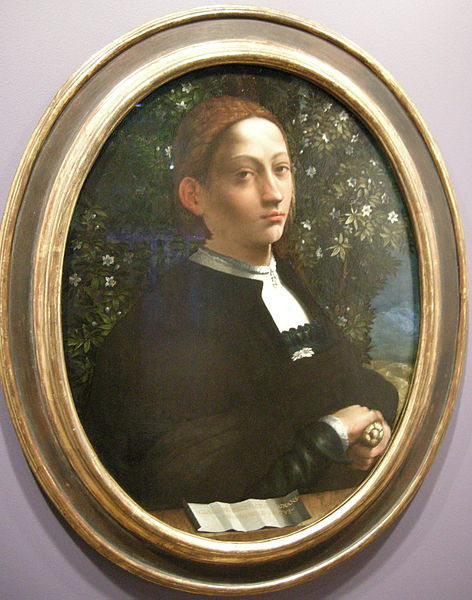
This girl knew how to party, in other words. How bad can reading her biography be?
Lucrezia has three books on the shelf, none of them published before 1960. Wonderful. I pick the least moldy looking, “The Life and Times of Lucrezia Borgia” by Maria Bellonci (published 1939, translated by Bernard and Barbara Wall, 1953) and check it out, my anticipation on slow simmer. Today I actually sit down to read said book, and about fifty pages in, I can take no more.
I’ve read fifty pages, and what I’ve gotten so far is not “The Life and Times of Lucrezia Borgia”, but rather “The Times and Political Climate Surrounding Lucrezia Borgia, Who’s Really Just in the Title of this Book so Someone Who’s Interested in 15th Century Women Will Be Persuaded to Read About Italian Renaissance Politics.” Lucrezia’s come up ONCE in the first fifty pages of her biography, and in that one instance, she was getting married.
Eeeeenteresting.
I take a moment to step back and consider why this is. Certainly one can make the argument that in order to understand Lucrezia’s life one has to understand the political circumstances of her father, Rodrigo, who, as I have already mentioned, was Pope Alexander VI. But to open a biography with the events that got her father elected as pope and not with, say, the birth of the title character, seems to me a bit dodgy.
Maybe there’s not enough research material on Lucrezia, and after Miss Bellonci picked her thesis topic figured this out and so padded it out with the available material on the men in Lucrezia’s life to make her three hundred page mark and appease her Ph.D. Thesis Examining Board, who wouldn’t have liked a biography on an Italian Renaissance wildwoman anyway. Too edgy. Not suitable reading material for the Misses Smith and Jones of the world who need good examples of pristine womanhood when they get home from their jobs as secretaries and elementary school teachers.
I’ve been reading Jill Ker Conway’s True North, the second of her three memoirs of her life as an Austrailian academic and a female trying to find a place in the post-secondary system. (For my review of her first memoir, The Road to Coorain, click here) Conway talks a lot about being taken seriously as a female academic interested in studying the contributions of women throughout history, and I wonder if that wasn’t the case with Miss Maria Bellonci circa 1939. It’s a man’s world in academia, and if she wants to write a book about one of history’s leading ladies, what she really has to write is a book about the men surrounding history’s leading ladies and keep her title character in the role she herself is supposed to be playing – a pretty face, a focal point at parties, but not the headliner or the leader of anything worth reading.
It struck me that history writing has changed a lot since this book was written – since women like Conway have worked their way up the ladder and worked to get Women’s Studies on the curriculum and allowed historians and economists and theologians to examine the part of history that can get ignored in history books. Nowadays, women like Antonia Frasier and Alison Weir can write biographies where their subjects can become the center and not the periphery of the world being described. I enjoy reading biographies like that, where I get just enough historical context to get me through the chapter and enough about the person I wanted to read about to sustain my attention.
Now come on, Amanda Foreman or one of you other great literary ladies, get on this Lucrezia Borgia issue and write me a biography I’m not going to have to kill myself reading.
(Interestingly, I read two articles on the “feminization of history” while writing this post – apparently a British historian named David Starkey got his undies in a bunch about a year ago over the fact that some people think the history of Europe wasn’t exclusively piloted by white males. You can read one response to his comments here: http://entertainment.timesonline.co.uk/tol/arts_and_entertainment/books/article6035805.ece )
Sunday, July 4, 2010
My Fiesty, Feministy Fourth
I am having a very strangely fiesty, feministy Fourth of July.
First, I was overcome with a sudden wave of anger when I walked into church this morning and hear the choir rehearsing “America.” I explain to my sister that I’m not sure why I’m angry but that it might have something to do with the imperialist, capitalist sentiment that seems to ooze from patriotic songs. We sing nothing but patriotic songs for the rest of the mass, except for The Prayer of Saint Francis and Let There Be Peace On Earth, which I think are very hypocritical for the day when we’re celebrating the proclaimation of the document that started us out on the path to being the world’s warmongers. Which, by the way, I think we should actually read on the Fourth, just like they used to do in the good old days.
Second, I keep seeing this headline on the CSM page -- Fourth of July: Female power triumphs at the movies
When I first read that, I thought “Oh, gee, what cool, feminist, uplifting-for-womenfolk film is coming out this weekend that is getting great reviews at the box office?”
Do you know what the story’s really about? The fact that New Moon is breaking box office records with a primarily female audience. Talk about misdirection on my part.
I finished reading all four books the other day and I have to say I wasn’t impressed. As so many other feminist bloggers have stated, Twilight is a harmful book for young women to read because among other things it glamorizes relationships with abusive characteristics, normalizes relationship violence in Native communities, glorifies a protagonist who thinks she doesn’t mean anything without a man in her life, and above all of this from my perspective, is just second-rate writing to begin with. Heck, it might even be third rate. Maybe my standards are too low. I only started enjoying myself halfway through New Moon when Bella becomes a vampire and actually starts, you know, enjoying her life, or un-life, or whatever you want to call it. Even then I still wasn’t enjoying it much – I rushed through the book in a day and a half and then refused to read anything else for a few days afterwards because I didn’t want to look at another book for fear it’d be just as bad.
Here’s what scares me about the mix of supposed 'female power' and Twilight -- Twilight doesn’t promote female power, it dampens it considerably( for all the reasons listed above and more.) And that women are getting together (in droves, apparently) to share this story instead of another story about the power of female bonding, about healthy love, about…anything else, really, is quite frightening.
I skipped the usual Fourth festivities – My dad and brothers went to go partake in RibFest and the manly activity of eating large hunks of meat (my brother seems to be under the delusion that if he eats a vegetarian meal, he’ll lose face or something) and no one in my house felt like going to the parade or the fireworks. So I went for a four mile bike ride with my mom. And we had fun.
First, I was overcome with a sudden wave of anger when I walked into church this morning and hear the choir rehearsing “America.” I explain to my sister that I’m not sure why I’m angry but that it might have something to do with the imperialist, capitalist sentiment that seems to ooze from patriotic songs. We sing nothing but patriotic songs for the rest of the mass, except for The Prayer of Saint Francis and Let There Be Peace On Earth, which I think are very hypocritical for the day when we’re celebrating the proclaimation of the document that started us out on the path to being the world’s warmongers. Which, by the way, I think we should actually read on the Fourth, just like they used to do in the good old days.
Second, I keep seeing this headline on the CSM page -- Fourth of July: Female power triumphs at the movies
When I first read that, I thought “Oh, gee, what cool, feminist, uplifting-for-womenfolk film is coming out this weekend that is getting great reviews at the box office?”
Do you know what the story’s really about? The fact that New Moon is breaking box office records with a primarily female audience. Talk about misdirection on my part.
I finished reading all four books the other day and I have to say I wasn’t impressed. As so many other feminist bloggers have stated, Twilight is a harmful book for young women to read because among other things it glamorizes relationships with abusive characteristics, normalizes relationship violence in Native communities, glorifies a protagonist who thinks she doesn’t mean anything without a man in her life, and above all of this from my perspective, is just second-rate writing to begin with. Heck, it might even be third rate. Maybe my standards are too low. I only started enjoying myself halfway through New Moon when Bella becomes a vampire and actually starts, you know, enjoying her life, or un-life, or whatever you want to call it. Even then I still wasn’t enjoying it much – I rushed through the book in a day and a half and then refused to read anything else for a few days afterwards because I didn’t want to look at another book for fear it’d be just as bad.
Here’s what scares me about the mix of supposed 'female power' and Twilight -- Twilight doesn’t promote female power, it dampens it considerably( for all the reasons listed above and more.) And that women are getting together (in droves, apparently) to share this story instead of another story about the power of female bonding, about healthy love, about…anything else, really, is quite frightening.
I skipped the usual Fourth festivities – My dad and brothers went to go partake in RibFest and the manly activity of eating large hunks of meat (my brother seems to be under the delusion that if he eats a vegetarian meal, he’ll lose face or something) and no one in my house felt like going to the parade or the fireworks. So I went for a four mile bike ride with my mom. And we had fun.
Book Recommendation: The Road from Coorain
I just finished reading Jill Ker Conway’s The Road From Coorain, her memoir about growing up in the Australian Outback in the 1930s and 40s, and realized there’s nothing better in my life at the moment to write about, so I’m furnishing you with a book review.
I didn’t realize this until after I finished the book and read the back cover, but the author was at one point in time the president of Smith College and an accomplished women’s historian, which should have been a huge clue that I’d enjoy this book. As it happens, I checked it out because the cover looked interesting, I’m in love with the idea of the Australian out country, and I was also checking out Eclipse and Breaking Dawn and wanted something a little more intellectual looking in my pile at the check-out line. (I live in fear that the librarians will judge me by what I’m checking out – It’s why I’ve never gotten around to just sitting down for a week during the summer with a heap of trashy romance novels.)
One of the first things I thought after finishing the first page of this wonderful little book is “God, this woman can write. This prose is mind-bendingly brilliant.” And it only got better as I zoomed through the rest of the book. Conway’s descriptions of the back country where she spent her childhood, working and helping her father on their sheep farm, drew me into a landscape I’ve only dreamt of through the poetry of Banjo Paterson. As I read on I couldn’t help feeling a sense of kinship and like-mindedness with Conway; One of the things that continually struck me as the narrative went on was the way she seemed to find the Divine in the harsh but somehow beautiful vistas of the desert around her. Raised by a devoutly anti-Catholic mother and a father who only dabbled in his faith, Conway stayed away from religion for most of her life, but despite this maintains a strong sense of the mightiness of nature and the serenity or intense strength one can find there.
As she moved away from the family farm and into the city, the author turned her insightful prose to examining her relationships, the people who enter her life and finally the academic life she’s easing into at the end of the memoir as a Master’s candidate in history at the University of Sydney. What really interested me towards the end of the book was the way she was drawn towards comparing the Australian Experience of settlement with the similiar American experience settling the West.
Anyway, it was a fantastic book, and I’d recommend it to everyone.
I didn’t realize this until after I finished the book and read the back cover, but the author was at one point in time the president of Smith College and an accomplished women’s historian, which should have been a huge clue that I’d enjoy this book. As it happens, I checked it out because the cover looked interesting, I’m in love with the idea of the Australian out country, and I was also checking out Eclipse and Breaking Dawn and wanted something a little more intellectual looking in my pile at the check-out line. (I live in fear that the librarians will judge me by what I’m checking out – It’s why I’ve never gotten around to just sitting down for a week during the summer with a heap of trashy romance novels.)
One of the first things I thought after finishing the first page of this wonderful little book is “God, this woman can write. This prose is mind-bendingly brilliant.” And it only got better as I zoomed through the rest of the book. Conway’s descriptions of the back country where she spent her childhood, working and helping her father on their sheep farm, drew me into a landscape I’ve only dreamt of through the poetry of Banjo Paterson. As I read on I couldn’t help feeling a sense of kinship and like-mindedness with Conway; One of the things that continually struck me as the narrative went on was the way she seemed to find the Divine in the harsh but somehow beautiful vistas of the desert around her. Raised by a devoutly anti-Catholic mother and a father who only dabbled in his faith, Conway stayed away from religion for most of her life, but despite this maintains a strong sense of the mightiness of nature and the serenity or intense strength one can find there.
As she moved away from the family farm and into the city, the author turned her insightful prose to examining her relationships, the people who enter her life and finally the academic life she’s easing into at the end of the memoir as a Master’s candidate in history at the University of Sydney. What really interested me towards the end of the book was the way she was drawn towards comparing the Australian Experience of settlement with the similiar American experience settling the West.
Anyway, it was a fantastic book, and I’d recommend it to everyone.
Saturday, June 26, 2010
Good News!
This upcoming Wednesday is the first session of my writing class, and as before any endeavor like this, the kind where you set yourself up as the embodiment of all knowledge on a subject and other people have to accept that knowledge from you, I'm very afraid that I'm not credentialed enough to make an impression on these high school students.
Oh, did I mention? I have fourteen people signed up for my class! FOURTEEN! So that's exciting.
Anyway, returning to my lack of credentials. College degree? Working on it. Published? Only in school literary magazines. Nominated for any awards? Nothing anyone else has heard of.
I've only got small feathers in my hat, but even so, sometimes adding another feather helps, even if it's just another small one. Today I got the news that my Percy Jackson story A Goddess's Lament has been nominated for The Veritas Award in the General category.
Yeah, you read that right. I've now been nominated TWICE, once last voting cycle and once this voting cycle. I'm the first person up on that page. See? Here I am!

Nifty, huh? Here's what my 'anonymous nominator' had to say about why my story deserved to be nominated.
So just when I was afraid I couldn't write, someone comes along and reassures me that they think I can. It's a good day to be me.
(Oh, and if you want, you can vote for the story by visiting http://fanmortals.webs.com/general.htm after the fall equinox. Or you could just go to fanfiction.net and review it -- I accept anonymous reviews as well as those from people with ff.net accounts)
Oh, did I mention? I have fourteen people signed up for my class! FOURTEEN! So that's exciting.
Anyway, returning to my lack of credentials. College degree? Working on it. Published? Only in school literary magazines. Nominated for any awards? Nothing anyone else has heard of.
I've only got small feathers in my hat, but even so, sometimes adding another feather helps, even if it's just another small one. Today I got the news that my Percy Jackson story A Goddess's Lament has been nominated for The Veritas Award in the General category.
Yeah, you read that right. I've now been nominated TWICE, once last voting cycle and once this voting cycle. I'm the first person up on that page. See? Here I am!

Nifty, huh? Here's what my 'anonymous nominator' had to say about why my story deserved to be nominated.
It has this nostalgic reminiscing tone that adds a special feel to the story, and unlike many PJO fanfics, their is no character-bashing or anything like that. The words flow smoothly, and Amphitrite is a very realistic character.My last nomination said "It puts characters in a new perspective and also shines a light on Amphitrite." Two different nominations with a bit of different reasoning behind them! Excellent!
So just when I was afraid I couldn't write, someone comes along and reassures me that they think I can. It's a good day to be me.
(Oh, and if you want, you can vote for the story by visiting http://fanmortals.webs.com/general.htm after the fall equinox. Or you could just go to fanfiction.net and review it -- I accept anonymous reviews as well as those from people with ff.net accounts)
Monday, June 21, 2010
The Mind in Summer, Idling Along
Having just recently discovered the simultaneous joy and curse that is social gaming on FaceBook (Hello, FrontierVille!) I am ashamed to admit that I haven't had a lot to write about this past week. I also just completed my first week of work, and as kindergarteners are not the most literate of audiences, the most word-based thing I've done in the past week and a half is read a few books (none of them knock-out-of-the-park brilliant) and emcee my library's Poetry Slam, which turned out be a resounding failure because a) someone is telling today's youth that poetry isn't cool and b) the Slam was at 3pm on a beautiful Saturday afternoon. Nevertheless, the three kids that did show up had a great time reading stuff out of books and I think good fun was had by all.
Since feeding my pigs and harvesting my apple trees has been taking up most of my idle time, I haven't been paying very close attention to my feed reader, which I've set to alert me every time FF.net gets a new submission in about ten different categories, among other things. Many of these posts are coming from the Percy Jackson section, and I think that's another reason why I'm breezing through and skipping over a lot of them. There's nothing there that really stands out, nothing that I want to read. I'm also getting a lot of posts from Flamespots, which I've also added to the feedreader just to see how much lag time there is between the story getting posted and someone putting it up as flamable. It's also interesting because occasionally the Flamespots posters will add comments that they've gotten back from the authors, and those are ALWAYS worth a read.
Reading these replies, you get the sense that there seems to be an idea of entitlement in the writing world -- I wrote it, I worked on it, it must therefore be good, and if you don't agree with me, I have the right and possibly the duty to shout at you. I know this exists because I feel it sometimes. No one is entitled to be recognized as good -- you have to earn that right, through practice, through revision, and through listening to critique. But everyone is entitled to know what they did right and wrong, and it is a duty of owning that right that you must listen to all your supporters and detractors with good grace, and not shout back in your author's comments.
I actually got talking with the three teens at the poetry slam about online reviews, and their response was clear -- everyone needs to get bad reviews once in a while. But one of the teens said something very interesting on the subject of non-complimentary reviews -- "Everyone needs constructive criticism."
Very true, everyone does need concrit. Concrit is what makes the writing world go round. I endeavored to explain to him that in the online writing world there is such a thing as a non-complimentary review that offers very little basis for improvement, which shocked him and my other two audience members (I was at this point doing a little lecture/Q&A on fanfiction).
Does such a thing exist in the face-to-face world? Is it easier to deal with there? Or are the social situations in which writing is shared so exclusive (or so friend- or kinship based) that baseless criticism is seldom found there?
Since feeding my pigs and harvesting my apple trees has been taking up most of my idle time, I haven't been paying very close attention to my feed reader, which I've set to alert me every time FF.net gets a new submission in about ten different categories, among other things. Many of these posts are coming from the Percy Jackson section, and I think that's another reason why I'm breezing through and skipping over a lot of them. There's nothing there that really stands out, nothing that I want to read. I'm also getting a lot of posts from Flamespots, which I've also added to the feedreader just to see how much lag time there is between the story getting posted and someone putting it up as flamable. It's also interesting because occasionally the Flamespots posters will add comments that they've gotten back from the authors, and those are ALWAYS worth a read.
Reading these replies, you get the sense that there seems to be an idea of entitlement in the writing world -- I wrote it, I worked on it, it must therefore be good, and if you don't agree with me, I have the right and possibly the duty to shout at you. I know this exists because I feel it sometimes. No one is entitled to be recognized as good -- you have to earn that right, through practice, through revision, and through listening to critique. But everyone is entitled to know what they did right and wrong, and it is a duty of owning that right that you must listen to all your supporters and detractors with good grace, and not shout back in your author's comments.
I actually got talking with the three teens at the poetry slam about online reviews, and their response was clear -- everyone needs to get bad reviews once in a while. But one of the teens said something very interesting on the subject of non-complimentary reviews -- "Everyone needs constructive criticism."
Very true, everyone does need concrit. Concrit is what makes the writing world go round. I endeavored to explain to him that in the online writing world there is such a thing as a non-complimentary review that offers very little basis for improvement, which shocked him and my other two audience members (I was at this point doing a little lecture/Q&A on fanfiction).
Does such a thing exist in the face-to-face world? Is it easier to deal with there? Or are the social situations in which writing is shared so exclusive (or so friend- or kinship based) that baseless criticism is seldom found there?
Sunday, June 13, 2010
Summer Reading
Ah, the glorious month of June. Home to the beginning of summer, the anniversary of D-Day, the Glorious First of June and at my local library the beginning of Summer Reading Programs. This year's theme, rather lamely, is BANK ON YOUR LIBRARY, just to hammer home to the rest of the community who hasn't heard about their budget troubles. I think it needs to be given a rest, but hey, I go to the library at least once a week, so maybe it just seems like overkill to me.
Anyway, I've made several goals for this summer -- one of them is to finish summer reading, another is to learn how to roll sushi, and the third is to read the last three Stephanie Meyer books. So, yesterday, with great trepidation, I spent a good five minutes in front of the bookshelf at the library contemplating why it was again I wanted to bring these books home. My sister walks up, looks from me to the bookshelf and back again, and says "No. Don't do it."
Not even kidding. That's my sister -- always looking out for me and my continued mental stability. I respond "Well, I know they're terrible...but if I read it then I'll have something to write a blog post about!"
I could just feel the awful leaking out of the book as I went to go check it out. I'd make a big deal of blogging how bad it is, but someone else is doing that -- if you haven't already heard about it, go check out Alex Reads Twilight, an absolutely hilarious series of YouTube videos done by Alex Day where he reads Twilight and makes fun of how bad it is. (The rate of posts on this subject on his YouTube Channel is a testament to just how difficult Twilight is to get through when you don't want to read it.)
Maybe the little sister and I will watch the Twilight movies and make fun of them while we're at it. Dunno if that will happen, though... To give you some idea of the movies we enjoy, right now we're in the middle of a cracking PBS series called Colonial House. It's reality TV as only PBS and your history teacher can provide, and it's wonderful!
New Moon is sitting next to me as I write this blog post, so obviously it did make it home, but I realized something about reading and books when I put my library books away.
Anyway, I've made several goals for this summer -- one of them is to finish summer reading, another is to learn how to roll sushi, and the third is to read the last three Stephanie Meyer books. So, yesterday, with great trepidation, I spent a good five minutes in front of the bookshelf at the library contemplating why it was again I wanted to bring these books home. My sister walks up, looks from me to the bookshelf and back again, and says "No. Don't do it."
Not even kidding. That's my sister -- always looking out for me and my continued mental stability. I respond "Well, I know they're terrible...but if I read it then I'll have something to write a blog post about!"
I could just feel the awful leaking out of the book as I went to go check it out. I'd make a big deal of blogging how bad it is, but someone else is doing that -- if you haven't already heard about it, go check out Alex Reads Twilight, an absolutely hilarious series of YouTube videos done by Alex Day where he reads Twilight and makes fun of how bad it is. (The rate of posts on this subject on his YouTube Channel is a testament to just how difficult Twilight is to get through when you don't want to read it.)
Maybe the little sister and I will watch the Twilight movies and make fun of them while we're at it. Dunno if that will happen, though... To give you some idea of the movies we enjoy, right now we're in the middle of a cracking PBS series called Colonial House. It's reality TV as only PBS and your history teacher can provide, and it's wonderful!
New Moon is sitting next to me as I write this blog post, so obviously it did make it home, but I realized something about reading and books when I put my library books away.
If you need to rationalize why you're getting the book, chances are it's not a good choice for you at the moment.
Saturday, May 29, 2010
Beyond the Law -- A Review of Robin Hood.
Being the rabid Ridley Scott fan that I am, last week I went to go see his new movie, Robin Hood, at the theatre. (Being the cheapskate that I am, I went in the morning and paid four dollars less than going at night, because really, ten dollars to see a movie is ridiculous.)
Robin Hood isn't Kingdom of Heaven, let's start with that. I know a lot of reviewers, myself included, went in thinking it would be much of the same material, and it wasn't...to a point. Robin Hood takes place about nine years after the events in KoH, close to the end of Richard's wars in France, which come to an unforeseen halt when Richard dies. The main character, Robin Longstride, is an average man in the ranks of Richard's army, pulled to the king's attention when Richard, on a whim, goes through the camp looking for 'an honest man.' Scott set out to retell Robin Hood, and in that he succeeded, but while he was doing it he took a lot of the fun out of the Robin Hood story and inserted a lot of politics.
 I think the big draw of Robin Hood is that he's a man that exists outside of political interests, or if he is involved, his intentions are always very clear -- he's King Richard's man, he supports Richard's causes, and he supports the people. Simple and easy to remember. Scott's Hood should be simple, but instead comes off as much more complicated and politically embroiled than a character who up until a half hour into the movie was just a common archer. He expresses himself much better than a commonborn would have. That's kind of a theme in Scott's movies, but Balian somehow got away with it in KoH. On Robin, the high-handed speeches just sound dull.
What's interesting to me about this movie is the extremely mixed response it got throughout the reviewing world. Most people disliked it, and I can see why. Two sources that liked it a little more than the rest, however, interested me. Feministing.com's regular contributor Anna Marie reviewed it with evident enthusiasm, reporting that she loved the strong female lead offered by Cate Blanchett (appropriate sentiments for a feminist blog) and the revolutionary aspects of the idea that you didn't have to be a noble to speak up an affect change in a society.
The other interesting review is from the National Catholic Register, which is the only weekly paper my house now recieves. Thier film critic, Steven Greydanus, the writer of The Decent Films Guide said it was "more watchable in most respects" than Kingdom of Heaven (a statement I'd like to vehemently disagree with) and judged that "the moral issues [were] less muddled, the hero more compelling, the heroine more relevant, and the romance at least relatable, if not especially engaging."
I've read Greydanus' review at least three times now and I still can't decide if the man liked the movie or not -- halfway through the article he lashes out at Scott's conception of the medieval world, saying that "I'm sick of this...grim joyless faux realist medieval world with its constant brutality, hypocrisy and debauchery" but adding at the end that the movie should get some points for portraying its main character as a man capable of piety. I agree that the medieval world does get a bum rap in Hollywood, but after that he kind of lost me with his more compelling hero/ relevant heroine argument.
As much as I love Blanchett and the idea of a feminist Marian, that was one of the elements in the movie that didn't sit well with me. Both critics bring it up as something to be praised in Scott's epic, and I'm going to have to disagree. Kingdom of Heaven had a strong female lead in Princess Sybilla, a woman who was interesting because she was hard to understand at times and remarkably transparent in others. Sybilla made sense in the context of her story -- for part of her life she had been a political pawn and needed to continue being a political pawn (something that went against her personality) if she wanted to see her kingdom survive. Marion, on the other hand, makes less sense. Even if her husband had been gone with Richard for ten years, the idea that she would have become this Amazonian leadership lady in that time didn't seem possible in England circa 1200. Is she more relatable? Yes, more people could probably relate to Marion than they could to Sybilla. That doesn't necessarily mean she belonged in the story. A woman taking up a sword at the end of the film? It doesn't even begin to make sense. The feminist element in Robin Hood contributes just as much to the revisionist view of history that Greydanus (rightfully) accuses Scott of as any of the other wildly inaccurate historical elements in the film.
As I tried to figure out how to write this post, I attempted to find some lesson I could take away from the different ways these different people reviewed this film. Anna watched it as a feminist and found something she liked -- Steven watched it as a Catholic and found it lacking. As for myself, watching the film as both a Catholic and a self-identified feminist as well as a lot of other things, I found my lens as an amateur historian taking more and more of my attention away from the others.
I won't claim that I took note of all the inaccuracies in Robin Hood, and I'll certainly admit to ignoring some of the revisionist elements in Kingdom of Heaven. But both movies inspired me to do more research on the period in question -- I have four books from the library on William Marshall (a small character in Robin Hood) and a growing collection of literature on what life was like in Europe and the Latin East in the 1100s. To me, the idea that a piece of media can be a gateway into a wider world of fact-checking and research is a valuable one, and one that is helping me find the joyful Middle Ages behind Hollywood's "faux-realist medieval world", the real links of mutual respect between the Muslim world and the Christian one, and the real proto-feminist figures in the medieval history, women like Eleanor of Aquitaine, Hildegarden of Bingen and Queen Melisande of Jerusalem.
Overall, I'd recommend avoiding the admission price (however low) at the theater and waiting for the DVD of Robin Hood if you were thinking of going to see it. In the meantime, you'd be welcome to join me in reading "Warriors of God" by James Reston or "Four Queens" by Nancy Goldstone for a more historical look at the the Crusades or women in the middle ages.
And if you must have your ridiculous but fantastic crusades, there's always the other Scott named Walter.
Robin Hood isn't Kingdom of Heaven, let's start with that. I know a lot of reviewers, myself included, went in thinking it would be much of the same material, and it wasn't...to a point. Robin Hood takes place about nine years after the events in KoH, close to the end of Richard's wars in France, which come to an unforeseen halt when Richard dies. The main character, Robin Longstride, is an average man in the ranks of Richard's army, pulled to the king's attention when Richard, on a whim, goes through the camp looking for 'an honest man.' Scott set out to retell Robin Hood, and in that he succeeded, but while he was doing it he took a lot of the fun out of the Robin Hood story and inserted a lot of politics.
 I think the big draw of Robin Hood is that he's a man that exists outside of political interests, or if he is involved, his intentions are always very clear -- he's King Richard's man, he supports Richard's causes, and he supports the people. Simple and easy to remember. Scott's Hood should be simple, but instead comes off as much more complicated and politically embroiled than a character who up until a half hour into the movie was just a common archer. He expresses himself much better than a commonborn would have. That's kind of a theme in Scott's movies, but Balian somehow got away with it in KoH. On Robin, the high-handed speeches just sound dull.
What's interesting to me about this movie is the extremely mixed response it got throughout the reviewing world. Most people disliked it, and I can see why. Two sources that liked it a little more than the rest, however, interested me. Feministing.com's regular contributor Anna Marie reviewed it with evident enthusiasm, reporting that she loved the strong female lead offered by Cate Blanchett (appropriate sentiments for a feminist blog) and the revolutionary aspects of the idea that you didn't have to be a noble to speak up an affect change in a society.
The other interesting review is from the National Catholic Register, which is the only weekly paper my house now recieves. Thier film critic, Steven Greydanus, the writer of The Decent Films Guide said it was "more watchable in most respects" than Kingdom of Heaven (a statement I'd like to vehemently disagree with) and judged that "the moral issues [were] less muddled, the hero more compelling, the heroine more relevant, and the romance at least relatable, if not especially engaging."
I've read Greydanus' review at least three times now and I still can't decide if the man liked the movie or not -- halfway through the article he lashes out at Scott's conception of the medieval world, saying that "I'm sick of this...grim joyless faux realist medieval world with its constant brutality, hypocrisy and debauchery" but adding at the end that the movie should get some points for portraying its main character as a man capable of piety. I agree that the medieval world does get a bum rap in Hollywood, but after that he kind of lost me with his more compelling hero/ relevant heroine argument.
As much as I love Blanchett and the idea of a feminist Marian, that was one of the elements in the movie that didn't sit well with me. Both critics bring it up as something to be praised in Scott's epic, and I'm going to have to disagree. Kingdom of Heaven had a strong female lead in Princess Sybilla, a woman who was interesting because she was hard to understand at times and remarkably transparent in others. Sybilla made sense in the context of her story -- for part of her life she had been a political pawn and needed to continue being a political pawn (something that went against her personality) if she wanted to see her kingdom survive. Marion, on the other hand, makes less sense. Even if her husband had been gone with Richard for ten years, the idea that she would have become this Amazonian leadership lady in that time didn't seem possible in England circa 1200. Is she more relatable? Yes, more people could probably relate to Marion than they could to Sybilla. That doesn't necessarily mean she belonged in the story. A woman taking up a sword at the end of the film? It doesn't even begin to make sense. The feminist element in Robin Hood contributes just as much to the revisionist view of history that Greydanus (rightfully) accuses Scott of as any of the other wildly inaccurate historical elements in the film.
As I tried to figure out how to write this post, I attempted to find some lesson I could take away from the different ways these different people reviewed this film. Anna watched it as a feminist and found something she liked -- Steven watched it as a Catholic and found it lacking. As for myself, watching the film as both a Catholic and a self-identified feminist as well as a lot of other things, I found my lens as an amateur historian taking more and more of my attention away from the others.
I won't claim that I took note of all the inaccuracies in Robin Hood, and I'll certainly admit to ignoring some of the revisionist elements in Kingdom of Heaven. But both movies inspired me to do more research on the period in question -- I have four books from the library on William Marshall (a small character in Robin Hood) and a growing collection of literature on what life was like in Europe and the Latin East in the 1100s. To me, the idea that a piece of media can be a gateway into a wider world of fact-checking and research is a valuable one, and one that is helping me find the joyful Middle Ages behind Hollywood's "faux-realist medieval world", the real links of mutual respect between the Muslim world and the Christian one, and the real proto-feminist figures in the medieval history, women like Eleanor of Aquitaine, Hildegarden of Bingen and Queen Melisande of Jerusalem.
Overall, I'd recommend avoiding the admission price (however low) at the theater and waiting for the DVD of Robin Hood if you were thinking of going to see it. In the meantime, you'd be welcome to join me in reading "Warriors of God" by James Reston or "Four Queens" by Nancy Goldstone for a more historical look at the the Crusades or women in the middle ages.
And if you must have your ridiculous but fantastic crusades, there's always the other Scott named Walter.
Wednesday, May 12, 2010
New Books, Author Talks, and Fanfic
Let me begin this post by saying that I never buy new books, and when I do, I buy paperbacks. I'm a poor college student and both space and hardcovers are expensive. So when I shell out twenty-six dollars to get a hardcover copy of Rick Riordan's book signed by him (in person!!), it's kind of a big deal for a lot of reasons. I was just as excited as all the ten year olds I was sharing the theatre with, and they were really excited. I got there a half-hour early (the doors opened an hour early) and sat reading my new book against the background of the musical gymnastics of the Tivoli Theater organist and the excited murmurings of the nearly 800 people who'd come to listen to what Mr. Riordan had to say. ( I also observed that I was probably the only college student in the audience, so I don't know what that says about me... or about my fellow college students, for that matter.)
 I'm fortunate enough to live in a heavily suburban area with at least one indie bookstore, Anderson's Bookshop, within reach. They're wonderful people there, and they really love what they do. They also bring A LOT of authors to come and sign books, and I got lucky -- Rick Riordan was one of them. So I paid my money and bought my book and went to go hear him speak. I guessed from his blog that he's a really laid-back, cool kind of guy, and seeing him in person confirmed that for me. (Truth be told, I wouldn't have minded having this guy for a middle school language arts teacher; the teaching profession has lost a special one there.) He basically book-talked his new book, The Red Pyramid, which I thought was funny, since these kids have already both bought it and dragged their parents out on a school night to let them hear the author speak. They're not the ones that need the book 'sold' to them on why it's a good read. But it was good to hear a well-done book talk.
After his prepared remarks, he took a few questions from the audience, most of which I took notes on if I didn't know the answer already. (Ten-year olds ask some really obvious questions sometimes.)
He says he was inspired to write about Ancient Egypt because that was always popular with his students while he was teaching. "Maybe it's the mummies, maybe it's the pyramids -- I don't know exactly why." It takes him about a year to write a whole story, but he's trying to shorten that to six months now that he's writing both the next two books in the Kane Chronicles and the new Camp Half-Blood Series Heroes of Olympus. The title is always the last thing he writes and the he really made my day by reaffirming something I'm going to share with my writing campers at the end of June.
He said that if there was one thing that he'd recommend to new writers it would be to outline everything that's going to happen in the book before you start writing. That way, he explains, you'll never be stuck on where the story will go next. He talked about how he started writing when he was twelve and there are a lot of stories he never finished, but that's because you're just practicing and you're learning how to write.
A real life example of prewriting! Fantastic! I was really excited for that.
Anyway, I've had a post-it note with a question for Riordan all ready and waiting on my desk since I found out he was speaking at Anderson's -- it was a good question, too, I think. Unfortunately, I didn't get a chance to ask it to the big group because I think there was a little ageism going on with the microphone lady, but I guess that's what I get for being a college student going to a young adult book signing. The question was this:
Needless to say, I didn't have time to ask all of this in the signing line, so I clipped it down to a very simplistic version of my original question.
Scene.
Me: Mr. Riordan, I have a question. What do you think of fanfiction? [had to add the 'question' marker since I obviously looked old enough not to be the one getting the book signed for myself]
RR: *slightly stressed face, appropriate for a man who's had to sign several hundred books in the space of two hours* Well, you know I can't read any of it, for reasons of copyright and all that, but I don't...I mean...I... I don't like it. It's like someone else trying on your clothes. *gestures with hands as if indicating he is trying to get something slimy and disgusting off them.*
Me: Trying on your clothes. That's a good one. Thanks! *moves along in line and writes this down in notebook*
End Scene.
And it was a good one. In fact, it was a great metaphor. Writing fanfiction and using someone else's characters is exactly like trying on someone else's clothes. I don't think he'd ever gotten that question before (His lack of an immediate answer would seem to suggest this) and I'm glad I asked it for that reason. There are a dozen better ways I might have asked it, whether he was impressed or flattered that children love his characters so much that they want to write adventures of their own for him, but I didn't, and I think that means I got an honest answer.
Does this mean I'm going to take down my PJO fic because I have it from the author himself that he disapproves? Nope. The way I figure, my one lonely PJO fic uses a character Riordan himself used for about a paragraph, and my story uses characters exclusive to PJO for a small fraction of the story. I think it's a fair exchange, more like borrowing a pair of socks from a friend after yours were soaked through than stealing a favorite t-shirt. You return the socks when you're done and thank him for the gesture.
I had a lot of time on the drive home to extend my metaphor, and this is what I came up with.
If writing fanfiction is like trying on someone else's clothes, then isn't writing fanfiction about a dead author's works something like second-hand clothes shopping?
Think about it. Jane Austen's dresses are having the ride of their life right now if that's the case.
 I'm fortunate enough to live in a heavily suburban area with at least one indie bookstore, Anderson's Bookshop, within reach. They're wonderful people there, and they really love what they do. They also bring A LOT of authors to come and sign books, and I got lucky -- Rick Riordan was one of them. So I paid my money and bought my book and went to go hear him speak. I guessed from his blog that he's a really laid-back, cool kind of guy, and seeing him in person confirmed that for me. (Truth be told, I wouldn't have minded having this guy for a middle school language arts teacher; the teaching profession has lost a special one there.) He basically book-talked his new book, The Red Pyramid, which I thought was funny, since these kids have already both bought it and dragged their parents out on a school night to let them hear the author speak. They're not the ones that need the book 'sold' to them on why it's a good read. But it was good to hear a well-done book talk.
After his prepared remarks, he took a few questions from the audience, most of which I took notes on if I didn't know the answer already. (Ten-year olds ask some really obvious questions sometimes.)
He says he was inspired to write about Ancient Egypt because that was always popular with his students while he was teaching. "Maybe it's the mummies, maybe it's the pyramids -- I don't know exactly why." It takes him about a year to write a whole story, but he's trying to shorten that to six months now that he's writing both the next two books in the Kane Chronicles and the new Camp Half-Blood Series Heroes of Olympus. The title is always the last thing he writes and the he really made my day by reaffirming something I'm going to share with my writing campers at the end of June.
He said that if there was one thing that he'd recommend to new writers it would be to outline everything that's going to happen in the book before you start writing. That way, he explains, you'll never be stuck on where the story will go next. He talked about how he started writing when he was twelve and there are a lot of stories he never finished, but that's because you're just practicing and you're learning how to write.
A real life example of prewriting! Fantastic! I was really excited for that.
Anyway, I've had a post-it note with a question for Riordan all ready and waiting on my desk since I found out he was speaking at Anderson's -- it was a good question, too, I think. Unfortunately, I didn't get a chance to ask it to the big group because I think there was a little ageism going on with the microphone lady, but I guess that's what I get for being a college student going to a young adult book signing. The question was this:
Mr. Riordan, on your blog you've made several posts about YouTube videos of tapes of Carter and Sadie Kane that fans have made themselves from the audio clip posted on your website and you say that 'it all must mean something.' I was wondering if you could expand on what you meant by that and what you think of other fan-produced works like fanart and fanfiction based on your work?
Needless to say, I didn't have time to ask all of this in the signing line, so I clipped it down to a very simplistic version of my original question.
Scene.
Me: Mr. Riordan, I have a question. What do you think of fanfiction? [had to add the 'question' marker since I obviously looked old enough not to be the one getting the book signed for myself]
RR: *slightly stressed face, appropriate for a man who's had to sign several hundred books in the space of two hours* Well, you know I can't read any of it, for reasons of copyright and all that, but I don't...I mean...I... I don't like it. It's like someone else trying on your clothes. *gestures with hands as if indicating he is trying to get something slimy and disgusting off them.*
Me: Trying on your clothes. That's a good one. Thanks! *moves along in line and writes this down in notebook*
End Scene.
And it was a good one. In fact, it was a great metaphor. Writing fanfiction and using someone else's characters is exactly like trying on someone else's clothes. I don't think he'd ever gotten that question before (His lack of an immediate answer would seem to suggest this) and I'm glad I asked it for that reason. There are a dozen better ways I might have asked it, whether he was impressed or flattered that children love his characters so much that they want to write adventures of their own for him, but I didn't, and I think that means I got an honest answer.
Does this mean I'm going to take down my PJO fic because I have it from the author himself that he disapproves? Nope. The way I figure, my one lonely PJO fic uses a character Riordan himself used for about a paragraph, and my story uses characters exclusive to PJO for a small fraction of the story. I think it's a fair exchange, more like borrowing a pair of socks from a friend after yours were soaked through than stealing a favorite t-shirt. You return the socks when you're done and thank him for the gesture.
I had a lot of time on the drive home to extend my metaphor, and this is what I came up with.
If writing fanfiction is like trying on someone else's clothes, then isn't writing fanfiction about a dead author's works something like second-hand clothes shopping?
Think about it. Jane Austen's dresses are having the ride of their life right now if that's the case.
Friday, May 7, 2010


Check Your Flamethrowers at the Door -- a few thoughts on Flaming.
I know I've been talking a lot about the Percy Jackson people on this blog lately, but it's really interesting watching this community work and evolve. It's like I'm turning into the Jane Goodall of fanfiction. It's kind of scary and kind of cool at the same time.
And lately, I've been thinking a lot about flames.
I've been seeing this kind of notice in story summaries for years, but I haven't started thinking about it until now -- it's the kind of hopeless, feeble attempt at saving face you could only find on the internet. "Plz don't flame! first fic!!!!!" the newbie writers cry plaintively from their summary boxes.
First of all, if you think your story is worth flaming, chances are you might be right, which means that you ought to go back and change it, get a second opinion from someone you trust and whose writing you admire...something else besides putting a note in your summary that might only attract more flamers.
I understand why people put the notes there. They're scared. They're venturing out onto the ice for the first time and they don't want to end up at the bottom of the lake with ten-thousand pounds of icy pressure drowning them in the sentiment that their writing sucks. And after a lot of further thought about this, I realized that not only does flaming hurt the recipient, but in the long run hurts the writer of the flame and the community as well.
A lot of you may be sitting in your desks going "Really now? Flaming doesn't hurt the flamers." But it does. Allow me to explain.
The reasons behind how flaming hurts the recipients is easy enough to understand. It's almost a form of cyberbullying, a senseless barrage into why the story is terrible and, in tandem, why the authors as people are terrible as well. Without face-to-face interaction, critiques against the material become critiques of the author themselves. (And often, flames bite into an author's personal character, asking why they'd be such a terrible person to put this up in the first place.) Flames also hurt recipients because they do nothing to solve the problems that started the flame. If flamers are truly anti-bad writing, they should begin by telling people (personally, not just in a blanket statement on their profile page) what it is they need to fix.
Now, on to the tough sell -- how flaming hurts the flamers.
The best writers (as Nancy Atwell, writer-workshop teacher extraordinaire, tells us in "Writing from the Inside Out") are the self-reflective ones, the ones who in addition to reading extensively THINK about what they're reading, why they like it, and what they can incorporate from that writing style to better their own work. I experienced this firsthand last semester when my Writing Essays professor asked us to read several essays by Annie Dillard (AMAZING!) and incorporate something from her writing that we admired (her sentence structure, her format, etc) into our next essay. Flaming as a practice does nothing to encourage this reflection -- because flamers don't stop to identify problems as well as possible solutions, their own writing doesn't benefit from the give-and-take process of attempting to mentor another writer.
When you attempt to explain what you would do differently, you're mentally problem-solving for something that you yourself might have to do in the future. When writers begin to work collaboratively and mentor each other's work, they gain an increased understanding of what they themselves need to change in order to become better at what they do. I know I've become very mindful of the critiques I give others and make sure that I'm following my own advice when I post my own stories.
Flaming is also hurtful to the flamers for another reason -- by starting blogs like Flamespots, (a collection of the worst PJO fanfics on the web) writers are drawing attention to the terrible examples of writing, which beginning writers see ALL THE TIME. Instead, attention should be given to the exemplary pieces in the collection, which serve as models for newer writers to emulate (like Annie Dillard in the example above.)
Now, I know what the hard-core flamers are thinking -- We haven't got time for all this hold-your-hand-and-talk-you-through-it nonsense! The world's a tough place. Deal with it. And I realize that in some cases, this very well might be true and there may not be much time for mentoring. If that's the case, then go with my mom's Golden Rule --
This works in fanfiction almost as well as it works in life. A lack of reviews says volumes to a new writer. It says "No one likes this enough to take the time to tell me; I need to change something." Just like attention-seeking children, sometimes giving them the cold shoulder is the best thing to change behavior.
In addition to all of this, flaming is hurtful because it doesn't foster a sense of community or networking, only fear. (And as we all know, fear leads to anger, anger leads to hate, hate leads to suffering and suffering leads to the Dark Side.) Who's going to want to begin writing if they know their first efforts are going to be knocked over like so many passers-by in a police chase? Heck, even I was scared to post my first PJO fic, and I'm a senior in college! People respond much better to the sentiments of a helping hand up -- "Well, I didn't loooove it, but if you changed this it could be really good -- keep working at it!" than a stomp in the face suggested by "You have got to be kidding. Seriously? Is your conscience clean after you posted this piece of sh*t? It can't be. It just can't." How can you expect the quality of writing to improve if you don't offer any suggestions on where to start?
Flamers only network with other flamers. Constructive Critics network with new writers and become mentors, sounding boards, and beta readers. Mentoring means that you hold yourself to a higher standard because you know someone's looking up to you for advice and direction. (This is also great practice if you want to teach English and/or writing some day like I'm doing this summer, but that's a small side-note.)
Constructive Critics also get emails like this in thier inboxes (received after five lengthy and at points kind of harsh reviews were sent to the same author) "Thanks for your in-depth reviews. Nobody apart from my beta has given me such CC before. I really feel as though I can improve this story with your help!"
That's much better than a flamewar, methinks.
And lately, I've been thinking a lot about flames.
I've been seeing this kind of notice in story summaries for years, but I haven't started thinking about it until now -- it's the kind of hopeless, feeble attempt at saving face you could only find on the internet. "Plz don't flame! first fic!!!!!" the newbie writers cry plaintively from their summary boxes.
First of all, if you think your story is worth flaming, chances are you might be right, which means that you ought to go back and change it, get a second opinion from someone you trust and whose writing you admire...something else besides putting a note in your summary that might only attract more flamers.
I understand why people put the notes there. They're scared. They're venturing out onto the ice for the first time and they don't want to end up at the bottom of the lake with ten-thousand pounds of icy pressure drowning them in the sentiment that their writing sucks. And after a lot of further thought about this, I realized that not only does flaming hurt the recipient, but in the long run hurts the writer of the flame and the community as well.
A lot of you may be sitting in your desks going "Really now? Flaming doesn't hurt the flamers." But it does. Allow me to explain.
The reasons behind how flaming hurts the recipients is easy enough to understand. It's almost a form of cyberbullying, a senseless barrage into why the story is terrible and, in tandem, why the authors as people are terrible as well. Without face-to-face interaction, critiques against the material become critiques of the author themselves. (And often, flames bite into an author's personal character, asking why they'd be such a terrible person to put this up in the first place.) Flames also hurt recipients because they do nothing to solve the problems that started the flame. If flamers are truly anti-bad writing, they should begin by telling people (personally, not just in a blanket statement on their profile page) what it is they need to fix.
Now, on to the tough sell -- how flaming hurts the flamers.
The best writers (as Nancy Atwell, writer-workshop teacher extraordinaire, tells us in "Writing from the Inside Out") are the self-reflective ones, the ones who in addition to reading extensively THINK about what they're reading, why they like it, and what they can incorporate from that writing style to better their own work. I experienced this firsthand last semester when my Writing Essays professor asked us to read several essays by Annie Dillard (AMAZING!) and incorporate something from her writing that we admired (her sentence structure, her format, etc) into our next essay. Flaming as a practice does nothing to encourage this reflection -- because flamers don't stop to identify problems as well as possible solutions, their own writing doesn't benefit from the give-and-take process of attempting to mentor another writer.
When you attempt to explain what you would do differently, you're mentally problem-solving for something that you yourself might have to do in the future. When writers begin to work collaboratively and mentor each other's work, they gain an increased understanding of what they themselves need to change in order to become better at what they do. I know I've become very mindful of the critiques I give others and make sure that I'm following my own advice when I post my own stories.
Flaming is also hurtful to the flamers for another reason -- by starting blogs like Flamespots, (a collection of the worst PJO fanfics on the web) writers are drawing attention to the terrible examples of writing, which beginning writers see ALL THE TIME. Instead, attention should be given to the exemplary pieces in the collection, which serve as models for newer writers to emulate (like Annie Dillard in the example above.)
Now, I know what the hard-core flamers are thinking -- We haven't got time for all this hold-your-hand-and-talk-you-through-it nonsense! The world's a tough place. Deal with it. And I realize that in some cases, this very well might be true and there may not be much time for mentoring. If that's the case, then go with my mom's Golden Rule --
IF YOU CAN'T FIND ANYTHING NICE TO SAY, DON'T SAY ANYTHING AT ALL.
This works in fanfiction almost as well as it works in life. A lack of reviews says volumes to a new writer. It says "No one likes this enough to take the time to tell me; I need to change something." Just like attention-seeking children, sometimes giving them the cold shoulder is the best thing to change behavior.
In addition to all of this, flaming is hurtful because it doesn't foster a sense of community or networking, only fear. (And as we all know, fear leads to anger, anger leads to hate, hate leads to suffering and suffering leads to the Dark Side.) Who's going to want to begin writing if they know their first efforts are going to be knocked over like so many passers-by in a police chase? Heck, even I was scared to post my first PJO fic, and I'm a senior in college! People respond much better to the sentiments of a helping hand up -- "Well, I didn't loooove it, but if you changed this it could be really good -- keep working at it!" than a stomp in the face suggested by "You have got to be kidding. Seriously? Is your conscience clean after you posted this piece of sh*t? It can't be. It just can't." How can you expect the quality of writing to improve if you don't offer any suggestions on where to start?
Flamers only network with other flamers. Constructive Critics network with new writers and become mentors, sounding boards, and beta readers. Mentoring means that you hold yourself to a higher standard because you know someone's looking up to you for advice and direction. (This is also great practice if you want to teach English and/or writing some day like I'm doing this summer, but that's a small side-note.)
Constructive Critics also get emails like this in thier inboxes (received after five lengthy and at points kind of harsh reviews were sent to the same author) "Thanks for your in-depth reviews. Nobody apart from my beta has given me such CC before. I really feel as though I can improve this story with your help!"
That's much better than a flamewar, methinks.
Thursday, April 29, 2010
All Systems Go!
An update on my summer plans. I've been officially rostered on to the schedule of events for Teens at the Glen Ellyn Public Library -- my writing workshop has been given the green light and I'm going to be teaching a (hopefully largish) group of teens how to improve their writing the last week in June and the first three weeks of July!
I don't have words for how excited I am!
I've also got some of my freinds lined up to make some short YouTube videos on what they're now doing as writers in College. I've got a comm major who's also in my book arts class now and one of my other English major friends who is involved in our poetry club and our school newspaper! (By the way, if you're an English major friend of mine and you're reading this, email me to talk about doing one of these videos, too!)
We're winding down to our last week of the semester here at CSB; several of my friends have just returned from London where they were studying abroad. It's hard to believe I've been home from Ireland for a whole semester now -- one of my freinds brought back a a whole lot of Digestives, which I practically lived on last semester, and they really brought me back.
Today I learned two new book bindings, one of which I'm going to be using for my final book project, which is going to be printed saturday and bound sunday. Tomorrow I'm turning in a semester's worth of writing prompts and four finished essays for my Writing Essays class. Sometime between now and next Wednesday I'm writing five lesson plans for a unit I just finished timelining this morning. I had no idea how good it feels to have at least a vague idea of how you're going to fill two and a half weeks of classes. And I have a really awesome final project planned!
There hasn't been a lot of time for free writing during all of this -- I posted my one and only Percy Jackson fic to great acclaim last week and I think it's been nominated for an award. I really hope it wins -- I've never been nominated for an online award before. Work is still progressing bit by bit on my Life of Godfrey piece, and I'm hoping I have some time in the carride on the way home to brainstorm a little bit.
I don't have words for how excited I am!
I've also got some of my freinds lined up to make some short YouTube videos on what they're now doing as writers in College. I've got a comm major who's also in my book arts class now and one of my other English major friends who is involved in our poetry club and our school newspaper! (By the way, if you're an English major friend of mine and you're reading this, email me to talk about doing one of these videos, too!)
We're winding down to our last week of the semester here at CSB; several of my friends have just returned from London where they were studying abroad. It's hard to believe I've been home from Ireland for a whole semester now -- one of my freinds brought back a a whole lot of Digestives, which I practically lived on last semester, and they really brought me back.
Today I learned two new book bindings, one of which I'm going to be using for my final book project, which is going to be printed saturday and bound sunday. Tomorrow I'm turning in a semester's worth of writing prompts and four finished essays for my Writing Essays class. Sometime between now and next Wednesday I'm writing five lesson plans for a unit I just finished timelining this morning. I had no idea how good it feels to have at least a vague idea of how you're going to fill two and a half weeks of classes. And I have a really awesome final project planned!
There hasn't been a lot of time for free writing during all of this -- I posted my one and only Percy Jackson fic to great acclaim last week and I think it's been nominated for an award. I really hope it wins -- I've never been nominated for an online award before. Work is still progressing bit by bit on my Life of Godfrey piece, and I'm hoping I have some time in the carride on the way home to brainstorm a little bit.
Sunday, April 25, 2010
Not Without Ambition -- Summer Plans take shape
It has been a very productive last two weeks. Since my last blog post, I've curated a book (put all the pages together in the right order, bound and covered the whole thing) typed my last essay for my Writing Essays course, have almost finished my portfolio for Writing Essays, sent a belated birthday package half-way around the world, and helped work a triathalon. I've sent in all my paperwork for one summer job (camp counselor's assist at my local Park District) sent an email asking for another job (summer term rush at the bookstore) and am now planning another caper.
I'm going to try and host a writing workshop this summer.
Yeah, I know, ambitious. I haven't really got any credentials to be doing this kind of thing, but I figure three years as a literature/education student and seven years as a participant in online communities should be to my advantage. Where did I get this crazy idea? Well, the dinner we hold for the English majors every year brings one of our alumni back as a guest speaker, and this year's was a woman who since graduation from Saint Ben's has worked on a children's lit mag, New Moon Girls, become a freelance copy editor and is now working as a young adult librarian.
Basically, she's where I want to be in ten years.
So after this, as well as the extended study of the Percy Jackson fanfiction, I thought it would be really cool to get together a group of beginning fanfic writers and talk to them, face to face, about how to create better stories online. Online critique is some of the worst to write and to read, and most of the time it's the hardest to get anything helpful out of, too. Beginning writers are either good from the get-go or really downhearted that the only thing people are saying about their stories is "This sucks; go do something else for a hobby, you loony." It doesn't have to start like that, but the advice given to these beginning writers is all the same, and it doesn't mean a terrible lot unless someone in real life affirms that yes, this would make the story easier to read or more interesting or what have you.
And I'd like that affirming person to be me. Now I realize I can't get a group of fanfictioneers exclusively, so I've expanded my criteria to beginning writers (6th through 12th graders) of varying ages to impart some lessons I've learned over the years. I began drafting a one day workshop.
After talking to several people (two professors included) it's morphed into a four session seminar. Here are the basic topics we'll be covering at each meeting.
Week One -- I'm a Writer: Who are You?( And what are you writing about my story?) -- introductions, goals, and how to leave good reviews
Week Two -- Before the Pen Hits the Page: Prewriting your Way to Good Product -- timelining, research, narrative decision-making
Week Three -- Creatures of Habit: Developing a Writing Process and a Revision Process
Week Four -- So, What Happens Now? On getting published, online communities to join before that happens, and how to get more help doing what you love
Thoughts, suggestions... strong hints I go get a new hobby? I'm open to anything.
I'm going to try and host a writing workshop this summer.
Yeah, I know, ambitious. I haven't really got any credentials to be doing this kind of thing, but I figure three years as a literature/education student and seven years as a participant in online communities should be to my advantage. Where did I get this crazy idea? Well, the dinner we hold for the English majors every year brings one of our alumni back as a guest speaker, and this year's was a woman who since graduation from Saint Ben's has worked on a children's lit mag, New Moon Girls, become a freelance copy editor and is now working as a young adult librarian.
Basically, she's where I want to be in ten years.
So after this, as well as the extended study of the Percy Jackson fanfiction, I thought it would be really cool to get together a group of beginning fanfic writers and talk to them, face to face, about how to create better stories online. Online critique is some of the worst to write and to read, and most of the time it's the hardest to get anything helpful out of, too. Beginning writers are either good from the get-go or really downhearted that the only thing people are saying about their stories is "This sucks; go do something else for a hobby, you loony." It doesn't have to start like that, but the advice given to these beginning writers is all the same, and it doesn't mean a terrible lot unless someone in real life affirms that yes, this would make the story easier to read or more interesting or what have you.
And I'd like that affirming person to be me. Now I realize I can't get a group of fanfictioneers exclusively, so I've expanded my criteria to beginning writers (6th through 12th graders) of varying ages to impart some lessons I've learned over the years. I began drafting a one day workshop.
After talking to several people (two professors included) it's morphed into a four session seminar. Here are the basic topics we'll be covering at each meeting.
Week One -- I'm a Writer: Who are You?( And what are you writing about my story?) -- introductions, goals, and how to leave good reviews
Week Two -- Before the Pen Hits the Page: Prewriting your Way to Good Product -- timelining, research, narrative decision-making
Week Three -- Creatures of Habit: Developing a Writing Process and a Revision Process
Week Four -- So, What Happens Now? On getting published, online communities to join before that happens, and how to get more help doing what you love
Thoughts, suggestions... strong hints I go get a new hobby? I'm open to anything.
Friday, April 9, 2010
Before The Pen Hits The Page -- Pre-Writing Your Way to Good Product
Yesterday in Pedagogy we began our unit on Writing Instruction, a process that my whole class (all eleven of us) has agreed is nuanced and complicated and definitely intertwined with reading. If you want good writers, it's been decided, you have to make them good readers first, and if you want them to be better readers, you have to get them to reflect on their reading activities by writing. Creating this kind of classroom, with the constant stimulus of new reading material and the constant expectation to have to think about it later, allows for the most development of a student's personal voice and taste when it comes to their own books, which will hopefully encourage them to read more later.
I've been reading voraciously for years. That is why I know what I enjoy reading and what I don't enjoy reading. I have a hard time explaining to people that I put the book down because I don't like the way the author structures sentences. Some people get it; some people don't. It's also why after three years, my mom can read this blog at home and hear my voice coming out of the computer. Constant practice is making it easier to put my narrative voice into type.
The first step of the writing process in the classroom should begin with Pre-Writing, a brainstorming process where the student puts down a lot of thoughts on paper first and then goes back to organize and further distill those thoughts. One process is webbing, where a central idea (the big question of the paper) is placed in the middle and offshoot thoughts are added to form a thought web. Another is questioning, a method where a question is asked by the teacher, the paragraph answer is written down and then four or more questions are asked to further shape your answers and finely tune your paragraph. This second method is a freewrite, where your brainstorm takes place in complete sentences and may form part of your finished work.
And while we were learning all of this, I began thinking about prewriting in fanfiction. The PJO people (I love them dearly, but they are really quite young) are showing more and more stories about "How to Write A Better Fanfic" and it saddens me that pre-writing never seems to show up on their lists.
So I've created some interrogative prewriting questions for fanfic. When I defined Fanfiction for my Linguistics paper (boy, was that a while ago...) I decided this brand of writing comes down to this:
Questions in fanfic are things like "What event or series of events was Jack Sparrow talking about when he said 'Clearly, you've never been to Singapore'?" or "What happens to Elizabeth and Darcy AFTER the happily ever after?" The first prewriting question an author should ask themselves is
1. What question in the Narrative am I trying to answer?
I just started a fanfic recently to answer a question I have about the character Godfrey in Kingdom of Heaven -- "What was Godfrey like before he came to the Holy Land?" We'll use that for example purposes here.
The second question is harder for younger writers because we don't teach them to look at both sides of an argument.
2. What possible answers can I find in the Narrative already? Am I creating this story because I don't like those answers?
This question is especially important because we need to see what preconceptions people already bring to our fanfic when they read it. If the book says that Percy and Annabeth end up together, it's going to be harder for you to make the case that Percy should really be with Rachel. You can do it, and you should do it, because fanfiction is meant to be subversive, but know that you're going to be talking to a tough crowd if you do. Come to the fight armed.
If the answer to the second part of that question is "Yes, of course!" you're going to have to work harder to answer some of these other questions. For the Godfrey question, I have to look at what other characters say about him; Tiberias and Baldwin IV both describe him as a friend, Baldwin recounts the episode where Godfrey determines he has leprosy, his brother in the extended edition talks about how his brother took the Cross. In this case, I don't need to answer the second part because I like the answers and I want to reveal more of them. The second part becomes important when creating stories around the premise of an alternate romance than the one the Narrative offers.
3. What answer did I want to find when I was reading?
I'd call this question the 'I could have been chasing ghosts' evaluation. Regardless of what it is we read, we bring to that text a list of assumptions and world views that shape what we read and what we pass over in a text. I'm going to use religion for this question because it's a bigger example (and I can make a pun!) I read the Gospel accounts of the Last Supper and relate it to the Eucharist because I'm Catholic and that's what my theology teaches me. Judaic scholars read the same accounts and recognize that Jesus celebrates the Passover wrong because it's their tradition and they're trained to notice that. Catholics pass over the Passover part, and Jews pass over the 'Jesus is trying to be divine here' part of the story. (Passover, pass over...see, there's my pun. I didn't say it was going to be good.)
If we read to look for evidence, we often skip the parts that could form a counterargument. This is bad, because in those counterarguments we could find (or create, as in Question 5) more evidence towards our goal.
4. What answer do I want to create?
Hopefully you already answered this question when you created what question it was you were trying to answer, but if not, now's the time to do so. Recognizing here that you're going against the Narrative is important -- if you are, it means you have to work harder than those canonically leaning fanfic folks to sell your case.
5. What, if anything, can I use from the Narrative to create my case?
Return to the evidence you collected or recalled in question 2 and see if there's anything there you can use. With Godfrey, I realized I could include his brother, his friendship with Tiberias and Baldwin, and his 28 year stint in the Holy Land as building blocks in my narrative. His brother's the reason he leaves in the first place, one of the first people he meets is a sixteen year old Raymond of Tiberias, and the story takes place over a good 28 year chunk of time. I'm also using the image of his house at Ibelin and Godfrey's flashbacks from the beginning of the movie.
6. What additions to the world of the narrative will I have to create in order for this story to work? How or where can I find help creating them?
Since very little is said about Godfrey in KoH, I needed to create his parents, where he was from in France, his hobbies, and perhaps most importantly, his history in love. To do this, since I had little Narrative scaffolding to work on, I turned to my Medieval Life sources about life in Frankish towns and cities during the 1150s, SCA name lists and chivalric code books.
In my Rose ReWrite, I needed to create the domestic sphere within Gondor -- what the women do when they're not looking pretty in the narrative. For help on this, I returned to Tolkien and looked at points in the narrative where women are involved in Rohan and in Gondor as well as researching what life was like in medieval cities and castles. Armed with these facts, I'm working on the less war-like side of life in Gondor during the War of the Ring.
When I was discussing the 'cyberbullying incident' of several weeks ago with my Pedagogy teacher, she seemed to think researching the links between home literacy and school literacy and the links that exist (or don't exist) between the would make a great senior thesis. Why do fanfiction writers shy away from teaching influences online? Why aren't they using tools they learned in school and applying them to their productions outside of school? Do we need to give them more tools they can use outside of the classroom? Is there a way to bring products like fanfiction into the classroom for instructional use?
It would be a fascinating study, I think.
I've been reading voraciously for years. That is why I know what I enjoy reading and what I don't enjoy reading. I have a hard time explaining to people that I put the book down because I don't like the way the author structures sentences. Some people get it; some people don't. It's also why after three years, my mom can read this blog at home and hear my voice coming out of the computer. Constant practice is making it easier to put my narrative voice into type.
The first step of the writing process in the classroom should begin with Pre-Writing, a brainstorming process where the student puts down a lot of thoughts on paper first and then goes back to organize and further distill those thoughts. One process is webbing, where a central idea (the big question of the paper) is placed in the middle and offshoot thoughts are added to form a thought web. Another is questioning, a method where a question is asked by the teacher, the paragraph answer is written down and then four or more questions are asked to further shape your answers and finely tune your paragraph. This second method is a freewrite, where your brainstorm takes place in complete sentences and may form part of your finished work.
And while we were learning all of this, I began thinking about prewriting in fanfiction. The PJO people (I love them dearly, but they are really quite young) are showing more and more stories about "How to Write A Better Fanfic" and it saddens me that pre-writing never seems to show up on their lists.
So I've created some interrogative prewriting questions for fanfic. When I defined Fanfiction for my Linguistics paper (boy, was that a while ago...) I decided this brand of writing comes down to this:
Fanfiction. N., fan(atic), one who admires or follows + fiction, a work of writing not based in fact. A story written by a fan of a particular existing work in which the writer re-examines the work and attempts to answer a question the work has raised. Also the entire body of said works. May also be clipped to 'fanfic.'
Questions in fanfic are things like "What event or series of events was Jack Sparrow talking about when he said 'Clearly, you've never been to Singapore'?" or "What happens to Elizabeth and Darcy AFTER the happily ever after?" The first prewriting question an author should ask themselves is
1. What question in the Narrative am I trying to answer?
I just started a fanfic recently to answer a question I have about the character Godfrey in Kingdom of Heaven -- "What was Godfrey like before he came to the Holy Land?" We'll use that for example purposes here.
The second question is harder for younger writers because we don't teach them to look at both sides of an argument.
2. What possible answers can I find in the Narrative already? Am I creating this story because I don't like those answers?
This question is especially important because we need to see what preconceptions people already bring to our fanfic when they read it. If the book says that Percy and Annabeth end up together, it's going to be harder for you to make the case that Percy should really be with Rachel. You can do it, and you should do it, because fanfiction is meant to be subversive, but know that you're going to be talking to a tough crowd if you do. Come to the fight armed.
If the answer to the second part of that question is "Yes, of course!" you're going to have to work harder to answer some of these other questions. For the Godfrey question, I have to look at what other characters say about him; Tiberias and Baldwin IV both describe him as a friend, Baldwin recounts the episode where Godfrey determines he has leprosy, his brother in the extended edition talks about how his brother took the Cross. In this case, I don't need to answer the second part because I like the answers and I want to reveal more of them. The second part becomes important when creating stories around the premise of an alternate romance than the one the Narrative offers.
3. What answer did I want to find when I was reading?
I'd call this question the 'I could have been chasing ghosts' evaluation. Regardless of what it is we read, we bring to that text a list of assumptions and world views that shape what we read and what we pass over in a text. I'm going to use religion for this question because it's a bigger example (and I can make a pun!) I read the Gospel accounts of the Last Supper and relate it to the Eucharist because I'm Catholic and that's what my theology teaches me. Judaic scholars read the same accounts and recognize that Jesus celebrates the Passover wrong because it's their tradition and they're trained to notice that. Catholics pass over the Passover part, and Jews pass over the 'Jesus is trying to be divine here' part of the story. (Passover, pass over...see, there's my pun. I didn't say it was going to be good.)
If we read to look for evidence, we often skip the parts that could form a counterargument. This is bad, because in those counterarguments we could find (or create, as in Question 5) more evidence towards our goal.
4. What answer do I want to create?
Hopefully you already answered this question when you created what question it was you were trying to answer, but if not, now's the time to do so. Recognizing here that you're going against the Narrative is important -- if you are, it means you have to work harder than those canonically leaning fanfic folks to sell your case.
5. What, if anything, can I use from the Narrative to create my case?
Return to the evidence you collected or recalled in question 2 and see if there's anything there you can use. With Godfrey, I realized I could include his brother, his friendship with Tiberias and Baldwin, and his 28 year stint in the Holy Land as building blocks in my narrative. His brother's the reason he leaves in the first place, one of the first people he meets is a sixteen year old Raymond of Tiberias, and the story takes place over a good 28 year chunk of time. I'm also using the image of his house at Ibelin and Godfrey's flashbacks from the beginning of the movie.
6. What additions to the world of the narrative will I have to create in order for this story to work? How or where can I find help creating them?
Since very little is said about Godfrey in KoH, I needed to create his parents, where he was from in France, his hobbies, and perhaps most importantly, his history in love. To do this, since I had little Narrative scaffolding to work on, I turned to my Medieval Life sources about life in Frankish towns and cities during the 1150s, SCA name lists and chivalric code books.
In my Rose ReWrite, I needed to create the domestic sphere within Gondor -- what the women do when they're not looking pretty in the narrative. For help on this, I returned to Tolkien and looked at points in the narrative where women are involved in Rohan and in Gondor as well as researching what life was like in medieval cities and castles. Armed with these facts, I'm working on the less war-like side of life in Gondor during the War of the Ring.
When I was discussing the 'cyberbullying incident' of several weeks ago with my Pedagogy teacher, she seemed to think researching the links between home literacy and school literacy and the links that exist (or don't exist) between the would make a great senior thesis. Why do fanfiction writers shy away from teaching influences online? Why aren't they using tools they learned in school and applying them to their productions outside of school? Do we need to give them more tools they can use outside of the classroom? Is there a way to bring products like fanfiction into the classroom for instructional use?
It would be a fascinating study, I think.
Saturday, April 3, 2010
My New Reading List
Finally! After waiting about two weeks for it, my library's copy of Percy Jackson and the Last Olympian was returned! I read the whole thing in about a day and then (as has become my custom with all the PJO books) I re-read it a second time. Good stuff. I didn't think the pacing was as good as some of Riordan's previous books -- the battle seemed to go on for forever -- but when I got to the end I was satisfied. I'm a little annoyed that he ended it on such a blatant "Yes, I'm writing another series" note, but I want to know more about Camp Half-Blood and the new life it's taking on after Percy's earth-shattering request, so I'm looking forward to the new series no matter what.
Riordan's announced on his blog that his new Egyptian series is beginning in May, which should be pretty awesome and apparently in May he's coming to a town near me for a book tour. I might have to recruit my sister or someone else to go -- I have a question I'd really love to have him answer. Given that he's writing in two mythological universes that are interacting with the present world, does he think that the gods of different mythologies should or could ever interact with each other in his books? Is it possible that, say, Horus and Athena ever get together and discuss pertinent world topics, or Hera and Isis do lunch sometimes?
Anyway. This week's my Easter Break, and in consequence of me being home, I've not only almost finished a PJO fanfic I've had floating around my head for a while, but I've also finished and added two books to my newest reading list:
I've divided the list into both Young Adult and Adult books, since I've been reading both. I've read some good ones and some so-so ones, but all of them are related to Greek Mythology somehow.
Young Adult Books
Quiver, by Stephanie Spinner.
A gorgeously retold Atalanta tale, sweetened still further by interjections from Artemis and Apollo. Spinner's Atalanta is wonderfully alive and her portrayal of the heavenly twins is quite funny. She's also written Quicksilver, about the messenger god Hermes, which I haven't read yet but can say has gotten great reviews from people who ought to know like, oh, I don't know, the School Library Journal.
Troy and Ithaka, by Adele Geras
I read both of these books when I went through my "Epic Poetry is Awesome" phase in 9th grade. Geras retold both the Iliad and the Odyssey very well, and I'll have to revisit these books again.
Oh My Gods, by Terralynn Childs.
This was one of my so-so books, a novel that uses as it's premise the idea that the descendents of demigods have their own school on a tiny island in Greece where they can get in touch with their godly past and hone their skills. Childs' protagonist was hard to empathize with and the premise was a little thin. At least Riordan's book involved the gods themselves -- Childs' style veers much more into the present.
Inside the Walls of Troy, by Clemence McLaren
Another book from my "Epic Poetry" period, and another winner, this one because it focuses not on the men of the Trojan war, but the women, who are an interesting and exciting bunch all to themselves. I've always had a soft spot for Cassandra, but Adaromanche, Helen, and Hecuba are all important characters as well. I'm still waiting for someone to write the story of Troy told exclusively from the gods' perspective.
The Arkadians, Lloyd Alexander
I remember during one summer reading almost every single book Alexander wrote, and the Arkadians was certainly among them. While I don't recall the exact plot, I remember that all those books were a joy to read.
Adult Books
The War at Troy, by Lindsay Clarke
I just finished reading this today and it was AWESOME. A beautifully worked retelling of what went on during the Trojan war. Clarke takes the interesting vantage point of Phemius, Odysseus's bard, and both telling the godly version of the story (Zeus smote the earth and a wall cracked) along with what we might take as the more modern version (there was an earthquake without any godly intervention and a wall cracked) I also like Clarke's retelling because his version of Helen isn't a floozy who runs off with Paris the first chance she gets, but a woman who's genuinely in love with her husband. I'll definitely have to read his Return from Troy when I get a chance.
The Last of the Amazons, by Steve Pressfield
It takes a guy to write about the all-female warrior society in such a headstrong, bloody manner, and I found myself becoming bored by the page-long bloodbaths. Pressfield did do a nice job delving deeper into the Amazonian culture (like all misunderstood 'savage' civilizations, they have another name for themselves, tal Kyrte, the Free) and I enjoyed reading from the different vantage points throughout the tale. Pressfield's also written novels about Alexander the Great and the Battle of Thermopylae, as well as more modern epic figures like Erwin Rommel.
Mary Renault wrote several fantastic books about Age-of-Heros Greece, including The King Must Die, The Last of the Wine, and The Bull from the Sea.
The Penelopia, by Jane Rawlings
This is an interesting offering, the continuation of the Odyssey centering around Penelope and told in epic verse. It was a bit boring at parts, but definitely did a lot to flush out the role of women in and around the time of Troy using the male-dominated epic style. Not to be confused with a similarly titled book by Margaret Atwood.
Riordan's announced on his blog that his new Egyptian series is beginning in May, which should be pretty awesome and apparently in May he's coming to a town near me for a book tour. I might have to recruit my sister or someone else to go -- I have a question I'd really love to have him answer. Given that he's writing in two mythological universes that are interacting with the present world, does he think that the gods of different mythologies should or could ever interact with each other in his books? Is it possible that, say, Horus and Athena ever get together and discuss pertinent world topics, or Hera and Isis do lunch sometimes?
Anyway. This week's my Easter Break, and in consequence of me being home, I've not only almost finished a PJO fanfic I've had floating around my head for a while, but I've also finished and added two books to my newest reading list:
"So You Liked Percy Jackson: What to Read Next"
I've divided the list into both Young Adult and Adult books, since I've been reading both. I've read some good ones and some so-so ones, but all of them are related to Greek Mythology somehow.
Young Adult Books
Quiver, by Stephanie Spinner.
A gorgeously retold Atalanta tale, sweetened still further by interjections from Artemis and Apollo. Spinner's Atalanta is wonderfully alive and her portrayal of the heavenly twins is quite funny. She's also written Quicksilver, about the messenger god Hermes, which I haven't read yet but can say has gotten great reviews from people who ought to know like, oh, I don't know, the School Library Journal.
Troy and Ithaka, by Adele Geras
I read both of these books when I went through my "Epic Poetry is Awesome" phase in 9th grade. Geras retold both the Iliad and the Odyssey very well, and I'll have to revisit these books again.
Oh My Gods, by Terralynn Childs.
This was one of my so-so books, a novel that uses as it's premise the idea that the descendents of demigods have their own school on a tiny island in Greece where they can get in touch with their godly past and hone their skills. Childs' protagonist was hard to empathize with and the premise was a little thin. At least Riordan's book involved the gods themselves -- Childs' style veers much more into the present.
Inside the Walls of Troy, by Clemence McLaren
Another book from my "Epic Poetry" period, and another winner, this one because it focuses not on the men of the Trojan war, but the women, who are an interesting and exciting bunch all to themselves. I've always had a soft spot for Cassandra, but Adaromanche, Helen, and Hecuba are all important characters as well. I'm still waiting for someone to write the story of Troy told exclusively from the gods' perspective.
The Arkadians, Lloyd Alexander
I remember during one summer reading almost every single book Alexander wrote, and the Arkadians was certainly among them. While I don't recall the exact plot, I remember that all those books were a joy to read.
Adult Books
The War at Troy, by Lindsay Clarke
I just finished reading this today and it was AWESOME. A beautifully worked retelling of what went on during the Trojan war. Clarke takes the interesting vantage point of Phemius, Odysseus's bard, and both telling the godly version of the story (Zeus smote the earth and a wall cracked) along with what we might take as the more modern version (there was an earthquake without any godly intervention and a wall cracked) I also like Clarke's retelling because his version of Helen isn't a floozy who runs off with Paris the first chance she gets, but a woman who's genuinely in love with her husband. I'll definitely have to read his Return from Troy when I get a chance.
The Last of the Amazons, by Steve Pressfield
It takes a guy to write about the all-female warrior society in such a headstrong, bloody manner, and I found myself becoming bored by the page-long bloodbaths. Pressfield did do a nice job delving deeper into the Amazonian culture (like all misunderstood 'savage' civilizations, they have another name for themselves, tal Kyrte, the Free) and I enjoyed reading from the different vantage points throughout the tale. Pressfield's also written novels about Alexander the Great and the Battle of Thermopylae, as well as more modern epic figures like Erwin Rommel.
Mary Renault wrote several fantastic books about Age-of-Heros Greece, including The King Must Die, The Last of the Wine, and The Bull from the Sea.
The Penelopia, by Jane Rawlings
This is an interesting offering, the continuation of the Odyssey centering around Penelope and told in epic verse. It was a bit boring at parts, but definitely did a lot to flush out the role of women in and around the time of Troy using the male-dominated epic style. Not to be confused with a similarly titled book by Margaret Atwood.
Monday, March 29, 2010
The Next Reason I Should Become a Librarian
Has it really been ten days since my last post? Sheesh. What kind of a sad excuse for a blogger am I?
As is the case with most huge gaps between posts, real life was giving me the short end of the stick when it came to having too much to do and not enough time to do it with. These last two weeks in addition to having to prep for my usual four classes, I had to carve out three hours everyday for teacher observation and find time to print and correct forty copies of my Book Arts project. Well, actually, forty copies of one side of my book arts project -- I have to go in next week and print the OTHER side of the sheet now. So that's where all my time's been going. No time for writing, no time for reviewing, and a smidge of time for reading before I went to bed at night. But them's the breaks, right? And I'll graduate in four years, which is fine and dandy because I don't want any more debt.
Teaching observation these past two weeks has been interesting, to say the least. For three hours every day I get to hang out and observe some seventh and eighth graders at a local junior high. I had conditioned myself to fear these two weeks, thinking those crazy preteens and their raging hormones and their ridiculous mood swings would get the most of me.
Truth be told, I'm having a lot of fun.
Seventh graders are fun because sometimes they still remember how to be kids. Give them an art project and they're happy. Ask them to read and eventually everyone will read. They love to tell you things about thier lives they don't think you already know (I got a lecture on how Facebook works after I had already said I have a Facebook) and they enjoy laughing. Some of them have learned already to hate school, but some of them -- some of them! -- are still out to learn. Last week we worked on poetic language, in the form of metaphors and similies, and I was pleased as punch to hear a few students describe school not as prison (although it was mentioned about four times) but as a party, a jungle, and a picnic. (Alliteration was one of the lessons I wasn't there for.)
On Friday I had planned to expose the reluctant reader I've picked out for a case study I have to conduct to ten books I thought she might enjoy. The week before I'd given her a reading interest survey and asked her about what she already enjoys reading (Twilight) her favorite movies (Twilight, John Tucker Must Die) and her hobbies (none)
Using this smidgen of information (and what I'd already observed about her) I found ten books I thought she might enjoy -- Books with strong, spunky female leads, books about vampires (all vetted by me to be better than Twilight, which, by the way, only has a forth grade reading level and a ninth to twelfth grade interest -- yikes!) and books with a healthy dose of comedy in them. At the end of class on Friday I tried to speak to her about why these books are awesome, using the 'book talk' format. It's a bit like pitching a new product to a consumer base, a commercial for the book, if you will. Well, my reader didn't listen to me, but five other people in the class did, so you know what? I call that a success. Some of them wrote titles down, some of them agreed that the books I had brought were good. I had gone home on Monday feeling like a failure. On Friday I felt like a hero. The Great Momapedia, savior of reading everywhere.
The mental conversation I had afterwards is one I've had with myself a few times this year -- I might not be good at this teaching stuff, but I am really good at being a librarian. I give a version of book talks every friday night when someone comes in without a movie and I find five or six to pitch to them. I love that part of my job.
And let's face it, I love to talk about books.
As is the case with most huge gaps between posts, real life was giving me the short end of the stick when it came to having too much to do and not enough time to do it with. These last two weeks in addition to having to prep for my usual four classes, I had to carve out three hours everyday for teacher observation and find time to print and correct forty copies of my Book Arts project. Well, actually, forty copies of one side of my book arts project -- I have to go in next week and print the OTHER side of the sheet now. So that's where all my time's been going. No time for writing, no time for reviewing, and a smidge of time for reading before I went to bed at night. But them's the breaks, right? And I'll graduate in four years, which is fine and dandy because I don't want any more debt.
Teaching observation these past two weeks has been interesting, to say the least. For three hours every day I get to hang out and observe some seventh and eighth graders at a local junior high. I had conditioned myself to fear these two weeks, thinking those crazy preteens and their raging hormones and their ridiculous mood swings would get the most of me.
Truth be told, I'm having a lot of fun.
Seventh graders are fun because sometimes they still remember how to be kids. Give them an art project and they're happy. Ask them to read and eventually everyone will read. They love to tell you things about thier lives they don't think you already know (I got a lecture on how Facebook works after I had already said I have a Facebook) and they enjoy laughing. Some of them have learned already to hate school, but some of them -- some of them! -- are still out to learn. Last week we worked on poetic language, in the form of metaphors and similies, and I was pleased as punch to hear a few students describe school not as prison (although it was mentioned about four times) but as a party, a jungle, and a picnic. (Alliteration was one of the lessons I wasn't there for.)
On Friday I had planned to expose the reluctant reader I've picked out for a case study I have to conduct to ten books I thought she might enjoy. The week before I'd given her a reading interest survey and asked her about what she already enjoys reading (Twilight) her favorite movies (Twilight, John Tucker Must Die) and her hobbies (none)
Using this smidgen of information (and what I'd already observed about her) I found ten books I thought she might enjoy -- Books with strong, spunky female leads, books about vampires (all vetted by me to be better than Twilight, which, by the way, only has a forth grade reading level and a ninth to twelfth grade interest -- yikes!) and books with a healthy dose of comedy in them. At the end of class on Friday I tried to speak to her about why these books are awesome, using the 'book talk' format. It's a bit like pitching a new product to a consumer base, a commercial for the book, if you will. Well, my reader didn't listen to me, but five other people in the class did, so you know what? I call that a success. Some of them wrote titles down, some of them agreed that the books I had brought were good. I had gone home on Monday feeling like a failure. On Friday I felt like a hero. The Great Momapedia, savior of reading everywhere.
The mental conversation I had afterwards is one I've had with myself a few times this year -- I might not be good at this teaching stuff, but I am really good at being a librarian. I give a version of book talks every friday night when someone comes in without a movie and I find five or six to pitch to them. I love that part of my job.
And let's face it, I love to talk about books.
Friday, March 19, 2010
Ethics and the Internet
Several studies have come out lately analyzing and examining the effect the Internet is having on our ethics, morality, and willingness to voice opinions. The case is being made that the Internet allows us to say things that we wouldn't normally say in public.
Today I experienced just that -- a random writer, whose work I'd never reviewed , set me a rather snarky PM chastising me (chastising is a soft word -- she reamed me out) for leaving what I thought was a friendly reminder review on someone's fic saying "I'm sorry to be the one to have to tell you this, but this shouldn't be on this site; it's listed in the rules as something you're not supposed to post here and I'm reminding you because I want to be nice instead of just reporting you." (I'm not the only one who noted this, either.)
This writer (who did not review the story in question herself) messaged me saying I was an "uptight asshole" for giving this review, no one gives a shit and I should "shut the hell up about it" because "a third of the fics on ff.net are chat-style stories anyway" and "some of them are really good."
(I have yet to read a chat style story that was any good, but I digress.)
I was going to PM the writer and say that I was sorry she thought that way but I thought I was doing something nice by reminding the author instead of just reporting her (as someone had already done on another story, leaving the review "Terribly OOC and against the rules. Reported for using a text format.") At least I gave the first writer the benefit of explaining which rule she was breaking. And I used a complete sentence to do it, too. Interestingly enough, the second author had disabled private messaging.
So I did the next best thing possible.
I wrote a really nice, really constructive-criticism filled review to her story. Her only story. The one where she nicely asked for constructive criticism and said she'd ignore flames. You tell me if this sounds like an uptight asshole. Because if it does, I have a problem; I've been reviewing like this for YEARS.
Today I experienced just that -- a random writer, whose work I'd never reviewed , set me a rather snarky PM chastising me (chastising is a soft word -- she reamed me out) for leaving what I thought was a friendly reminder review on someone's fic saying "I'm sorry to be the one to have to tell you this, but this shouldn't be on this site; it's listed in the rules as something you're not supposed to post here and I'm reminding you because I want to be nice instead of just reporting you." (I'm not the only one who noted this, either.)
This writer (who did not review the story in question herself) messaged me saying I was an "uptight asshole" for giving this review, no one gives a shit and I should "shut the hell up about it" because "a third of the fics on ff.net are chat-style stories anyway" and "some of them are really good."
(I have yet to read a chat style story that was any good, but I digress.)
I was going to PM the writer and say that I was sorry she thought that way but I thought I was doing something nice by reminding the author instead of just reporting her (as someone had already done on another story, leaving the review "Terribly OOC and against the rules. Reported for using a text format.") At least I gave the first writer the benefit of explaining which rule she was breaking. And I used a complete sentence to do it, too. Interestingly enough, the second author had disabled private messaging.
So I did the next best thing possible.
I wrote a really nice, really constructive-criticism filled review to her story. Her only story. The one where she nicely asked for constructive criticism and said she'd ignore flames. You tell me if this sounds like an uptight asshole. Because if it does, I have a problem; I've been reviewing like this for YEARS.
I don't know that I've ever read anything where a little voice inside someone's head has a name. I like the concept. I also like the little voice, who has a bit of a down-home personality I feel I could get along very well with. I hope you keep her in the story. I also like that you didn't directly come out and say who the immortal parent of your original character is -- that's a great first step towards not writing a Mary-Sue. Using all your clues (like the hissing hair and actually threatening her hairdo to behave) was a great way to introduce that in a way that shows rather than tells.
I'm not sure how much I like using the underlining as a way to denote when Queen is talking; for me it's a little distracting, but maybe that's just me. Apart from that, there's only a few punctuation errors (omitted commas in some places) and a randomly capitalized word (Jacket, in the last paragraph) keeping this from being a really solid beginning to what I hope will be a great story. My only other comment (and you can take this any way you like) is that I prefer my beginnings to be a little longer to give the reader just a little bit more of an idea where the story might be headed.
For a first try, this is very good, and I really am looking forward to see where you take this. (This is also my attempt at trying to prove that I am not, as you termed it, uptight.) Wherever you do take this, I'm sure it will be a good place. Best of luck, and keep up the high quality!
Friday, March 12, 2010
One Big Fishbowl
When teachers need some kind of observable assessment process to see if their students are learning (or have learned) something, we are told we can facilitate the type of discussion known as The Fishbowl, a technique where a small group sits in the midst of a larger group and are told to hold thier own discussion sans teacher guidance or outside class imput. The first two minutes of such a technique are agony for the students who haven't done their homework, as everyone is now watching them fail, which in my mind makes this a very strong motivator.
I've come to realize that my subscription to the "New Stories" thread in the Percy Jackson fandom on ff.net is exactly like me being on the outside of the fishbowl circle looking in.
This story is the third or fourth that I've come across there and it's fascinating to read. I say it's interesting because it's not a story at all, which means that as a violation of site rules that link will probably be broken soon. Rather, it's an open letter to members of the community who are behaving in an anti-community building way (flamers, writers of less than quality fanfic.)
After I discussed the question posed in my last post with a friend of mine, also an education student interested in young adult literature-- (I'm wondering if this narrow-mindness with the Canon is due to the relative youth of the fandom itself or the relative youth of the fans themselves) -- we decided that the PJO participants' adherance to Canon comes from a lack of confidence in thier own creative abilities due to their relative newness to the process of writing fanfiction and participating in the fanfiction community. Harry Potter, being a fandom that recieved a lot of traffic both from younger readers as well as older ones who had grown up with the series (like myself,) produces a different milieu of fanfiction because of the wide spectrum of ages and the length of time the participents have had to grow into the fandom and the writing process.
When in the case of PJO you have such a concentrated body (over 4000 fics) of young, inexperienced writers, it makes sense that from that group there will emerge several slightly more experienced writers who serve as flamers, reviewers who never have anything nice to say but always refrain from saying nothing. I think this happens when a fandom experiences a large growth spurt -- the 'old growth' writers in fandoms like LOTR (which got new life after the movies came out) become resentful of both the movies and the writers inspired by them who don't love the same fandom for the same reasons and so turn to flaming.
The most common response to flamers by young authors like this is to post passionate pleas asking them to stop or refrain from commenting in the first place. It's an ineffective tactic at best -- flamers pick the worst of the worst fanfics, usually the writers who are just starting out, and bully thier tenuous hold on their new craft into a complete lack of confidence. Asking them to stop won't do anything. (I got lucky in my beginning years as a writer -- I was adopted by a wonderful group of older writers who gave me confidence when I did get hurtful reviews, and...well, I never got many very hurtful reviews.)
This writer, however, takes a remarkably adept approach. In the first part of her essay (that's what we'll call it; diatribe's too strong a word) she speaks to people who flame, but in the second part, she addresses the authors themselves, saying this is a two way street and if they are getting flamed, they have only themselves to blame. I don't know of any beginning writers who have taken that approach before, and I must commend this young person on being so open to the idea that the problem of flames is two sided -- I created something you didn't like, but you didn't give me the help I wanted to make it better. She (or he) offers little in the way of specific improvement strategies, which in this fandom can usually start with "Find someone to teach you how to punctuate your sentences, and learn what a run-on sentence is and how not to write one." Nevertheless, a good effort.
Her/His style is very elementary, jumping from viewpoint to viewpoint with a lot of hopeless-to-follow mess in between coherant points (a style I believe might come from watching cartoons; it bears some resemblence) but her/his intent is admirable. A little beta polishing and a better place to post this would do wonders.
At the very least, it's teaching this writer-teacher once more that observing what your students produce outside of class may be the very best way to direct your instruction inside of class.
Grammar, here we come.
I've come to realize that my subscription to the "New Stories" thread in the Percy Jackson fandom on ff.net is exactly like me being on the outside of the fishbowl circle looking in.
This story is the third or fourth that I've come across there and it's fascinating to read. I say it's interesting because it's not a story at all, which means that as a violation of site rules that link will probably be broken soon. Rather, it's an open letter to members of the community who are behaving in an anti-community building way (flamers, writers of less than quality fanfic.)
After I discussed the question posed in my last post with a friend of mine, also an education student interested in young adult literature-- (I'm wondering if this narrow-mindness with the Canon is due to the relative youth of the fandom itself or the relative youth of the fans themselves) -- we decided that the PJO participants' adherance to Canon comes from a lack of confidence in thier own creative abilities due to their relative newness to the process of writing fanfiction and participating in the fanfiction community. Harry Potter, being a fandom that recieved a lot of traffic both from younger readers as well as older ones who had grown up with the series (like myself,) produces a different milieu of fanfiction because of the wide spectrum of ages and the length of time the participents have had to grow into the fandom and the writing process.
When in the case of PJO you have such a concentrated body (over 4000 fics) of young, inexperienced writers, it makes sense that from that group there will emerge several slightly more experienced writers who serve as flamers, reviewers who never have anything nice to say but always refrain from saying nothing. I think this happens when a fandom experiences a large growth spurt -- the 'old growth' writers in fandoms like LOTR (which got new life after the movies came out) become resentful of both the movies and the writers inspired by them who don't love the same fandom for the same reasons and so turn to flaming.
The most common response to flamers by young authors like this is to post passionate pleas asking them to stop or refrain from commenting in the first place. It's an ineffective tactic at best -- flamers pick the worst of the worst fanfics, usually the writers who are just starting out, and bully thier tenuous hold on their new craft into a complete lack of confidence. Asking them to stop won't do anything. (I got lucky in my beginning years as a writer -- I was adopted by a wonderful group of older writers who gave me confidence when I did get hurtful reviews, and...well, I never got many very hurtful reviews.)
This writer, however, takes a remarkably adept approach. In the first part of her essay (that's what we'll call it; diatribe's too strong a word) she speaks to people who flame, but in the second part, she addresses the authors themselves, saying this is a two way street and if they are getting flamed, they have only themselves to blame. I don't know of any beginning writers who have taken that approach before, and I must commend this young person on being so open to the idea that the problem of flames is two sided -- I created something you didn't like, but you didn't give me the help I wanted to make it better. She (or he) offers little in the way of specific improvement strategies, which in this fandom can usually start with "Find someone to teach you how to punctuate your sentences, and learn what a run-on sentence is and how not to write one." Nevertheless, a good effort.
Her/His style is very elementary, jumping from viewpoint to viewpoint with a lot of hopeless-to-follow mess in between coherant points (a style I believe might come from watching cartoons; it bears some resemblence) but her/his intent is admirable. A little beta polishing and a better place to post this would do wonders.
At the very least, it's teaching this writer-teacher once more that observing what your students produce outside of class may be the very best way to direct your instruction inside of class.
Grammar, here we come.
Sunday, March 7, 2010
Percy Jackson, Time Thief
Friends, I've been to the land of Young Adult Literature, and I've come back bearing wonderful treasures. Behold, a Percy Jackson addiction!

There aren't too many young adult books I hound my librarians for. Percy has become an exception. I read the first book in the five part series two or three years ago and remember not being terribly impressed -- I didn't like the main character, the language was simple...
Just me being an elitist jerk of a reader again, in other words.
After news that the movie was going to be starring two of my favorite leading men:
After news that the movie was going to be starring two of my favorite leading men:
 I gave the books another try. I wasn't disappointed this time. I went with a totally different approach and a drastically different set of expectations, wanting a young adult book that might be appropriate for reluctant readers and might also be great for a unit on the greek gods and perhaps mythology in general, and I found all I wanted. Percy was nicely snarky and pre-teen and perfect for any students I might have who deal with ADHD. In my true fashion, I stalked the library and devoured the first three books in a matter of a week and a half. Now I'm waiting for returns on books four and five and I'm still excited.
To make all this age-unappropriate fangirling even worse, I carved out part of my Monday afternoon two weeks ago to go and see the movie. Sean Bean and Kevin McKidd aside, I was more than a little disappointed. So much of the material that I had really enjoyed in the books wasn't there. I realize that sometimes film has to cut material to keep time manageable. Observe Lord of the Rings. But re-writing the whole plot so you don't have to cast someone as Ares, introducing some teen romance and topping it all off with lamentably poor fight quality? Poor show, Chris Columbus, poor show. My movie-going buddy Mal and I enjoyed ourselves, though, because we hadn't gone to the movies to see a top-quality, oscar winning film; we'd gone to see a tween movie. That's exactly what we got. (We also got the whole theatre to ourselves -- BONUS!) Mal hadn't read the books, so she didn't have anything to be disappointed about. (She has also been woken up to the wonderful realization that Kevin McKidd is VERY good looking, so there were no complaints on the car ride home about that.)
After all this, I've also starting following Rick Riordan's blog, and I have to say, he sounds like a wonderfully approachable fellow. He's in the middle of writing another Percy-Jackson universe book and another series, based in Egyptian Mythology, is coming out this year. I read the first chapter and I'm not going to deny that I'm excited.
Riordan's PJO universe has sparked a few fanfic ideas, one of which I've already started playing with about a semi-major Greek deity he left out of his universe, the sea-goddess (and wife of Posiedon!) Amphitrite, and per my usual, I've begun following the incoming stream of fanfic on FF.net to get a handle on what kind of audience exists out there for this kind of thing.
Friends, that audience is big, it's bad, and it's all under the age of fifteen and incapable of writing anything other than Mary-Sues. It's scary and exciting at the same time -- I want to know what happens when someone introduces something that's not quite Canon (and hopefully better written) into the fandom pool. (All these Mary-Sues also make me want to send in Thursday Next and some Reality Rounds, but that's a fanfic for another time.)
On the subject of Canon, one of the other things I've noticed about Percy Jackson's fans is that unlike some other genres of young adult literature (Harry Potter comes to mind) PJO people are VERY concerned about adhering to Canon. We're talking "almost to the point of insanity" concerned. If you don't ship Percy-Annabeth, they don't want you there, period. I've read the books, and just as in Harry Potter, I know that a case for Percy being romantically involved with any number of other female characters could be made and written very well. I'm wondering if this narrow-mindness with the Canon is due to the relative youth of the fandom itself or the relative youth of the fans themselves. More observations might have to be conducted for me to find out.
Anyway, that's all that's new from the Wordsmithy.
Friday, February 26, 2010
A Different Kind of Book Art
Being the week before spring break, today’s Monday to Friday was pretty hairy-scary, as the saying around here goes. People had too much homework and not enough time to do it, I had to theoretically be in three places at once on Thursday night (although I’m glad I was where I was at the end of the night) and everyone’s freaking out about how we’re going to get through the projects due on the flipside of break.
Not a lot of time for the blogging, in other words.
But now it’s Friday morning, I haven’t got to be anywhere for an hour and then all I have to do is finish my essay for Writing essays on my revelation on the nature of life, the universe, or anything and I’ve got two days before I go on retreat at the Monastery here at Saint Ben’s.
Ah, blog, how I have missed you.
I got to participate in two cultural activities this week I’d love to share with you, but I think I’ll save the first one for tomorrow morning. On Monday night I went to the movie theatre and saw Percy Jackson and Olympians: The Lightning Thief with a good friend of mine, and on Wednesday, I ate lunch with Buzz Spector, a reknowned book artist, art critic, and currently the Dean of the College and Graduate School of Art in the Sam Fox School of Design & Visual Arts at Washington University in St. Louis.
Percy needs a whole other post – Buzz I can talk about here.
If you EVER get a chance to see this man’s work or hear him speak at an event, GO. He is one of the most insightful, depth-filled and honestly funny men I think I’ve ever met. And he’s succinct, too. I honor and respect people who can be succinct without trying. He doesn’t look like much when he walks into a room, kind of a mad scientist type with curly gray hair that’s going everywhere and anywhere, but get him talking and it is a thing awesome to behold.
Buzz (I’m friends with him on facebook, I think I can call him Buzz; Mr. Spector sounds a little strange) is, as I mentioned, a book artist. He does things with books. Yes, that could sound dirty, but he also writes about how the rest of us do things with books as well – in his article “Going Over The Books” re-published from the magazine Dialogue in his collection of essays The Bookmaker’s Desire, he talks about how books, unlike any other artwork, are a medium consumed when we are at our most vulnerable –
Buzz also addresses the physical presence of the book as an erotic thing – open a book to the middle pages and set it out on a table. Do the spread pages remind us perhaps of spread legs? Do we not say after we have read a book that we “know” it?
I thought it was a beautiful image. The rest of my book arts class was a little wierded out by that one.
In our tour of the gallery exhibition Spreading The Word (which I had to help set up in exchange for good grace to be somewhere else other than the opening on Thursday) Buzz brought up the idea of surplus meaning when we read a book, and in order to explain this, I think we have to expand on the word 'book.'
BOOK in the book arts sense can, I think, be broken down into three elements. First we have Book as Concept, the ideas we get when we think of the word Book. A repository for knowledge, a way to communicate experience. Historically and conceptually, a scroll is a book, just not one we recognize. Book artists explore these ideas when they create books that at the end of their process don’t look like the second concept at all, Book as Object. This category intersects with element One a little bit -- Covers, pages, spine, words maybe, pictures maybe, story maybe, a particular book, paperback, hardback, no back at all. And third, we have Book as Text. Now that Kindle is removing the physicality of covers and paper pages, reading a book is coming back to reading text in a different vehicle. When we ‘discuss the text’ in English class, we don’t care about whether your copy is hardback or paperback – as long as it’s not abridged and you have THE TEXT, we’re fine.
The surplus meaning that Buzz was talking about comes when the book as text and the book as object work together to convey meaning. A less obscure example than the one Buzz gave us is Harry Potter’s textbook in Prisoner of Azkaban, the Monster Book of Monsters, a book about magical creatures that is itself a creature – attempting to pacify the book enough to read it is also to experience in the anger and power of the creatures portrayed in the book.
One of Buzz’s concepts as an artist is altering books – he tears out pages, removes text, adds elements like spindles to the middle of books. He feels bad about this process sometimes, as he grew up in a family of committed bibliophiles and is technically taking apart someone else’s piece of art. “The book came to me a finished product,” he says, “and I have unfinished it, yet when it leaves my hands as an artwork it is once again finished.” (On a side note, this reminded me of the quote from DUNE – “Arrakis practices the attitude of the knife – chopping off that which is incomplete and saying ‘It is complete because it ended here.”)
As I look at Spector’s work online, I can’t help drawing some connections between the art of physically altering the book and the less physical process of fanfiction and the way it alters the way we experience books. Can’t we say that attempting to make two characters love each other in a non-canonical way is the same thing as putting a knife through the text in an attempt to create “space”?
I’m not saying all fanfiction rips out pages and gouges prose. Certainly some of mine does. The Rose re-write, for instance, is akin to taking a tractor-trailer through Tolkien’s original concept and brutally running it down in the middle of the road, a blatant disrespect in some eyes. But some of it is a different type of book art, the kind that gently pries apart the spine of the book and gently attempts to wedge another page, another character, another scene inside, something that expands the experience of the text at the same time it alters it.
Fanfiction is also different from book art in another way – it’s far more accessible on the internet than most galleried art works. But does it loose something as Text when we don’t have the physically comforting prescence of the Book-Object to find it in? Is there a way to incorporate fanfiction as part of a Book-Object-as-Art-Experience?
An interesting thought.
Not a lot of time for the blogging, in other words.
But now it’s Friday morning, I haven’t got to be anywhere for an hour and then all I have to do is finish my essay for Writing essays on my revelation on the nature of life, the universe, or anything and I’ve got two days before I go on retreat at the Monastery here at Saint Ben’s.
Ah, blog, how I have missed you.
I got to participate in two cultural activities this week I’d love to share with you, but I think I’ll save the first one for tomorrow morning. On Monday night I went to the movie theatre and saw Percy Jackson and Olympians: The Lightning Thief with a good friend of mine, and on Wednesday, I ate lunch with Buzz Spector, a reknowned book artist, art critic, and currently the Dean of the College and Graduate School of Art in the Sam Fox School of Design & Visual Arts at Washington University in St. Louis.
Percy needs a whole other post – Buzz I can talk about here.
If you EVER get a chance to see this man’s work or hear him speak at an event, GO. He is one of the most insightful, depth-filled and honestly funny men I think I’ve ever met. And he’s succinct, too. I honor and respect people who can be succinct without trying. He doesn’t look like much when he walks into a room, kind of a mad scientist type with curly gray hair that’s going everywhere and anywhere, but get him talking and it is a thing awesome to behold.
Buzz (I’m friends with him on facebook, I think I can call him Buzz; Mr. Spector sounds a little strange) is, as I mentioned, a book artist. He does things with books. Yes, that could sound dirty, but he also writes about how the rest of us do things with books as well – in his article “Going Over The Books” re-published from the magazine Dialogue in his collection of essays The Bookmaker’s Desire, he talks about how books, unlike any other artwork, are a medium consumed when we are at our most vulnerable –
“The space of reading is intimate; only the beloved’s body comes closer to that
of the reader than the book, held in the hands, resting on the chest, or nestled
in the lap…we dress up and go out to look at art. Undressed, in bed, we read.”
Buzz also addresses the physical presence of the book as an erotic thing – open a book to the middle pages and set it out on a table. Do the spread pages remind us perhaps of spread legs? Do we not say after we have read a book that we “know” it?
I thought it was a beautiful image. The rest of my book arts class was a little wierded out by that one.
In our tour of the gallery exhibition Spreading The Word (which I had to help set up in exchange for good grace to be somewhere else other than the opening on Thursday) Buzz brought up the idea of surplus meaning when we read a book, and in order to explain this, I think we have to expand on the word 'book.'
BOOK in the book arts sense can, I think, be broken down into three elements. First we have Book as Concept, the ideas we get when we think of the word Book. A repository for knowledge, a way to communicate experience. Historically and conceptually, a scroll is a book, just not one we recognize. Book artists explore these ideas when they create books that at the end of their process don’t look like the second concept at all, Book as Object. This category intersects with element One a little bit -- Covers, pages, spine, words maybe, pictures maybe, story maybe, a particular book, paperback, hardback, no back at all. And third, we have Book as Text. Now that Kindle is removing the physicality of covers and paper pages, reading a book is coming back to reading text in a different vehicle. When we ‘discuss the text’ in English class, we don’t care about whether your copy is hardback or paperback – as long as it’s not abridged and you have THE TEXT, we’re fine.
The surplus meaning that Buzz was talking about comes when the book as text and the book as object work together to convey meaning. A less obscure example than the one Buzz gave us is Harry Potter’s textbook in Prisoner of Azkaban, the Monster Book of Monsters, a book about magical creatures that is itself a creature – attempting to pacify the book enough to read it is also to experience in the anger and power of the creatures portrayed in the book.
One of Buzz’s concepts as an artist is altering books – he tears out pages, removes text, adds elements like spindles to the middle of books. He feels bad about this process sometimes, as he grew up in a family of committed bibliophiles and is technically taking apart someone else’s piece of art. “The book came to me a finished product,” he says, “and I have unfinished it, yet when it leaves my hands as an artwork it is once again finished.” (On a side note, this reminded me of the quote from DUNE – “Arrakis practices the attitude of the knife – chopping off that which is incomplete and saying ‘It is complete because it ended here.”)
As I look at Spector’s work online, I can’t help drawing some connections between the art of physically altering the book and the less physical process of fanfiction and the way it alters the way we experience books. Can’t we say that attempting to make two characters love each other in a non-canonical way is the same thing as putting a knife through the text in an attempt to create “space”?
I’m not saying all fanfiction rips out pages and gouges prose. Certainly some of mine does. The Rose re-write, for instance, is akin to taking a tractor-trailer through Tolkien’s original concept and brutally running it down in the middle of the road, a blatant disrespect in some eyes. But some of it is a different type of book art, the kind that gently pries apart the spine of the book and gently attempts to wedge another page, another character, another scene inside, something that expands the experience of the text at the same time it alters it.
Fanfiction is also different from book art in another way – it’s far more accessible on the internet than most galleried art works. But does it loose something as Text when we don’t have the physically comforting prescence of the Book-Object to find it in? Is there a way to incorporate fanfiction as part of a Book-Object-as-Art-Experience?
An interesting thought.
Tuesday, February 16, 2010
Eine Kleine Schneemuisk -- A Little Bit of Snow Music.
I could write an actual blog post this week about my writing essays paper on relationships, which I am turning in today after what I think was a successful workshop and edit. I could talk about the unwilling and struggling readers we've been discussing in Pedagogy. I could talk about my book arts project and the typographer Eric Gill.
All of these involve work and some semblence of brain function. Instead, I'm going to give you a poem. I wrote it while I was at work the other day staring out the window to our courtyard and watching the drifting snow.
I think, if I stare out this window long enough
out into the whiteness,
out into the drifting snow
I'll see an angel there.
The wind wraps the snow around,
folds it up like origami and makes it slide around curves
that aren't there,
sewing up the seams on this sheet
with a needle made out of the icicles
hanging from the house eaves.
I think they're angel curves
that make the body being wrapped around,
the celestial being getting dressed for the day in another snow-white garment.
So maybe, if I stare long enough out of this window,
I'll catch a glimpse of what has never been before seen by man or woman --
One of God's elect in their underthings,
Another form to be caressed
Another body made cold by wind
and warm by love.
All of these involve work and some semblence of brain function. Instead, I'm going to give you a poem. I wrote it while I was at work the other day staring out the window to our courtyard and watching the drifting snow.
I think, if I stare out this window long enough
out into the whiteness,
out into the drifting snow
I'll see an angel there.
The wind wraps the snow around,
folds it up like origami and makes it slide around curves
that aren't there,
sewing up the seams on this sheet
with a needle made out of the icicles
hanging from the house eaves.
I think they're angel curves
that make the body being wrapped around,
the celestial being getting dressed for the day in another snow-white garment.
So maybe, if I stare long enough out of this window,
I'll catch a glimpse of what has never been before seen by man or woman --
One of God's elect in their underthings,
Another form to be caressed
Another body made cold by wind
and warm by love.
Friday, February 12, 2010
When Worlds Collide
In string theory, the universe is given as being composed on a gigantic membrane, a large flat surface that ripples, flows, and in some cases, runs into other membranes like it, causing the universes (yes, in string theory there are multiple universes) to collide. If you watch Fringe, you know that funky things happen when universes collide, like what happened in last week's episode, Jacksonville.
Yeah, I know, string theory. Something you probably thought would never be mentioned on this blog. But it's interesting stuff, though, really. If you are looking for a book, I recommend The Elegant Universe by Brian Greene. Good stuff.
Back out in the real world, we don't necessarily have worlds colliding on a quantum level, but I at least have my internet life and my real life colliding quite a bit this week over the matter of reviews.
Normally I'm pretty open about the fact that I lead this 'other life' on the internet. I write a blog that I love to tell everyone about. I use Facebook. I Skype. I write a lot of fanfiction. And, perhaps more importantly about the fanfiction, I review other people's stuff. Not as much anymore as I probably should in order to remain an active and participating member of my community, but enough. And I start running into trouble when people from my real life outside the internet tell me they'd like me to read their stories and review them.
Okay, that's not the troubling part. The troubling part is when I read them and I don't like them.
It's one thing to get a review from someone you don't know saying "I didn't like this for reasons A, B, and C listed below" and another thing entirely when you get a review from someone you DO know saying "I don't like your story for reasons A, B, and C listed below." When someone asks you to read something in person you feel obligated to like it and say nice things.
Especially troubling is when the person you're reviewing for is older than you (so theoretically you should be defering to them in matters of style and expierience) and you have more experience in the online community. I've been writing (and publishing, the publishing-and-exposing-for-critique part is important) online for six years -- the person in question has been writing and publishing online, as far as I can tell, for two.
Let me explain for the fanfiction laypeople in the audience-- In the online community, because many participants lack what in the real world might be called credentials to show that they're experinced in the field and because the age of the participants ranges across such a wide continuum, legitimacy is defered to those members of the community who have been participating the longest. I've been writing for six years. I have well over three hundred reviews on those stories, with several of them having a chapter to review ratio of 1 to 20. Chapter to review ratios mean that not only have a lot of people read it, but a lot of people have liked it enough to review. It's one thing to have a hundred chapters and six hundred reviews -- that's six reviews a chapter. Nothing special. It's another thing to have twelve chapters and 150 reviews. That's twelve reviews a chapter, a much more respectable number. The LOTR rewrite is averaging seven or eight reviews a chapter, not surprising given that the fandom is large and the original population has moved on to writing and reviewing other things.
Ergo, six years of writing fanfic and review ratios like that give me...well, I don't know, something like a bachelor's degree, maybe even a master's degree equivalent in fanfiction. At least that's what I like to think of it as.
And so we're at a bit of an impass. I'm supposed to defer to her in real life, but in online life, she should be defering to me. Meaning it's going to be hard for her to take my critique and it's going to be hard for me to give it. I don't want to write a long and disinterested review because for reasons of online etiquette no one gives those disinterested reviews and for reasons of proximity I don't want to tell her flat out that I didn't like it because then she can come up to me in person and say "Why?"
I'm also having the same problem not with fanfiction but with editing and workshopping we're supposed to be doing for my Writing Essays course. This week we turned in copies of our essays to our workshop groups and this afternoon we'll be getting together to discuss revisions. There are three other people in my group.
I had no problem finishing and editing two of the essays.
The third was a disaster. Okay, maybe I'm overstating a little bit. The first two were funny, relatable. The third was...an essay. We had a topic, and Essayist Number Three wrote about his topic. It was neither funny nor engaging nor even very well written. It was words on a page, and they weren't even cleverly placed. And I don't know how I'm going to tell him that in workshop today after I'm in raptures about the other two essays.
Anyway, we'll report back this afternoon and tell you how it went. Meanwhile, I think I'm going to type up my notes to my online/real-life freind and see how rocky that road gets. Maybe worlds colliding won't have to be a diaster after all.
Yeah, I know, string theory. Something you probably thought would never be mentioned on this blog. But it's interesting stuff, though, really. If you are looking for a book, I recommend The Elegant Universe by Brian Greene. Good stuff.
Back out in the real world, we don't necessarily have worlds colliding on a quantum level, but I at least have my internet life and my real life colliding quite a bit this week over the matter of reviews.
Normally I'm pretty open about the fact that I lead this 'other life' on the internet. I write a blog that I love to tell everyone about. I use Facebook. I Skype. I write a lot of fanfiction. And, perhaps more importantly about the fanfiction, I review other people's stuff. Not as much anymore as I probably should in order to remain an active and participating member of my community, but enough. And I start running into trouble when people from my real life outside the internet tell me they'd like me to read their stories and review them.
Okay, that's not the troubling part. The troubling part is when I read them and I don't like them.
It's one thing to get a review from someone you don't know saying "I didn't like this for reasons A, B, and C listed below" and another thing entirely when you get a review from someone you DO know saying "I don't like your story for reasons A, B, and C listed below." When someone asks you to read something in person you feel obligated to like it and say nice things.
Especially troubling is when the person you're reviewing for is older than you (so theoretically you should be defering to them in matters of style and expierience) and you have more experience in the online community. I've been writing (and publishing, the publishing-and-exposing-for-critique part is important) online for six years -- the person in question has been writing and publishing online, as far as I can tell, for two.
Let me explain for the fanfiction laypeople in the audience-- In the online community, because many participants lack what in the real world might be called credentials to show that they're experinced in the field and because the age of the participants ranges across such a wide continuum, legitimacy is defered to those members of the community who have been participating the longest. I've been writing for six years. I have well over three hundred reviews on those stories, with several of them having a chapter to review ratio of 1 to 20. Chapter to review ratios mean that not only have a lot of people read it, but a lot of people have liked it enough to review. It's one thing to have a hundred chapters and six hundred reviews -- that's six reviews a chapter. Nothing special. It's another thing to have twelve chapters and 150 reviews. That's twelve reviews a chapter, a much more respectable number. The LOTR rewrite is averaging seven or eight reviews a chapter, not surprising given that the fandom is large and the original population has moved on to writing and reviewing other things.
Ergo, six years of writing fanfic and review ratios like that give me...well, I don't know, something like a bachelor's degree, maybe even a master's degree equivalent in fanfiction. At least that's what I like to think of it as.
And so we're at a bit of an impass. I'm supposed to defer to her in real life, but in online life, she should be defering to me. Meaning it's going to be hard for her to take my critique and it's going to be hard for me to give it. I don't want to write a long and disinterested review because for reasons of online etiquette no one gives those disinterested reviews and for reasons of proximity I don't want to tell her flat out that I didn't like it because then she can come up to me in person and say "Why?"
I'm also having the same problem not with fanfiction but with editing and workshopping we're supposed to be doing for my Writing Essays course. This week we turned in copies of our essays to our workshop groups and this afternoon we'll be getting together to discuss revisions. There are three other people in my group.
I had no problem finishing and editing two of the essays.
The third was a disaster. Okay, maybe I'm overstating a little bit. The first two were funny, relatable. The third was...an essay. We had a topic, and Essayist Number Three wrote about his topic. It was neither funny nor engaging nor even very well written. It was words on a page, and they weren't even cleverly placed. And I don't know how I'm going to tell him that in workshop today after I'm in raptures about the other two essays.
Anyway, we'll report back this afternoon and tell you how it went. Meanwhile, I think I'm going to type up my notes to my online/real-life freind and see how rocky that road gets. Maybe worlds colliding won't have to be a diaster after all.
Subscribe to:
Posts (Atom)

 Posts
Posts


