Monday, August 20, 2012

Hittin' the Books -- Back to School with the Centennial Dress Project

The little yellow signs are out at all the crosswalks in my neighborhood and traffic slows to a crawl just around 9 o'clock -- which means that school must be back in session. Unfortunately, I am not among the lucky little duckies going back to their classrooms for lots of learning and making new friends and breaking in your new box of crayons and whatever else back to school means. But I am not going to let that get me down, no sir! I am trying to get ready for my back to school as well, next June!

I'll be honest with you -- the dress project stalled out a few months ago. The reason? I decided, after lugging a folding table in and out of my room for about a week so I could finish my walking skirt, that I needed a sewing table, or at the very least a sewing cabinet that once housed a sewing machine. You know, one of these numbers where the machine flips down inside?


I already have a machine, so all I really needed was an empty cabinet that I can set it on top of. I went to all my local secondhand shops (at least twice) and the local ReStore, a shopping outlet run by Habitat for Humanity that, in addition to taking used or left-over building supplies, also sells reused furniture. (If you have one in your area, GO! It supports a good cause and they have all kinds of odds and ends.) They had a lot of sewing cabinets...in a corner of the sales floor where I couldn't go and look at them. So that trip was a  bit of a bust too.

I spent a weekend on vacation in the city with some of my school friends, and when I called to check-in with my family on Saturday night, my mother told me that she and her sister and found (and purchased for me) a sewing table they thought I was really going to like. So, when I arrived home on Sunday night, I found this little beauty waiting for me:

Helloooo, gorgeous!
It's a Sears, Roebuck, and Company cabinet with a matching stool, and after checking all the sites on the internet I could find, I still have no idea when it was manufactured or what kind of machine was originally inside. I also did not find a single picture of a table that looks a thing like this one -- it's in a sort of Japanoiserie/ Frank Lloyd Wright Prairie style, which makes me love it even more. Given the model number inside, I think it was manufactured in the late 1930s.

And they told me it was my birthday present. Thanks, Mom and Sis!

So, with my table problem solved, I went to the library, checked out a number of books on 1910s fashion, and continued with my research. One of the books I really wanted (and eventually found) was Dover Publications "Everyday Fashions, 1909-1920, as Pictured in Sears Catalogs". The other books I've found are nice, but not very helpful. My turn-of-the-century Bennie is not buying a Parisian couture dress by Lucille or Poiret.  She's probably getting a ready made dress from the Sears or Montgomery Ward catalog, a significant investment for school that will set her parents back anywhere between $5.90 and $6.95. A hefty sum, considering the average salary of a US Postal worker was about $1124 dollars a year, and that of a teacher was a meager $547 yearly.  For hourly workers, wages could range from 21 cents an hour in manufacturing to 55 cents an hour in construction trades. (Statistics from The National Bureau of Economic Research)

And, as today's parents can commiserate, new clothes for school come after paying for school, which is also not cheap. In 1916, one semester at Saint Ben's would cost this Bennie's parents a whopping $172, not including boarding at school over Christmas and Easter vacations, which would have been twelve dollars more.

So, what does a six dollar, off-the-rack dress look like in 1913?

All of the dresses in this illustration, with the exception of the second from the left, fit the price range.
 Sears and Roebuck also state very nicely at the bottom of the catalog page that "All dresses will be furnished in skirt length ordered, but with open hem so that length can be adjusted to suit customer." Even if we buy a ready-made dress, we're still going to at least hem it so it fits. How interesting.

Sears also has a page of dresses for 'Misses' (I think this may be the 1910s term for a 'young adult') and 'Junior Dresses for 13 to 17 year old Girls.' Have we really been calling it the Juniors department since the 1910s? I never knew.

This is what the Plastics looked like in 1912. Big perfect hair and tiny ankles.

These dresses are being made up in fabrics like velveteen, mohair, whipcord serge, and broadcloth. Norah Waugh's 1968 book "The Cut of Women's Clothes, 1600-1930" reports that fabrics like voile or muslin were in use, as were materials like linen, cotton, and shantung for something called a tub frock, which I think might be another name for a washdress.

Next step -- Buying a pattern, and a trip to the fabric store!

Friday, July 20, 2012

The Centennial Dress Project: Potential Patterns

For starters, a closer look at that original photo --

The two young ladies here have two very different dresses -- it seems to me that the girl on the right has a much more modern cut to her dress with a wide skirt and drop waist. The girl on the left seems to be wearing the lace armlets specified for use with short-sleeved dresses. Not sure about the wingspan on those sleeves, but I  really like her belt though.

This girl seems to have  a sort of tunic -style skirt and shirtwaist. Love the skirt.

Another really fab belt.  I dig the three-quarter sleeves, because unlike the other sleeve in this picture, they do not look like something your grandmother would wear to bed.

These girls are seated, making it harder to see the exact  'fall' of the dress, but both  also seem to have three-quarter sleeves on their dresses. Two very different collars, too -- on the left she has a sort of embroidered bit at the front, while on the right she has a square neck and what looks like a middy collar. (I like both of these dresses a lot.) Also, we can see Left-girl's SHOES. They look like plain black pumps to me.


So, in summary, we're seeing a lot of three-quarter sleeves and more dresses in the older style (longer, slimmer cut, higher, nipped in waist) than the new dropped waists and full skirts of the late teens. Some of these girls appear to be wearing skirts and shirt-waists. Dress or skirt, some have wide belts in a contrasting color. A wide mix of collars are in view, from the higher straight collars of the early 1900s to a sort of ruffly short collar on out through a soft, flat collar very much like a middle or sailor collar. 

And honestly, the girl in the drop-waist in that first picture looks awful. Let's not do that.

Oh, and I have an introduction to make: Everyone, I want you to meet my new best friend for the duration of this project -- May Knupp.

I don't actually have a photo of May, but the archives did send me a copy of one of her letters, which is what this is taken from. It is dated September 1st of 1913, and in it, May reports back to her family that "I arrived here just fine. Everything has gone off splendidly so far." She has not, unfortunately, made it to college yet -- she and her traveling companion expect to be there tomorrow for dinner. 

It is not, in the main, a terribly interesting letter, but apparently the archives has a whole BOX of her correspondence, as well as several poems she wrote while away at school. Not helpful to the dress project in the least, although for the sake of price comparisons, I am sure they will be helpful -- May reports having three dollars and eighty cents left after car fare and hotel fees, and promptly tells her family not to worry about her. (I think my mother might worry a lot if I left the house with nothing but three dollars and eighty cents, let alone go off to college with it.)  

Monday, July 16, 2012

Movie Review: Snow White and The Huntsman

It is general practice, when writing recipe titles, that the ingredient that plays the biggest role in the dish be named first -- for instance, a monstrosity like Lime Jello Marshmallow Cottage Cheese Surprise should contain more lime jello than marshmallows, more marshmallows than cottage cheese, and so on. Therefore, it stands to reason that a movie called "Snow White and the Huntsman" should contain more Snow White than...well, than any other character.

And yet who do we see dominating the movie poster? Yeah, that's right,  not either title character

I'm not the only person who thought that the primary title character of this particular film didn't fill her lovely leather boots very well. Most of the reviews I read before going to see this movie remarked that Chris Hemsworth ended up carrying the story, and after seeing the film, I agreed with everything that was said both about his performance as well as that of Charlize Theron. At the end of the film, my friend and I agreed that while we understood what was driving both the Huntsman and the Queen, Snow White was a bit of a mystery to us. She started the film locked in a tower, managed to escape, find her way to friendly territory, and ended up riding to war at the end of the story, but we never got a really clear grasp on why it was she was doing these things. Revenge just didn't seem to sit well on her -- there was never a moment in the film where we all said, "Yes, this is what Snow will go and beat down the Queen for." She was never moved to a moment of great agony or suffering -- or at least, a moment where Stewart convinced us she was suffering.


One could argue that spending your teenage years locked in a tower is about as close to suffering as you'll get, but I would have liked to see a monologue from Snow while she's in the enchanted forest or something, telling someone about what it was like being locked up all those years. We got quite extensive backstory about the Queen (which made me pity her more than Snow White for at least five minutes of the film before she went and brutally murdered someone else) and the Huntsman even put in his (somewhat unconvincing) backstory about how his wife died. (I would have liked a flashback to explain that more.)

What I absolutely loved about the film was its texture. There were some really wonderful sets and locations on display, and apart from Snow's strangely helpful escape outfit (who on earth locks someone up in a tower with leather leggings and large spangly sleeves?) the costume department did a wonderfully robust job outfitting the cast. I really loved the costumes for the women on the water, the people who rescue Snow and the Huntsmen from the Swamp. On first glance, I thought every woman in that village was crying, until a closeup shot revealed that what I had thought were tear-trails on their faces were actually scars, carved there so the queen couldn't take their beauty from them.

The other thing that made me enjoy this film a little bit more than I might have otherwise was the series of learning moments it inspired in me afterwards. As I was watching this story about a pair of women with very different goals in life, one of whom is being driven to extreme measures to maintain her beauty because her mother told her once beauty was the only thing that would save her, I was struck by how that character, and the darkness that she stoops to, could be used to talk to women of all ages about what measures we resort to in order to keep the world's eyes on us. Before the story begins, the Queen was powerless and in a terrible situation -- her village was being overrun by a raiding party -- and her mother, seeking to save her daughter, casts a spell on her that will keep her beautiful, and allow her to enslave the hearts and minds of men. It seems to me that this spell is actually the Queen's undoing rather than her making, since for the rest of her life she finds it impossible to trust men. Her great and terrible magical power leaves her powerless to form real bonds of love with anyone, male or female, a skill that Snow White (we assume) does have and one that even the Queen admits makes Snow a stronger, more formidable opponent.*

*A stronger, more formidable opponent who does the unspeakably stupid and throws her shield away before going into battle. Really now, Snow, did you not watch Eowyn in Return of the King while she slays the Witchking? Shields are damn useful when you're fighting supreme evil. Also, where is your helmet? Eowyn had a helmet and a "Fwoosh-look-at-my-awesome-hair-moment" and she turned out all right.

The other teachable moment I got out of this film was the importance of purpose-full characters. Not purposeful, all characters in a story are purposeful, but purpose-full, full of their sense regarding what they are supposed to do for the story. The Queen, throughout the whole film, was purpose-full. A great and terrible purpose, as Loki might say, but purpose nonetheless. She was bent on remaining beautiful and remaining in power. Snow White, on the other hand, had this destiny that she didn't seem to ever take by the horns. Maybe this was Kristen Stewart's acting, or lackluster work by the director -- I'm not sure. When she was trying to rally her troops into battle, I was too distracted by the fact that she ripped off a Shakespeare speech to understand or personally buy into what she was saying. (For he that dies today shall be my brother? Really now.) It sounded like a stolen Shakespeare speech, not something that character would say. I would have liked to see the role done by Emma Watson or Saorise Ronan, because I feel like both of those ladies can play characters filled with the same kind of great and terrible purpose the Queen embodies throughout the film.

This realization helped me a lot with the story I'm working on right now. Whatever's happening in the story, I need to make sure my characters are full of their purpose -- that they're not simply there to be the title character and look good in a dress, but to carry the story and make the reader draw into the action with them. Several reviewers, and even some of my friends, commented on how this version of Snow White was profoundly better than most princess dramas because the princess spends a good deal of time in the muck with a weapon in her hand, and that we should praise her for being a 'strong female character'. I never got the sense that she was a strong female in any sense, apart from being able to ride in plate armor, and it's because she never seemed full of purpose to me. Because she never seemed to truly step into the circumstances surrounding her, she lost a little bit of what would have made her strong to me. A lot of what being 'feminist' means to me, personally, is a sense of focus and decision-making around where you are in life, and allowing that power of choice (around all things -- where to live, what job to take, whether to have kids or a job or both) to go to other people as well. And I didn't really see Snow White making a lot of her own decisions. (Merida, now, Merida looks like she makes her own decisions. I'll get back to you on that film when I finally see it.)

I also realized the importance of a good ending. Snow got her crown at the end, (which didn't seem to fit her very well, another fact I found funny) but they never resolved anything with the Prince or the Huntsman, two elements that were introduced and then never brought to a conclusion. (Why bring them up if you won't do anything with it? Chekov's gun, anyone?) I think that coronation scene was the moment for a rousing speech, or at least standing up, or doing something defiant like raising that strange looking staff she was carrying. But nothing happened. She sat. The previously closed doors closed again and the credits rolled. There was no "And they lived happily ever after" or a voiceover from the huntsman explaining how life in the kingdom went after that, or even "The End" and I think the movie would have benefited from any of those things.

So the moral of the story is this -- Don't live solely for beauty's sake. Take life's trolls by both horns and shout convincingly at them. Always have a reason for your actions, remember it from time to time, and revisit and revise when necessary. And remember, as Mary Anne Radmacher says,


Courage does not always roar. Sometimes courage is the quiet voice at the end of the day saying, 'I will try again tomorrow.” 


As for my tomorrow, it will be spent trying to write more of my three hundred page fanfic. Good grief...

Sunday, July 8, 2012

So You Think You Can Sew: The Centennial Dress Project

In the last episode of "So You Think You Can Sew" I attempted (and finished!) one Starfleet shirt for my Volunteer Appreciation Dinner. I'm happy to say the dinner went very well, all the volunteers felt appreciated, and I was one of the only people there with a costume. I was rather proud of that fact, since mine had not come out of a box and still managed to look pretty good!

Beam me up, Scotty!

So with my ego suitably inflated with my burgeoning sewing skills, I tackled the next project in my queue -- a  1900s style walking skirt for one of my historical interpreter positions. I don't have many pictures of that project, since it is still technically ongoing (damn you, waist measurements that seem to change from fitting to fitting) but it is almost nearly finished and I have learned several important lessons that I am going to apply to my next project. 

Because this next project is a big one. Oh yes, it is.

Next year, my college is celebrating one hundred years of education, and in honor of this accomplishment, the school is publishing a book on the school's history, and a group of students and faculty is putting together a volume of art and poetry commemorating the centennial. And after seeing a picture in my alumni magazine, I lit upon an idea.

The picture in question.
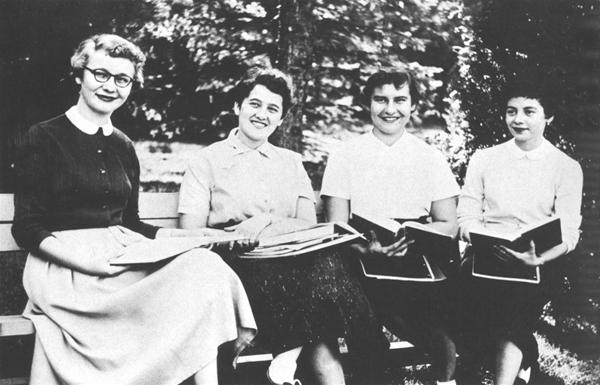
I wanted to make a dress, very similar to the ones on display in the photo. These women are the first class of 1913, and they're sitting on the steps of the main building (Saint Theresa Hall, I believe) with some school swag and a lot of Edwardian attitude. How very, very different from my own freshman class photo. Not a knee, ankle, or shoulder in sight -- and this is Minnesota in August, presumably. It's hot. They're all wearing white -- and in a lot of variations, too!

So began what I am calling the Centennial Dress project, or the 1913 dress project. Over the next eleven months (The Centennial will be celebrated en masse in June of 2013) I will research, find a pattern for, cut, and sew a dress similar to the ones worn by those original college girls, and wear it to the Centennial celebrations.

The first steps in my research have already been completed -- First I emailed the college archivist for pictures similar to the one above, and asked for any other resources she could put me in touch with. While I was waiting for her reply, I checked our digital archives online and found the 1916 College Catalog, a listing of the requirements for graduation in 1916, as well as a listing for what every girl had to bring to school with her in 1916. (I imagine the requirements didn't change much in three years.)

REGULATIONS FOR WARDROBE 
No uniform is required. For school wear, dress of any color, material to suit the season. A better dress for Sundays. An inexpensive white dress for special occasions. Dresses must not be low in the neck; sleeves must reach to the wrists or lace sleevelets may be worn with short sleeved gowns. Shoes must have rubber heels. 

And there we have it. The list of requirements goes on (a sufficient supply of 'plainly made underclothes', three changes of underwear for the winter season, four napkins and a place setting including a napkin ring with your initials on it, et cetera) and truly, you could make some kind of very interesting museum exhibit with a trunk filled with the average 1913 girl's possessions on one side of the room and a suitcase filled with her 2013 equivalent possessions on the other.

So the next steps become more difficult. Explore period sources for other dresses in the same style that would have been available to the average college girl in Minnesota (Probably out of the Sears Roebuck Catalog or a similar company in the Twin Cities.) Find a pattern similar to those garments. Find appropriate fabric, and cut, piece, and sew the dress. Find appropriate shoes, hat, and gloves. Continue research on average student experience at college in the 1910s in order to arrive at school in June in Edwardian style ready to talk about what I'm wearing and what life would be like for me in it.

Oh, and maintain my nerve. I do at some point actually have to create a wearable garment.

Sunday, June 17, 2012

Keeping up Appearances

Frequent visitors to this blog will notice that we have gotten a bit of a facelift -- a few items in the sidebar have moved around, and we've gotten a new header. I liked the old one, but the Internet, in its infinite wisdom, seems to have misplaced it, so I spent a bit of time this morning making a new one. I have to say, I think it's an improvement on the old.

This sudden disappearance of my banner (and the rather un-sudden way in which I discovered it was missing) has reminded me that I need to devote a little more time to this blog. The last post was nearly two months ago, and it was, very helpfully, a cry for help.

Let me update you all -- I am fine now. After the kind words of many friends, I was reminded that I do have a place in this world and that it is a fine and noble one, and that it is perfectly acceptable to be unsure about one's path in life.

I still don't know what I want to do for grad school -- it still seems like an awful lot of money with very scant promise of a better job at the end of the road. So I have devoted myself to other projects.  Yesterday, for instance, being one of my first days off in a long while, I began a sewing project that I purchased the materials for in November -- a walking skirt for one of my living history museums. Five hours later, my pile of fabric now resembles a small tent-like skirt. I've begun following a lot of historical costuming blogs, which you can see on the sidebar towards the bottom.

I have also started planning my staycation. In August, two of my good friends from college are coming into town and I, as the only 'local' of the group, have been asked to give a walking tour of the downtown on one of the days they will be staying here. Since I love my city and its history, my next trip to the library will be for books so I can continue researching into giving a brief but interesting view of Chicago's history and architecture, two things I love. It will be a much needed break and an opportunity to catch up with some folks that I haven't had a decent conversation with in over a year.

Since starting my sewing project yesterday (and finding it a little less difficult that originally imagined) I have also been thinking a lot about a project that's been on my mind for a little while now. Next year, my college is  celebrating it's 100th anniversary. Since 1913, they have been educating young women like myself and training them for all kinds of professions, and let me tell you, the life of college women has changed a great deal since then. (For instance, women now outnumber men at colleges across the country, which would have been hard for the class of 1913 to believe.)

So many of the costuming blogs I've been following talk about different reasons for making these clothes -- attending new events, coming up with new stories, or sometimes simply just for the fun of it. As a living historian (or at least someone interested in living history) I think it would be enlightening to attend the centennial next year in the same type of clothes that a girl coming to college in central Minnesota would have worn in 1913, and talk -- to goodness knows who -- about the student experience  in those very early years. I know that one of our history professors will be publishing a history of the school that I am very anxious to read, but so often the material experience of the past is what really gets people hooked in. How would my school experience have changed if I had to go to class in the sweltering heat of Minnesota late summer if I had to be dressed like these young ladies?


Curse the college website for not having more pictures from the early 1910s. Well, I have to email the archivist anyway. So it is onward and upward for me, and hopefully, for all of you as well!

Tuesday, April 24, 2012

Any Help You Can Give In This Matter Would Be Invaluable.


I had a bad day today. I am trying to figure out why.

My day didn’t begin badly. By all accounts, it was actually a really good day until about two in the afternoon, when I went in to have a talk with my boss about data entry for our volunteers. And somewhere in the middle of that meeting, my day exploded, and I have no idea why.

We’d finished talking about everything we had to talk about. We’re both new, we’ve inherited a system we don’t like, and we’re trying to fix it. We’d both like it fixed now, but it’s becoming apparent that an immediate solution is not happening. I think he’s getting more frustrated than I am by this, but he’s paid more to be frustrated. I feel that I am paid to do grunt work and figure out solutions to these problems before they become problems, so I always feel responsible when a solution I come up with doesn’t fix things. This is  the way my mind works.

After we have finished discussing this, he abruptly asks me what I do at my other job. I am taken aback. I always feel as though I am giving the wrong impression when I talk about my other job while I am one place or the other. I explain that I give tours and do a small amount of research. Then he asks me what I want to be doing in five years.

And I proceed to burst into tears.

The last time I remember bursting into tears in a completely unnecessary situation was in 8th grade. I’d been called on the carpet for doing really poorly on a math test, and when the teacher asked me if I needed help, I started crying. In front of the whole class. Several people started laughing at me. Which is understandable, looking back several years, but in 8th grade, being laughed at in math class for crying  is something you continue crying about. It wasn’t that the teacher was criticizing me for anything – she had a legitimate desire to understand what was wrong and why I hadn’t done well. And I had a legitimate desire to…something. I’m not sure what it was at the time. I think, knowing what I know about myself know, that it was a desire not to create a fuss. I wanted to be independent, and to admit, to the teacher who was supposed to be teaching me these things, that I had not understood it, had not asked a question about it, and imply that however she was teaching it didn’t make sense to me, was more than my pride could stand. Hence, the bursting into tears.

I think that’s why I started crying today. Here is my boss, a man that I have known for about a month now but who continually amazes me  with his willingness to grab a problem by the throat, to think in big pictures and who has worked at some of the largest and most reputable museums in the world,  and he is  asking me what I want to do with my life. Because, as both of us know and neither of us will say, I cannot stay working two part time jobs forever.

There are other things that go into the crying besides that. There is the implication that I still need to make something of myself, the realization that I do not actually have a good answer to his question, the implication that going to grad school takes money I do not have and my parents will be unable to help me because they’ll be sending three children to college this fall, and my mother is getting a second job to help with that. But mostly, it comes down to the fact that I am a little ashamed of myself for not having a clue where I want to be in five years.

Now, that is not entirely true – I have a very good idea of where I want to be in five years. I would like to be a museum educator in a costume somewhere cooking over a woodburning stove or darning socks or making butter-- creating, manipulating, or explaining some physical product so that children will understand what life was like in the past. The problem then becomes a question of how to get there.

I get asked a lot at the lobby desk whether I have a degree in history. I always feel ashamed when I say that I don’t, my degree is in English, but I really love museums. I never get a good feel for what people think about that, but after I say it, it always comes with a sense of failure. I’m not doing something related to my degree. I spent four years on nothing. I have a teaching certificate I don’t want to use.

I have good reasons to say all these things, and I’m not lying, and yet I still feel guilty about saying them. Some part of me feels like I’m not allowed to go for a museum studies degree. I haven’t earned that privilege by writing lots of papers or slaving over a thesis or spending months on end doing original research. I don’t have the right background. I am unworthy of a professor’s time.

Which is what finds me in my boss’s office on a Tuesday afternoon crying for a five year plan I don’t have. Let me say it is a credit to my boss that he maintained his calm as I proceed to blubber and cry for the next twenty minutes and explain this mishmash of ridiculous reasons why I am in tears in his office after an absurdly simple question. It is also a credit to him that he made sense out of all of it, addressed my fears about being fired and a failure and bad at my job, and somehow maintained his aura as one of the nicest human beings I will ever have the pleasure to meet in this universe, and probably the next several universes as well.

I finally stopped crying. I blew my nose several times. I went back to work for another hour. And then I got in the car to go home. I plug in my Ipod, and Rufus Wainwright’s “Hallejuhah” comes on. He’s singing about David’s psalms and the secret chord that David played to please the Lord and  I start crying again. And I let myself cry, and somewhere in the midst of that silent, sobbing wreckage there is a prayer in there of some kind or another. It probably doesn’t sound like much, more an emotional cry  to the universe and whatever version of the Deity is listening that I need help, and I just need someone to listen for  a moment. I realize while I am crying and driving that I have been living hand-to-mouth in the way of life experiences for the past three months. I go to work and I go home – that’s it. I have not taken myself out to do anything un-work related. I have not had a legitimate conversation with anyone outside my family or my coworkers in months, and I have not talked about or discussed my emotional health, my plans for  the future, or something other than history with anyone pretty much since I got home from college. I have no friends in the immediate vicinity to talk to, and I am too afraid of interrupting anyone else’s life to call them.

Just when I’m getting over “Hallelujah” Coldplay’s “Fix You” comes on, and I am still in tears, and wondering what crazy program is picking all these songs I can cry about, because after that Regina Spektor serenades me with “No One’s Laughing With God” and  between these three songs, I spend my fifteen minute commute in tears. I park my car, I go inside, my mother asks me if I am okay, and I respond with a heart-shaking ‘NO’ and start crying again.

This is the last thing I wanted to do, and I make even less sense of the reasons behind why I am crying as I explain to my mother. My mother has enough problems in her life – she does not need any of mine. I am her oldest child. I have a college degree. I should be able to take care of myself. Yet I am living at home, still letting her cook me dinner, still living on my parent’s good grace. Yet I am still her problem. And I am crying in her office, trying to explain why I spent a good forty five minutes of my afternoon in tears. It doesn’t make as much sense to her as it does to my boss, because I don’t talk about the second job thing (she didn’t have to get a second job to send *me* to college) and I don’t do a very good job of explaining my guilt about the scheduling conflict between my two jobs, because she keeps telling me if that happens too often someone’s going to fire me, which leads back to that sending three kids to college problem, and I’ve figured out the less I say about calendars in her presence the better it will be for the both of us.

She gives me the answers she always gives – maybe your boss is right. Maybe you do need to make a plan. Maybe you need to look at museum studies programs. Maybe you need to move. Maybe you need to give up one of these jobs. All these things make sense, but they do not comfort me. Moving, museum studies programs, plans down the road, all of these things require money, and money is something I do not have a lot of. The newspaper reminds me of this nearly every day. I am part of the generation who seems to know awful well how to spend money for education, and doesn’t know a thing about getting an education they can actually use, or a job that will make it worthwhile. It’s this realization that scares the shit out of me. What if I’m just another college graduate getting a Master’s Degree that I can’t pay for? Why not stay where I am with my two jobs I have to juggle like a crazy person and build a little insulated place for myself where I save a little, spend less, volunteer, and try to be a nice person?

I try to tell her that I feel like I am not setting a good example for my siblings, and this, at least, she understands. She leaves me alone for twenty minutes to write this blog post, and then returns downstairs and tells me that what she thinks is really bothering me is staying at home. This is probably true. Maybe I do need to move. Maybe I do need to start looking at jobs outside the state of Illinois.

But before I do any of that, I would like to talk with someone. I would like to talk with ANYONE. I would like to see if my fears make sense.

As I seem to end all my emails at work, “Any help you can give in this matter would be invaluable.”

Saturday, March 24, 2012

So You Think You Can Sew: My First Adventure in Costuming.

One day I'll have a real costume blog, where I talk about real costume projects.

One day. Unfortunately, it's not today, and it's certainly not this blog post. Today I want to share my much-less-than-legit excuse for a costume project, a project that required not so much skill as creative thinking on how to make a costume I'll probably only wear once but not make break the bank and not make it look totally lame, either.

There's a dictum in manufacturing that you can have quick, cheap, or good-looking, but you can't necessarily have all of them at once -- we'll see how I did here.

The Assignment: For volunteer appreciation at one of my museums this year, their theme is "Out Of This World" and the volunteer coordinators invited everyone to come in the 'space-themed' costume of their choice. Since no one but the Browncoat, conventioneering crowd would recognize my Mal Reynolds costume from last   Halloween, and making a Jedi costume on a budget became next to impossible outside of Halloween season, I decided to make that tried and true staple of the space adventure canon -- The Starfleet Uniform.


Instantly recognizable even by people who don't call themselves sci-fi fans, comfortable enough to sit through dinner in, and low-budget enough for, well, the first season of a groundbreaking TV show, this was something even I could do. Let's face it -- I'm an English major, Jim, not a seamstress! (At least not yet. But we'll get there. Yes, we will.)

Step 1 -- Acquire shirt. Remind myself while watching several episodes of Star Trek who wears blue, yellow, and red. Went to Goodwill. Found them having a sale on red turtlenecks from Target. Make executive decision not to be a redshirt. Find really nice blue cowl-necked shirt that reminds me of Dr. Dehner from Episode 1.1 "Where No Man Has Gone Before."


Step Two -- Acquire gold braid for rank insignia on the sleeves, and something with which to make the Enterprise Insignia to cover up the logo on this shirt. Find gold metallic thread in Mom's sewing box. Score one for budget conscious projects and using what you have in the house! 

My desk. It is messy.

The fabric itself is a stretchy sports fabric, and I want to be able to roll up my sleeves. Solution -- pin braid on while fabric is stretched out over empty wine bottle.  I can keep the braid straight this way, too.

Step 2.5 -- Decide which rank to assign Starfleet-self. Since Captains can't wear blue, I go for Lieutenant. Proceed to think about Master and Commander for the rest of the braid-sewing exercise and remain amused by the British pronunciation of Lef-ten-ant.


Lots of pins gave their lives for this uniform....


Six episodes of Star Trek and two feet of braid later, Progress! But wait. We appear to be missing something, Captain!

 Ah, yes, one of those.

Step Three: Find Gold fabric, gold paper, black puffy paint, and several copies of the starfleet insignia. Have momentary debate over whether it needs to be the Command insignia or the Sciences department insignia. Father reminds me no besides me will probably notice this, and Command insignia is the one everyone recognizes. Now, which size to use?

The one on the right is the smaller (2.5 inches tall) version, made with a gold plastic paper from my scrapbooking box -- I think it was used as a gift bag filler at some time. The  larger one on the right is wide gold ribbon glued over a cardboard backing (3.5 inches tall). Both models will have the insignia done in the black fabric paint using a stencil. It's also been drawn onto the cardboard backing of the fabric one.


Voila! Semi- finished uniform shirt! (That's one of my paper copies of the insignia there.)

So, for less than ten dollars -- five for the shirt, two for the spool of gold braid, two for the puffy paint and an extra dollar to factor in the things I found around the house -- I created a costume that doesn't look half-bad. We'll factor in another  ten to fifteen dollars for some black boots I have yet to find, and for less than twenty dollars, I've created something I wouldn't mind wearing.

Not a bad week's work. 

On next week's episode of "So You Think You Can Sew?" Mercury attempts to make a six-gored skirt out of corduroy...

Friday, March 9, 2012

Putting Down Roots -- Adventures in Genealogy and other Storytelling Endeavors


This is supposed to be a writing blog, and as I look back at the last few posts, many of them don’t have a thing to do with writing. To be perfectly honest, there hasn’t been a lot of writing going on at my computer in the last few months. My time is being spent in a lot of other places, and while I may not have been writing, I am finding out a lot of different ways to tell stories.

Since graduation, I’ve started volunteering (and then working) at two different historic houses. One of them was built and inhabited by famous rich people and the other, built at about the same time about ten miles down the road, was built by non-famous, nonrich people. The purpose of both museums is to tell a story – for the famous house, it is a very specific story of a very specific person, while at the other, the story is supposed to be more general, a picture of what life would have been like for hundreds of families working on farms in Northern Illinois in the 1890s. 

But in both houses, the object of giving a tour is to tell a story – using objects in the home and facts about daily life. The tours I give for both houses are vastly different, but I believe one of my strengths as a tour guide comes from my knowledge of story-telling – having the ability to draw people in with objects or events that are of interest to them, and bringing to their attention parts of the houses’ story that they can connect with. At the big house, I had to give a tour yesterday to a group of fifth grade boys. I skipped talking about the influential women in the house’s history (and they were all characters, let me tell you!) and focused instead on the military service of the man who left us the house.

The other project I’ve been working on a lot in the past several weeks is my family genealogy. Unfortunately for me, my family (both sides) does not seem to be one who believed in saving photographs or death records or anything material that would help me learn about the kind of people my great grandcesters were. All I’ve been looking at are digitized census records, but, when read in chronological order, they form their own little black and white narrative, playing out like the best reel-to-reel melodrama. Every ten years, there is an update to their lives. What children have moved out of the house? Have they finally paid their mortgage? Has someone’s job situation changed? 

As strange as it sounds, I feel like I know these people now. I mourned for the women who listed '3 children birthed, 1 surviving' on the 1910 census return. I practically stood up in the library and cheered when I found naturalization records for my great-great grandfather and his two brothers. After twenty years of living in the United States, they were finally citizens. They owned their houses. Their children were thriving. Three young men who came from Bremen, Germany, to the port of Baltimore in 1886 and 1889 with nothing more than a piece of luggage each were making their way in the world.

In many of the stories I write, as well as the stories I read, a great deal of emphasis is placed on family trees – on where people have come from, what their parentage and connection is. I don’t have anyone famous or well-connected in my family tree – my grandcesters were carpenters and masons, seamstresses and cooks, farmers and textile mill workers, mothers and fathers. But the fact that the story is there – and that I can find it, and read it, and share it with my family – is comforting. I’m proud of my great-great grandfather the carpenter and his wife with no occupation except raising her 12 children. To me, they are famous – I want to tell everyone all about them! I come from the library and tell my parents all about these relations of ours like I just sat down for coffee and got an update from them on how the family’s doing.


Another one of my projects in the coming days is to make a new skirt and shirtwaist for my costume for the non-famous house museum. As I’m making it, I’ll be thinking a lot about the stories I’ll tell while wearing it, but I’ll also be thinking a lot about the women in my family who would have dressed similarly while going to their own jobs. And in a small way, even though they lived hundreds of miles and a hundred years away, I’ll be telling their story, too.

Sunday, February 19, 2012

Hello, 1920! Surviving after the Downton Abbey Season Finale.

By 9 PM Central Standard time tonight, my family and myself will be in a state of heavy sadness. Why? Because Downton Abbey is done for the season. No longer will we be able to sit around the TV and watch the Crawley family be brilliantly troubled, or shout at the TV when our favorite characters do something we dislike, or discuss over breakfast just why O'Brien is so evil or why Mary is still insisting she marry Carlisle even though we all agree he's a total creep and Matthew is so much better for her.

My mother, in particular, is practically up at arms that she has to wait for season three, and has even proposed a trip to England so we can watch it before everyone else. No joke. So, to make sure she and I do not go stir crazy during our Downton Abbey-less downtime, I've come up with a list of things that we (and you guys reading at home!) can do to tide yourselves over until season three.

1. Read a good book.
If you're me, you've been doing this all season long, but since most people don't voraciously research their costume dramas, our hiatus between seasons is a perfect time to catch up on the historical nuances that inform this show. You could read more about the Buccaneers, the generation of young american women who went over to England, like Cora, to marry the English for their titles, by picking up Edith Wharton's book of the same name, or by checking out Marion Fowler's In A Gilded Cage: From Heiress to Duchess, which details the lives of 5 American women who married dukes. (It comes highly recommended by me!)

If you're interested in learning a little bit more about the real life events inspiring the shenanigans of the Crawley Sisters and women like them, try reading Fruits of Victory: The Women's Land Army of America in the Great War (for Edith fans especially) American Women in World War One (Which I am in the middle of reading for the second time right now, it is so good) or a more general book like Juliet Nicolson's The Great Silence: Britain from the Shadow of the First World War to the Dawn of the Jazz Age.

I'm really excited about the next season because we're heading into the 20s! Yes, the Decade that Roared will be coming full force to Downton, and it should be fantastic. You could read about the new direction of high society by delving into Bright Young People, a biography of the jazz babies and flappers that really  made the older generation role their eyes in the late twenties. (I really liked Bright Young People, and I recommend it highly.) If you're not one for nonfiction, try Evelyn Waugh's Vile Bodies, the novel that inspired Stephen Fry's 2004 movie about the Bright Young Things. I myself will be reading Anything Goes: A Biography of the Roaring Twenties in the next couple of days, which looks like it will be a real treat.


2. Make something.

Do Mrs. Patmore proud and try your hand at baking a period recipe or hosting a teaparty for all your nearest and dearest fellow Downton fans. There are a number of articles (like this one from the Huffington Post) and blogs like Downton Cooks which would help a fan find a recipe or menu to serve.

I myself will be spending time making a teacake stand for my viewing parties next season.  What's a teacake stand, you ask? Well, here's Molesley holding a very sculptural example in season one --


Mine will not look nearly as nice (I'm taking the DIY approach suggested in this tutorial and using sherry glasses and plates from Goodwill) but it will be a conversation piece, I hope.

3. Revamp your closet.

You know your  favorite TV show is a big deal when Ralph Lauren rolls out a collection inspired by it at New York  Fashion Week.


Maybe we all don't have an RL compatible budget, but we can certainly take some design elements out of the DA book as easily as Mr. Lauren does. Cloche hats, wide legged pants, oxford shoes or french/spool heels, opera length gloves and long necklaces are all fairly easy to find in stores today. Indulge your inner Sybil and go find a frock that flatters and makes a bold statement. Polyvore is great for seeing what others have in mind when they think of Downton. There's a great tumblr out there, too -- Downton Abbey Fashion.

Oh, and if you're feeling really ambitions, the folks over at Reconstructing History have a number of patterns for you.

4. Watch another show in the meantime.

Sacrilege, some of you cry! Don't worry, it's just until next season.

The House of Eliott -- two sisters whose father has just died become couturiers and deal with the crazy world of fashion design in the twenties. Lots of beautiful dresses.

The Grand -- follows the life of the rich and famous living at a hotel in Manchester. Contains more drama than a busload of high school girls, but interesting to watch.

Birdsong -- Based on a novel by Sebastian Faulks, is going to be on Masterpiece Contemporary in the near future.

Titanic -- It's the 100th anniversary of the sinking of the Titanic in April. Where will you be? (I'd hate to be trying to fill a cruiseship in April of this year. Such bad press, that is.)


Casulty 1900 -- It's like Gray's Anatomy without the comforting idea that science will prevail by the end of the episode. I wasn't able to watch this show on account of period medicine being beyond my comfort zone, but I hear good things about it.

The Forsyte Saga -- I reread the book recently, but Soames isn't quite the same as when Damien Lewis is brooding over Irene's departure on my television screen.

Iron-Jawed Angels -- Go make Sybil proud and learn about Alice Paul and the women's movement.

5. Go read some fanfic. 

There's some really great pieces of fic out there on the internets, and fanfiction.net is as good a place to start as any. If you are thinking there are plot points you would like to tie up, if you think all of Thomas' problems will be solved if he meets a nice boy, if you think you'd just like to read a little fluffy story where Robert and Cora muse some more about their children, or grandchildren, go make some fanfiction writer happy and read (and review!) their story. If my mother were a writer, this is totally where she would be.


Well, Downton Fans, there are your marching orders. Scamper off and invade tumblr.  Lend out your DVDs to your coworkers. Make #downtonabbey and #downtonPBS the trending hashtags on Twitter. Go be the crazy, outrageous people we know you are. And have fun with it! See you for Season Three!

Saturday, January 21, 2012

You Can't Put Nothing Past William Howard Taft: A Review of Jason Heller's "Taft 2012"


Those of you that know me could tell a lot of anecdotes relating to how much I like free stuff. It’s a bit of an obsession, really. But better than your everyday tradeshow swag (Stuff We All Get) is the free stuff I have to work a little for – answering a trivia question, or giving my opinion, or playing a game of bingo. One of my new favorite free things is the books I receive from Quirk Books when they nicely ask for internet denizens to review them. Two things occur when I get those emails – one, I get to help the enterprising and creative people at Quirk sell more product, and two, free book!

I’ll be the first to admit that I’m not as in-tune with the political process as I should be. As a self-identified Democrat living with a very conservative Republican father, it’s probably safer for me this way. That said, I was a little leery of any book identifying itself as a satire of the political process. However, I figured that any book about the guy who inspired this song was worth looking into:


Yup. The Two Man Gentleman Band got me to read “Taft 2012” and strongly encourage friends, family, and co-workers to DRAFT TAFT. In my defense, I’ve read more serious books for sillier reasons, but in the long run, I’m glad I read this quirky and surprisingly insightful look at the American political process and the absolute circus it inspires every four years.

The premise of Jason Heller’s novel is fairly simple – William Howard Taft disappears from the past without any reason whatever and re-appears in the future – our future – just as election season is beginning. After reacquainting himself with the world, getting in touch with his great-granddaughter and her family, and doing a few rounds of the talk show circuit, Taft finds himself in the middle of a grassroots movement focused on getting him re-elected as president, a movement that forces him (and the reader) to examine what the American political process has become.

At a volunteer dinner several weeks ago,  one of my dining companions turned to me and said, “Now, I know we’re not supposed to talk about politics at dinner, but who are you thinking of voting for in the next election?” This was a hard question for me to answer, since the place where I am volunteering was founded by a very staunch Republican and I am, as mentioned above, of the Democratic persuasion. I told her the honest truth – “Well, I voted Democrat in the last election, but I really don’t know. It seems to me that politicians promise a lot of things during campaign season and never follow up on them, so is it fair to say, ‘He promised this and didn’t deliver’ when we know that always happens?”

My dining companion seemed to view this as an acceptable answer, and the matter was dropped, but the same situation came up in “Taft 2012.” Throughout the book, Heller uses a mixed media format, drawing in poll numbers, twitter conversations, and plain old prose to tell his story, and one of those ‘mixed media’ pieces is a transcript of a political analyst’s TV coverage of Taft. The  excerpt explains that the groundswell of Taft support is because he’s an ideal candidate who will bring us back to the good old days of yore, as this campaign advertisement will attest.


Taft is billed, in the beginning of the book and the marketing campaign for the candidate/book, as the candidate who always delivered on his promises and stuck to his morals, two things modern political candidates seem to lack.  Yet as the story progresses, he finds himself being sucked into the circus just like the rest of us, giving up on things he values to help his cause.

John Cass, an op-ed writer for the Chicago Tribune (a strongly Republican leaning newspaper, interestingly enough, run  way back when by the same man whose house I was volunteering at for that volunteer dinner) wrote a piece about a week ago about why he thinks Obama will win the election. Simply put, Cass says that Obama knows who he is and what he stands for, and the Republican candidates running against him are so busy infighting amongst themselves that they’ve forgotten to show the American public who  they are and what they’re about. Heller suggests at the end of his book that this is the only way candidates can win in politics – when Taft realizes that he’s forgotten who he was, he begins to work as a force for real change in society.

If you, like I do, come from a family of mixed political views, I think that “Taft 2012” is a great piece of writing to share with your family. It provides a (somewhat surreal) way to talk about how crazy the political process is, and it’s pretty amusing to boot. And even if you don’t, Taft 2012 is still an amazing piece of literature, and one I’m grateful to have read.

So, gentle citizens, get out and vote this November – and remember, DRAFT TAFT.

You can buy Taft 2012 directly from Quirk Books, from your local independent bookstore, or  from Amazon, Barnes and Noble, or, if you’re lucky, you can try getting a copy from a site like PaperbackSwap.

Saturday, January 14, 2012

Downton Recommends: An Edwardian Trip back in Time

This will probably be very obvious to anyone who knows me, but it bears putting down on paper: I am a very plugged in person. I read a lot of books, I follow a lot of blogs, I keep up with a number of news outlets, and I watch a lot – A LOT – of television and movies. I do this because I think it makes me a more interesting person, and also because I love having things to recommend to other people. Lately at my house the focus has been on – what else? – Downton Abbey.


 I love PBS and the work they put on TV, because it is usually fun to watch and also because, unlike much of mainstream television, their shows can usually be counted on to be something I can watch with my parents. (A lessening commodity, let me assure you.) My parents – my mother in particular – are very selective about what they will and won’t watch, and in an era where swearing and sex are becoming more commonplace on broadcast television, PBS usually pulls through for me with something that has no swearing, no sex, and no dubious scenes in dubious places like dark allies, strip clubs or seedy bars. It helps that my mom likes period dramas, too. So, after I dragged my sister through the first season of Downton Abbey (which I think she likes – she could just be putting up with me) and declared that I would have the TV Sunday night to watch the second season or perish without, my mom came down and watched the season opener with us. And, in a fashion true to my mother, when the whole thing was over, she asked, “So, when’s the next one?”

 Picture me at this point beaming in joy.

Of course, when the second season is over and we have to go back to our lives without the shenanigans of Matthew, Mary, and the rest of the Crawleys, I will have to find something else for my mother to watch. (She and my father complained at the end of the first season of Cranford, and the second season couldn’t come fast enough for them.) And being the plugged-in person I am, I’m compiling a list of (PBS approved) shows that I’ve watched in the past and wouldn’t mind watching again. So, without further ado, the list!

1. (The Original) Upstairs Downstairs (ITV/PBS, 1971-1975)

There has been much dirt thrown between the Upstairs Downstairs reboot people and the Downton Abbey folks, but it does bear saying that Downton Abbey is cast from the same clay as the 1970s PBS series. That fact cannot be denied. I still maintain that Downton is much more interesting that the recent remake of this beloved show, but the original is definitely worth watching at least once, if not two or three times. Upstairs Downstairs follows the adventures of the Bellamy family upstairs at 165 Eaton Place, London, and the lives of their servants downstairs as they deal with the turn of the century, the end of Victorian England and the beginning of the Edwardian age. (Interestingly enough, the Earl of Grantham’s sister Lady Rosamund Painswick is said to have a house in Eaton Square. I smell an imminent crossover fanfic.)

My mother claims that when this show was first on in the 70s her mother refused to let her watch it on the grounds that it held some scenes of a dubious nature. I watched it all several summers ago and was not at all fazed by the plot, but I am not my grandmother, and a servant getting with child out of wedlock, broken engagements, the first World War, and shell shock do not shake me. The cast was wonderful, the stories were alive and engaging, and there were some really first rate performances throughoutthe show’s run. I shall forever love David Langton’s Richard Bellamy, who gave a new meaning to the idea of the silver fox and who deserves a lot of really ravishing fanfiction, and Gordon Jackson’s Mr. Hudson, the loveable and peppery butler, was the type of character I should have loved to have spent time under as a housemaid, a demanding taskmaster but truly compassionate besides.


 2. The Duchess of Duke Street (BBC/PBS, 1976-77)

When it first came out, this series was accused of trying to ride on the success of Upstairs Downstairs, and to be sure, both shows feature a similar format – a house with servants below and a family of sorts upstairs, trying to deal with life in the Edwardian period. The title character, Louisa Leyton, enters the series as a lowly assistant cook with high ambitions – to become the best chef in London. A big goal in an era when it is universally acknowledged that while women can be cooks, only men have the artistic flair and panache required to be chefs. Through a series of complicated events, she becomes the proprietor of a hotel with its own ménage of interesting guests, servants, and family. The series was based on the life of Rosa Lewis, the proprietor of the famous Cavendish Hotel, a woman who was sometimes titled ‘the Duchess of Jermyn Street’ for the way she held court over the men who came to admire her cooking (and her good looks). I watched this before seeing Upstairs Downstairs, and the memories of it are a bit hazy, but I do remember liking the passionate and spunky performance put in by Gemma Jones as Louisa.


 3. To Serve Them All My Days (BBC/PBS, 1980)

If the end of World War One does for Matthew Crawley what it does for David Powlett-Jones, the protagonist of To Serve Them All My Days, I will be a happy fangirl indeed. I watched this miniseries several years ago and loved it so much I went and found the book by R.L. Delderfield upon which it was based. My copy, interestingly enough, is the tie-in version published for the series on “Mobil Masterpiece” as it was then called. (My, how times have changed.) TSTAMD follows the life of young Mr. Powlett-Jones as he returns from World War One a shell-shocked wreck of a twenty-two year old whose doctor has recommended fresh air and an enclosed community as the best hope for recovery. He begins teaching at a public school in Devon called Bamfylde under the auspices of a wonderfully jolly headmaster, Herries, and shepherds several generations of troublemakers and brownnosers alike through the joys of studying and examining history.

Delderfield was criticized for his flat characterizations in the novel, but I’ve never found any of his cast wanting in any respect of character. The miniseries was excellent, with top-notch performances by Alan MacNaughton as Mr. Howarth, the crusty and proud English professor and Frank Middlemass as Mr. Herries, as well as a particularly good bit of casting for the parts of several of the students who make up PJ’s cadre at school. (My favorite is always Boyer, a scoundrel with a good deal of charm who, just missing the action of World War One at the beginning of the series as a troublemaker in the 4th form, ends up enlisting at the end of the series in World War Two as a well-rounded young man of nearly 30.) This show also introduced me to the sound of spoken Welsh. Watch it for nothing else than that, if you must. John Duttine’s simple, scared young PJ is absolutely adorable rambling on in Welsh cadence. As is the terribly British and schoolmastery Carter, played by Neil Stacy.


Many of these shows are Edwardian in word and deed, but PBS has a treasure trove more set in the 1920s that I intend to preview for you! Any suggestions from the peanut gallery would be appreciated as well!

Wednesday, January 11, 2012

Resolved -- Excelsior!


Excelsior -- From Latin excelsior, comparative of excelsus (high(archaic) (1) Loftier, yet higher; ever upward.  (2) title of poem by H.W. Longfellow, which reads 

The shades of night were falling fast,
As through an Alpine village passed
A youth, who bore, 'mid snow and ice,
A banner with the strange device,
"Excelsior!"

Today we are eleven days into the new year. Eleven days. Today I had a job interview, and in order to prepare for that interview, I cleaned out my portfolio. I printed out a new copy of my resume, and threw out the ten copies that were still in my portfolio from the Education Job fair I attended in Minneapolis last April. And my, what a lot has changed since then! My old resumes bear witness to a distinct shift in goals – the objective on the old ones reads “To obtain a position as a mid-level language arts teacher.” The new one no longer has an objective on it, because I needed space to list my many myriad qualifications for being a museum tour guide.

It turns out I didn’t need the resume – the job I was interviewing for is at a museum where I’ve been training as a volunteer since August, so my meeting today was less of an interview and more of a pre-hire meeting where they offer you the job and you fill out paperwork. I just need to get clearance and name badges and a drug test done, and I will officially have a second job, for which I am very grateful.

If you had told me at this time last year that in twelve months I’d have two jobs, I probably would have kicked you. But a lot changes in twelve months. In the last year, I’ve taught five classes of middle school students, four classes of high school students, and written I don’t even want to remember how many lesson plans. I dealt with workplace bullying drama and the sudden death of a mentor. I graduated from college with honors. I moved home and read a lot of articles about how this seems to be the new normal of my generation. I taught camp for the second summer and learned I’m much better at dealing with crisis and crying children than I ever gave myself credit for before.

 I decided (probably before the screaming children) that I wasn’t going to become a teacher. I interviewed at a number of different places, and found out I was not unemployable. I received my first real job offer, and gave my first job refusal. I entered the work force. I began volunteering at two different museums and learned a great deal about the nature of the museum visitor and the direction of museums in general. I tried to handle all three of my living grandparents having serious health problems throughout the year. I celebrated the birth of two new cousins (once removed.)


I look at that list, and I can’t believe that all those things happened in twelve short months. I managed to pack, intentionally or unintentionally, a lot of meaningful, life-changing experiences into twelve months, and I’m not sure that another year of my life will ever be so filled again. Some of them were wonderful experiences, and some of them were very far from wonderful, but all of them, I hope, have made me a better, brighter, stronger person.

In the last four years, I’ve seen the amount of writing I do for this blog slowly taper off, and for all that I know not too many people are reading this, that dwindling number still saddens me. At the beginning of a new year, it is customary to make a resolution regarding these sorts of things, but try as I might, I can’t bring myself to promise that I’ll write on this blog more. My resolutions are different – broader, in some ways. I resolve to make better use of my time. I resolve to be kinder and more welcoming with everyone. I resolve to care for my body more. I resolve to be a good steward of my money. I resolve to move myself higher as a human being. 

Perhaps a better resolution than ‘write more’ would be ‘be a better steward of my talents.’ In addition to invoking the Roman meaning of talent as a unit of money, this phrase brings together everything I want to strive for in the coming year. Use my time better by finding causes, places and people that need my help or my skills as a teacher, as a speaker, as a mover of boxes or a purveyor of useless facts. Become healthier, happier and more content with my life and my place in the world by helping others and enjoying the natural world around me.

It’s a lofty list of goals, to be sure, but I think that I can do it. After all, I’m writing another blog post, aren’t I?